
How a WA lithium project protected airfreight payload and skipped quarantine with a 5.4 kg nestable ISO pallet
A Western Australian (Goldfields) lithium project.

The operator
This is a lithium project in Western Australia shipping documentation-critical samples and small parts to partners and laboratories in New Zealand, the USA and Europe. A lot of that movement goes by air, where every kilogram of pallet tare is a kilogram of chargeable payload you are paying to fly instead of product. The project's logistics team came to us wanting the lightest possible compliant pallet that would clear biosecurity without being held up at the border.
The problem with the old handling
Samples and parts were being air-freighted on timber pallets. Two problems followed. First, timber is heavy, so a meaningful slice of every chargeable airfreight position was being spent on dead pallet weight rather than saleable or critical cargo, an expensive waste on an air lane. Second, timber going into NZ, the USA and Europe attracts ISPM-15 heat-treatment and is routinely flagged at biosecurity, so consignments needed fumigation, certification and sometimes sat in quarantine, adding cost and unpredictable delay to time-sensitive sample shipments.
Why this product
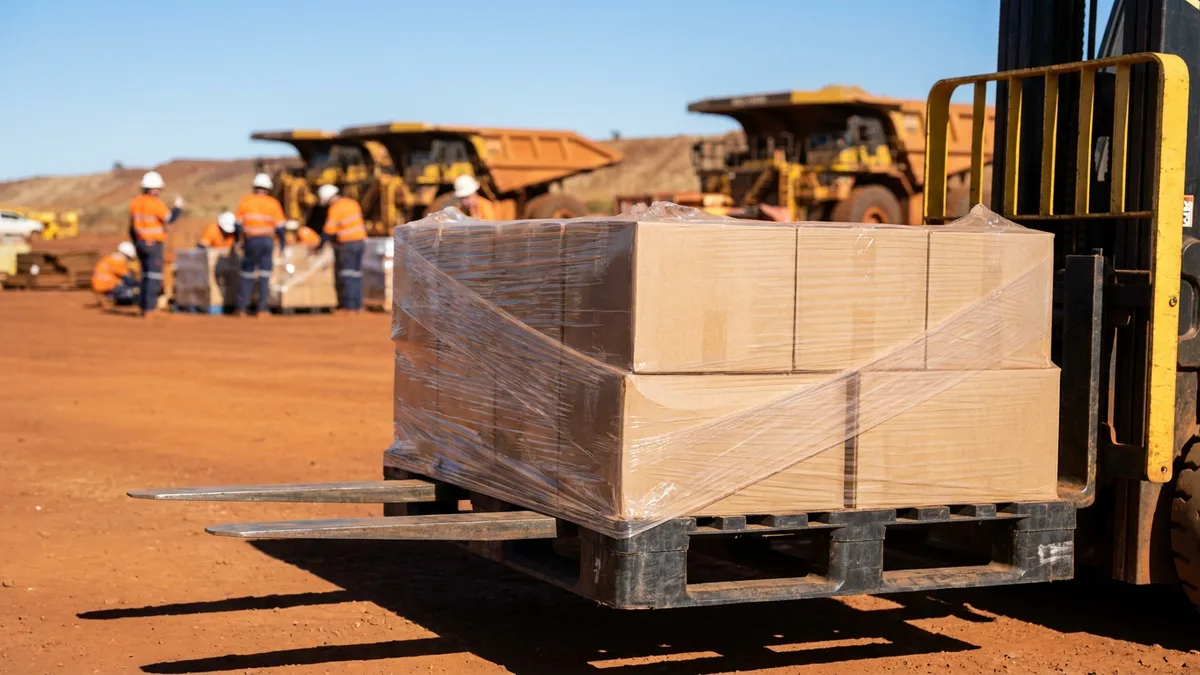
They moved to the Light Weight Plastic Pallet (BPB-110): a 1200 x 1000 mm ISO footprint moulded from HDPE at just 5.4 kg, rated to 1,600 kg static and 800 kg dynamic, on a nine-foot base with 4-way entry, and both nestable and stackable. The spec is built for air export. At 5.4 kg the tare barely touches the chargeable payload, so far more of each air position carries cargo rather than pallet. Being plastic, it is exempt from ISPM-15 heat treatment and fumigation, so consignments to NZ, the USA and Europe clear without treatment paperwork or quarantine holds. And because it nests, the empties stack down compactly when pallets are cycled back to site or stored between shipments, keeping return-freight cube and warehouse footprint low on a project running a tight logistics budget.
The rollout
They switched their export sample and parts lanes onto the pallet and kept it for the intermittent outbound consignments the project runs. The logistics team saw the chargeable-weight benefit immediately on the first air shipments, and dropping the ISPM-15 step removed the treatment-and-certification scramble that had been adding a day and a cost line to each dispatch. The 1,600 kg static rating was more than enough for the light sample and small-parts loads the project moves, and the 800 kg dynamic figure covered forklift handling at both ends without concern. When pallets came back or sat idle between the project's intermittent shipments, nesting them down kept the store tidy and the return cube low rather than parking flat decks across the warehouse floor.
The estimated result
We frame these as estimates because the benefit scales with how much each lane flies and how often pallets are returned. On chargeable weight, swapping heavy timber for a 5.4 kg deck we estimate frees on the order of 4-5% more billable airfreight payload per pallet position, real money on high-value, time-critical sample lanes. On border cost and time, avoiding ISPM-15 treatment and certification we estimate removes around a meaningful sum of cost and up to a day of lead time per outbound consignment, and takes a recurring source of quarantine delay out of the picture entirely. The nestable form then keeps return-empty freight from eating into the project's logistics budget between shipments.