
A Goldfields exporter cleared biosecurity faster with a medium-duty ISO export pallet
A Western Australian Goldfields exporter of fabricated mining parts to NZ and the USA.

Timber pallets flagged at the border
An exporter in the Western Australian Goldfields shipped fabricated mining parts, fittings, brackets and machined components, to customers in New Zealand and the United States. The freight itself was straightforward, but the pallets kept causing trouble at biosecurity. Timber export pallets are subject to ISPM-15: they must be heat-treated and certified, and they still get inspected and occasionally held at the destination border. For an exporter trying to hit delivery windows, that meant a recurring source of cost, paperwork and unpredictable delay sitting underneath otherwise clean consignments. They wanted a pallet that carried a useful dynamic load for forklift work but cleared biosecurity without the treatment ritual.
Why the medium-duty nestable ISO export pallet
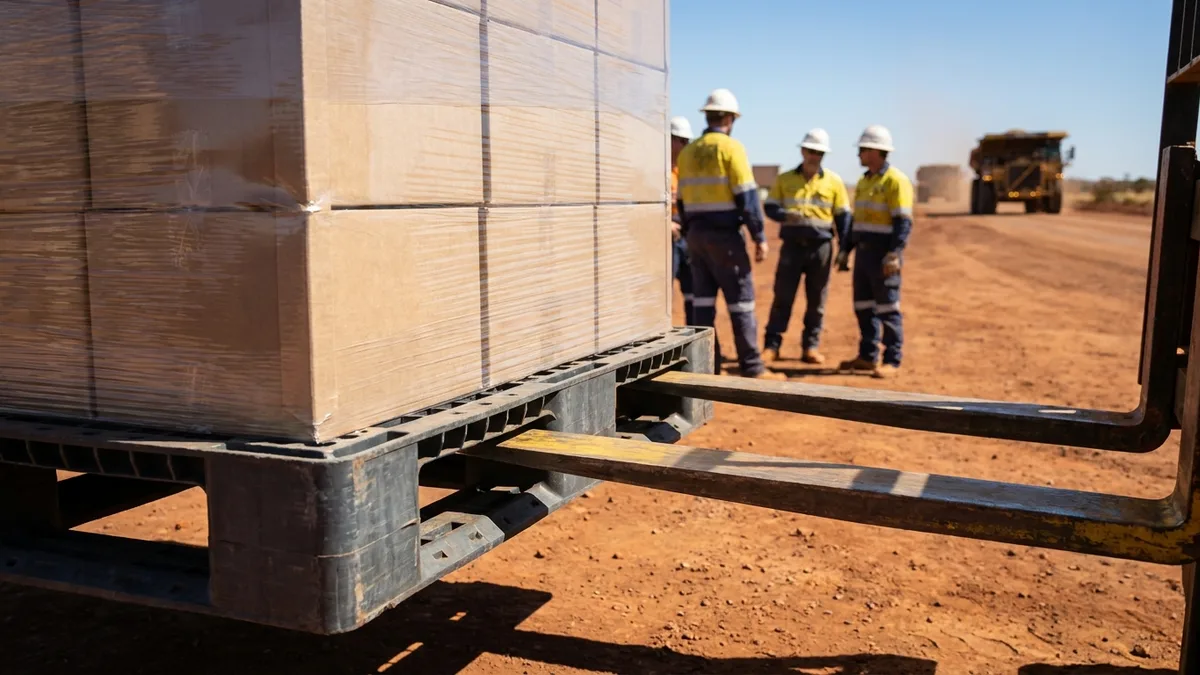
The exporter standardised on the Medium Duty ISO Export Plastic Pallet (BPB-1210-3). On the 1200x1000 mm ISO footprint it matched international racking and handling, and its ratings suited the job: 2500 kg static and a solid 1200 kg dynamic, enough to take a meaningful palletised load of dense metal parts on the forks during loading and unloading. Being moulded PE rather than timber, it is exempt from ISPM-15 heat treatment and fumigation, so consignments clear biosecurity as plastic pallets without certificates or treatment marks, which is the entire point of the switch. At 9.3 kg it is light enough to handle easily and to keep freight weight sensible, and the nestable design means empties cycling back take minimal cube rather than riding home as flat, bulky timber. As a durable reusable, one plastic deck does the work of several one-trip timber pallets over its life.
Rollout on the export lanes
The pallets went onto the NZ and US dispatch lanes, where fabricated parts were palletised and shipped without the heat-treatment and certification step that timber demanded. Consignments stopped being flagged for timber-related biosecurity checks, and the paperwork that used to accompany every outbound pallet disappeared. Where pallets returned, they nested for compact backhaul. The change slotted into existing handling because the footprint and forklift entry were unchanged, only the treatment burden went away.
The estimated result
The saving is partly money and partly time. We estimate that avoiding heat treatment, certification and re-inspection saved an estimated meaningful sum per outbound pallet, framed explicitly as an estimate rather than a quoted price, plus roughly a day of lead time per consignment that no longer waited on treatment and paperwork. On the asset side, because the reusable PE deck replaces an estimated 5 or more one-trip timber pallets over its life, the recurring export-packing spend is estimated to fall materially. Removing a chronic source of border delay also has a value that is harder to put a number on but real for an exporter working to delivery windows. As always these are planning estimates rather than a guarantee, the realised per-pallet saving depends on the destination's treatment rates, consignment frequency and how the pallets are cycled. For a Goldfields parts exporter, a plastic ISO pallet that is simply exempt from the timber rules takes a recurring headache off the loading dock.