
A WA Goldfields mining operation cuts pallet replacement and quarantine cost with a 1000 kg-rackable heavy-duty ISO HDPE pallet
A remote Western Australian gold operation running a racked central warehouse that feeds underground crews and ships repair freight..

The operator and the problem
A remote gold operation in Western Australia's Goldfields runs a central warehouse that feeds underground crews with consumables, ground-support steel, electrical spares and packaged reagents. Its cost problem was never the pallet purchase line, it was everything downstream. Splintered timber stringers jammed in racking, protruding nails punctured polythene-wrapped parts, and after rain wet boards added dead weight to every fly-in freight load that the site pays for by the kilogram. Hygiene and quarantine made it worse. Equipment heading interstate or overseas for repair needed pallets that would not trip ISPM-15 timber rules, and in a dust-and-grease environment any board that went into the wash bay never came back out usable.
Why this pallet
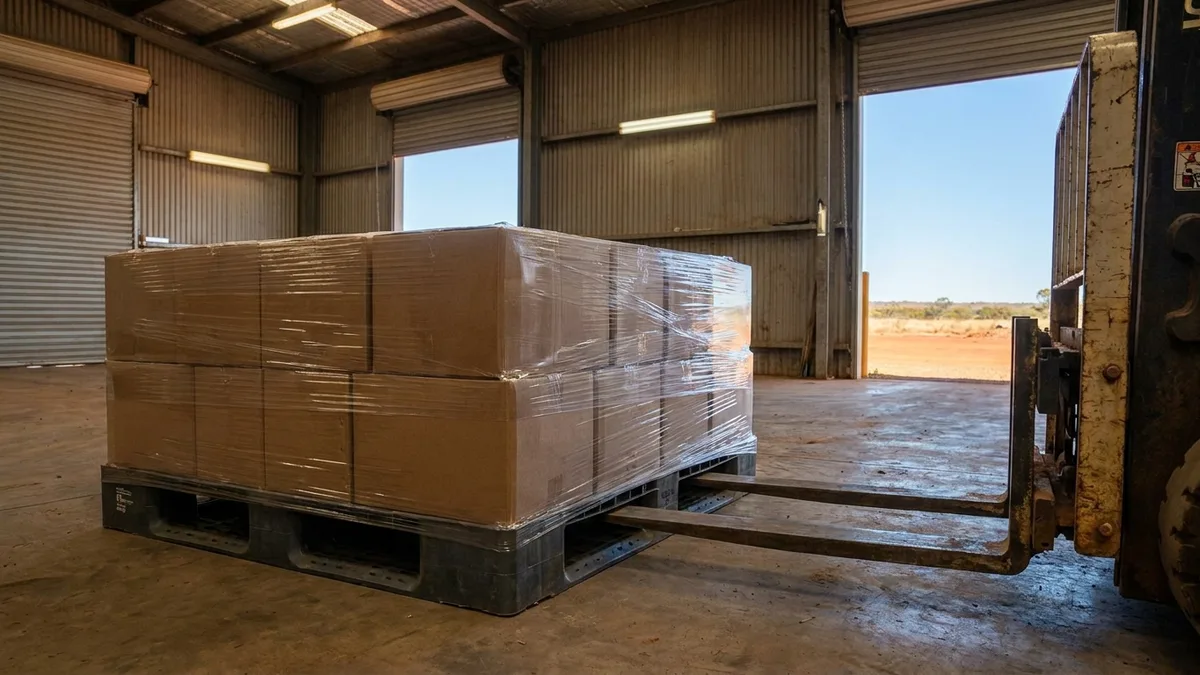
The operation moved its racked and export lines onto this heavy-duty ISO pallet, an HDPE platform on the standard 1200 x 1000 x 164 mm footprint weighing 24.5 kg. The numbers did the arguing. A 1000 kg racking rating means loaded units sit safely on beam racking without the sag, splitting or surprise collapses that timber threw up; an 8000 kg static and 2000 kg dynamic rating covers stacked staging and a fully loaded forklift travel move with margin to spare. The full perimeter base spreads load evenly and resists the point damage that nails and rough handling inflict, while 4-way forklift and pallet-jack entry lets crews pick a unit from any side in tight warehouse aisles. Being a single moulded HDPE piece, it carries no nails to puncture wrap, washes down to a clean surface for reagent and food-grade consumable handling, and shrugs off the moisture that ruins timber. It is also exempt from ISPM-15 heat-treatment and fumigation, so export-bound repair freight clears quarantine without the timber paperwork.
The rollout
We started with a single trial drop above the 40-unit minimum order quantity, ring-fenced to the two flows that hurt most: beam-racked spares storage and outbound repair freight. The warehouse team racked them at the rated 1000 kg, ran them through the wash bay between dirty returns and clean dispatch, and tracked breakages against the timber baseline over one shift cycle. Because the footprint matches the existing racking and the 164 mm height suits standard jack and forklift tines, no racking reconfiguration was needed and crews needed no retraining. Once the trial units came back unmarked, the operation rolled the pallet across its racked and export pools and held timber only for one-way consumable loads it never expects to see again.
Industry fit
Mining warehousing is exactly the duty this pallet is built for. Remote sites run on racked inventory and air or road freight where every kilo and every quarantine delay is money, and where the abrasive, wet, greasy conditions chew through timber fast. A washable HDPE platform with a genuine 1000 kg racking rating and an 8000 kg static rating handles dense, heavy mine spares and survives a wash-bay cycle that timber cannot. The ISPM-15 exemption matters for any operation that ships equipment out for off-site repair or returns it to interstate suppliers, removing a recurring fumigation and inspection cost. The same traits carry into the produce and food-distribution lines listed for this pallet, where wash-down hygiene and consistent racking behaviour are just as load-bearing.
Estimated result
On this operation's volumes, the planning case rested on replacement rate and freight. A timber export pallet might survive only an estimated 3-5 trips before it splinters out of service, whereas a heavy-duty HDPE pallet on this footprint is built to cycle for years, so the effective cost per trip falls sharply once it is reused rather than written off. Folding in fewer punctured parts, less quarantine friction on export freight and lighter, drier loads on charged-by-weight fly-in lanes, a switch like this typically pays back its premium within roughly a year and then keeps returning value across the pool's service life. These are planning estimates only, not a quoted price, and the real payback depends entirely on the operation's own throughput, reuse rate and freight lanes.