
A pharma air-freighter protects chargeable payload with the lightest Euro pallet on the market
A pharmaceutical exporter air-freighting to Europe.

Every kilo of tare was costing airfreight dollars
A pharmaceutical exporter shipping high-value product to Europe by air was paying for every kilogram of pallet tare. On airfreight, dead weight in the pallet is weight you cannot bill as cargo, so a heavy timber board quietly erodes the chargeable payload on every position. On top of that, timber pallets going into Europe must be ISPM-15 heat-treated and certified, adding fumigation cost, paperwork and the risk of a biosecurity hold at the destination. For repeated high-value shipments, both problems compounded.
Why the 4.4 kg Euro pallet was the obvious tool
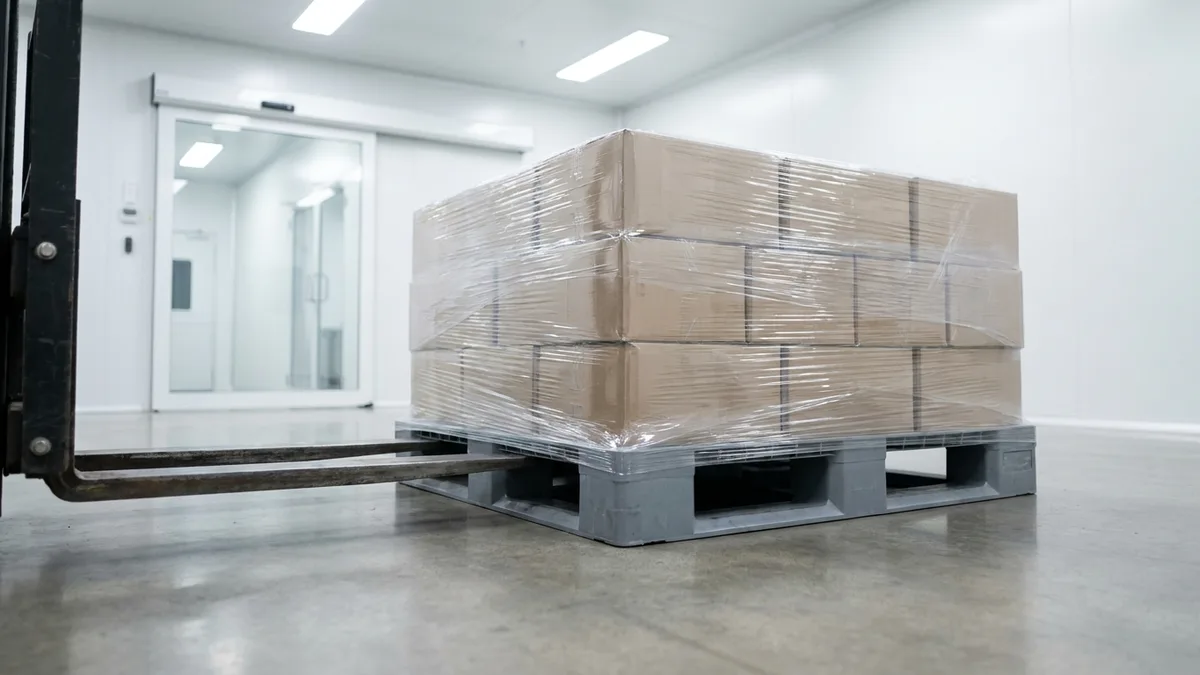
The exporter moved to the lightest Euro pallet on the market, a 1200 x 800 mm nestable HDPE pallet weighing just 4.4 kg, rated to 1,600 kg static and 800 kg dynamic. The ultralight tare is the whole point: at 4.4 kg the pallet barely eats into chargeable airfreight weight, so far more of each position is billable cargo than with a heavy timber board. Because it is plastic, it is exempt from ISPM-15 entirely, no heat treatment, no fumigation certificate, no treatment-related quarantine hold, which removes both a cost line and a source of delay on the European leg. And being nestable, the empties stack compactly in the cleanroom store between shipments rather than consuming floor space.
The 1,600 kg static and 800 kg dynamic ratings are well matched to the job: high-value pharmaceutical air cargo is rarely dense, so the exporter was paying to fly timber weight it did not need to carry the load. Trading a heavy board for a 4.4 kg deck simply stops subsidising dead tare on every position. The unit is still a true Euro 1200 x 800 mm footprint, so it indexes correctly into pallet positions, ULD planning and the consignee's handling at the European end, the exporter gained the payload and treatment savings without introducing a non-standard footprint that would have created problems downstream.
The rollout
The exporter introduced the lightweight pallets on its European air lanes, where the payload and treatment savings were most directly felt. The tare reduction showed up immediately in how much billable cargo each position could carry, and consignments cleared without the ISPM-15 paperwork that timber required. In the cleanroom, nesting kept the empties compact. Over repeated shipments the avoided treatment cost and the reclaimed payload accumulated, and the pallet became the standard for the air-export programme.
An estimated result, clearly hedged
These are estimates, not guaranteed savings, and they depend on lane, payload and how an airline rates a given consignment. On that basis we estimate the ultralight 4.4 kg tare preserved an estimated 4 to 5% of billable airfreight weight per position versus a timber pallet, a recurring gain that, on high-value cargo, adds up quickly across a shipping programme. Skipping ISPM-15 is estimated to have removed treatment and certification cost and shortened despatch lead time by avoiding the fumigation step and treatment-related border holds, while nesting kept the cleanroom store compact. We are not quoting an absolute price or a fixed return; an exporter can test the case against its own airfreight rating, its historical treatment costs and its lead times, and the conservative read is that reclaimed chargeable payload plus avoided treatment cost makes the lightweight pallet pay for itself rapidly on repeated high-value air consignments.