
A Brisbane pharmaceutical wholesaler retires sagging cartons with a deep 68L stack-and-nest tote
A Brisbane pharmaceutical wholesaler picking bulky consumables.

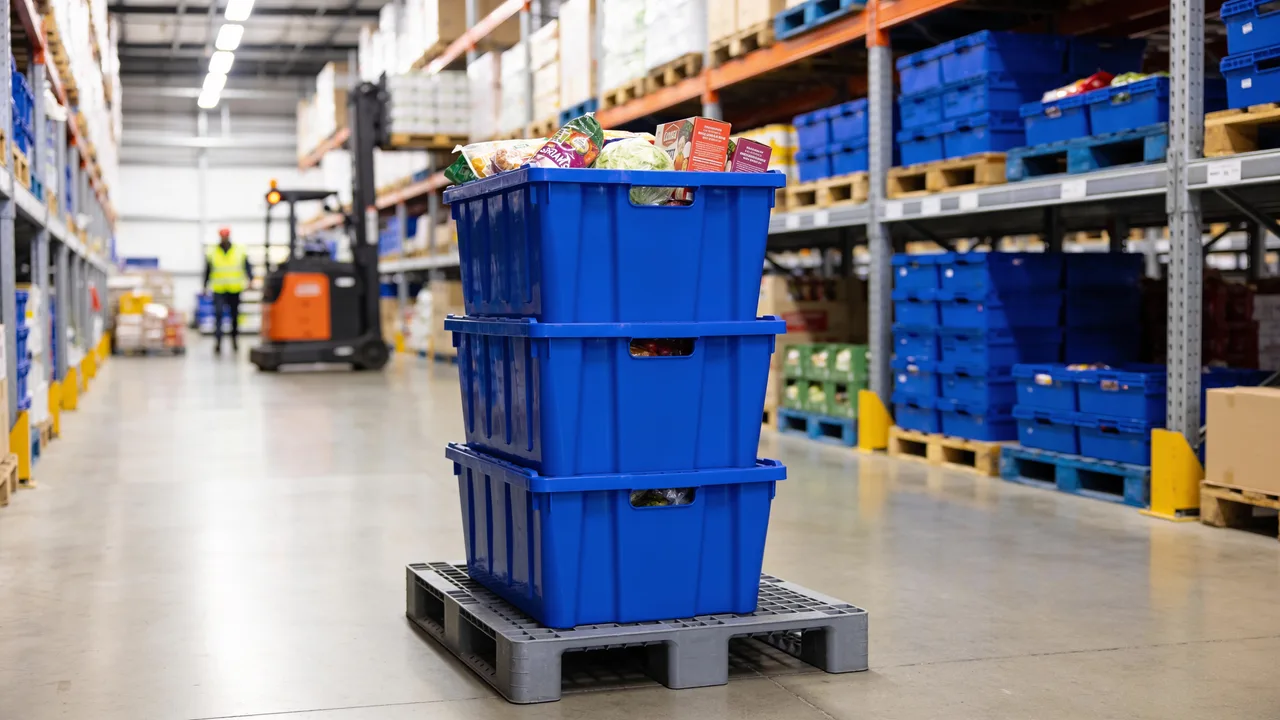
Deep cartons that sagged four-high and a store running short on space
A pharmaceutical wholesaler in Brisbane was picking bulky, slower-moving consumables into deep cardboard cartons. In a regulated environment those cartons were a poor fit twice over: they sagged and lost shape when stacked four-high, putting product at risk and creating untidy, unstable pick faces, and they could not be wiped down or cleaned to the standard the operation wanted. Every carton was effectively single-use, so the business was buying, storing and disposing of them continuously, and the flat-pack cartons consumed storage even before they were made up.
Why a deep, washable stack-and-nest crate suited a regulated pick face
The wholesaler standardised on a 68 L stack-and-nest solid crate measuring 645 x 413 x 397 mm, moulded from food-grade-clean PP and HDPE. The depth handles the bulky deep lines that the cartons struggled with, and because the crate is genuinely rigid it holds its shape stacked four-high rather than slumping, a real safety and tidiness gain in the pick face. The smooth, washable surface suits a controlled pharmaceutical environment in a way cardboard never can, simplifying contamination control. And the stack-and-nest design is the space story: full of product the crates stack securely, empty they nest down into one another, so the floor area tied up between cycles collapses compared with the equivalent rigid boxes.
The deep 68 L body also changed how the pick face was laid out. Slow-moving consumables that used to be split across several shallow cartons now consolidate into one rigid crate per line, which means fewer units to label, scan and shift, and a tidier face that pickers can read at a glance. The 645 x 413 mm footprint stays consistent across the AP-series totes the wholesaler already ran in shallower depths, so the deep crate dropped into the same shelving, the same dollies and the same clip-on lid pool without a separate handling standard, a quiet but real benefit when a regulated operation values one predictable system over a patchwork of box sizes.
The rollout
The crates went in across the deep, slow-moving lines where carton sag was worst, replacing single-use boxes one programme at a time. The immediate change was structural: stable four-high stacks that held their shape, and a washable surface that made sanitation sign-off cleaner. As the crate pool grew, the nesting paid back on space, empties that used to sit as bulky boxes now collapsed into a fraction of the footprint between cycles. Carton purchasing and disposal on the converted lines fell away to near zero. With the format proven, the wholesaler extended it across the relevant deep-line picking.
An estimated result, clearly hedged
The figures here are estimates rather than guaranteed outcomes, and they depend on throughput, line mix and how much storage an operation carries. With that caveat, we estimate the crates paid back against ongoing carton spend within an estimated 18 months on the converted deep lines. Nesting the empties is estimated to have reclaimed around 55% of the floor area the equivalent rigid boxes had occupied between uses, and the washable build is estimated to have cut contamination-related rejects by removing the porous, un-cleanable cardboard from a regulated pick face. We are not quoting an absolute price or a promised return; a wholesaler can test these against its own carton bill, its storage footprint and its reject rate, and the conservative read is that the end of recurring carton spend plus reclaimed space plus fewer contamination rejects justifies the changeover well inside a couple of years, after which the durable crates keep saving on every cycle.