
How a Brisbane meat-processing supplier reclaimed chiller space and retired single-trip cartons with a small washable nesting tote
A Brisbane meat-processing supplier handling portioned smallgoods.

The operator
This is a meat-processing supplier in Brisbane handling portioned smallgoods, a high-rotation operation where product moves through a tight chiller in small, frequent lots. Food-contact hygiene is non-negotiable, sanitation has to be signed off, and cold-store floor space is permanently scarce. Their challenge was a mundane but expensive one: the small cartons they used for portioned lines were a recurring cost, a contamination risk, and a space hog when empties piled up between runs.
The problem with the old handling
Single-use cardboard cartons are a poor fit for a wet, cold, food-contact environment. They cannot be properly washed or sanitised, so they are a one-trip item that complicates hygiene sign-off rather than helping it. They sag and lose integrity in chiller humidity. And flat or part-collapsed empties take up just as much awkward floor space as anything else in a chiller that has none to spare. For a high-rotation smallgoods line, the carton spend and the wasted cold-store space were both adding up.
Why this product
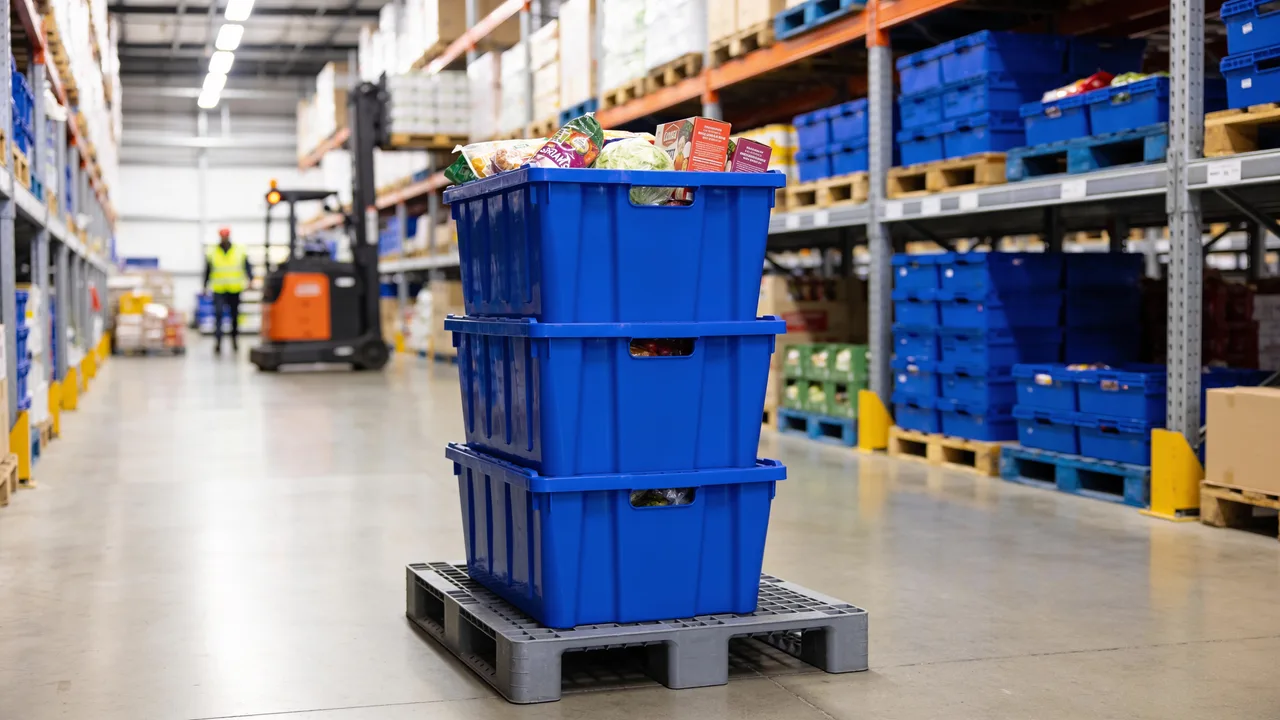
They switched to the Solid Plastic Crate (BPB-AP4): a compact 430 x 323 x 127 mm tote, 13 L, moulded from PP, that both stacks full and nests empty. The fit for the job is in three features. It is food-grade PP with a smooth, hose-down surface, so it washes and sanitises cleanly between runs and actually simplifies the sanitation sign-off rather than complicating it. It stacks rigidly when full, so portioned lots build a stable column in the chiller. And, the key space lever, it nests down into itself when empty, so a stack of empties occupies a fraction of the footprint that rigid boxes or flat cartons demand. At just 0.62 kg it is effortless to handle on a fast line, and the modest MOQ of 120 let them roll it out across the high-rotation lines without a big commitment.
The rollout
They introduced the totes on their highest-rotation portioned lines first, where the carton churn was worst. The crew settled in quickly: full totes stacked and moved through the chiller as before, and the moment they were emptied they nested down out of the way. Sanitation staff found the smooth washable surface straightforward to clean and sign off, and the carton waste stream on those lines fell away almost entirely. From there it was a simple matter of extending the tote pool across more lines as the benefit proved out.
The estimated result
These figures are estimates, framed deliberately, because payback and space recovery depend on rotation rate and how much carton the line was consuming. Against ongoing single-use carton spend on high-rotation lines, we estimate the totes paid back within roughly 12-18 months, then kept saving as durable reusables that outlast cardboard many times over. On space, the constraint that really hurts in a packed chiller, nesting the empties reclaimed an estimated 60% of the cold-store footprint that the equivalent flat boxes had needed between runs. And the washable food-grade surface simplified sanitation sign-off and cut the contamination exposure that cartons carried in a food-contact, cold-chain environment.