
A Tasmanian onion grower cuts empty-return freight with 565 L folding vented Euro bulk containers
A Tasmanian onion grower packing field-run crop for domestic supermarket programs..

The operator and the problem
A mid-sized Tasmanian onion grower packing field-run crop for domestic supermarket programs came to us with a storage and freight problem rather than a growing one. Through harvest they moved bulbs in a mixed fleet of timber bins and one-trip cardboard, and two costs kept stacking up. First, solid-walled bins trapped field heat and moisture against the crop, and any grower handling onions knows poor airflow in the stack is where shrink starts the FAO has long put post-harvest losses for fruit and vegetables in the order of 30 to 40 percent globally, much of it tied to heat, condensation and handling damage (fao.org). Second, once emptied or returned from a distribution centre, rigid bins came back full of air, so the operator paid to truck and store empty cubes through the off-season.
Why this container
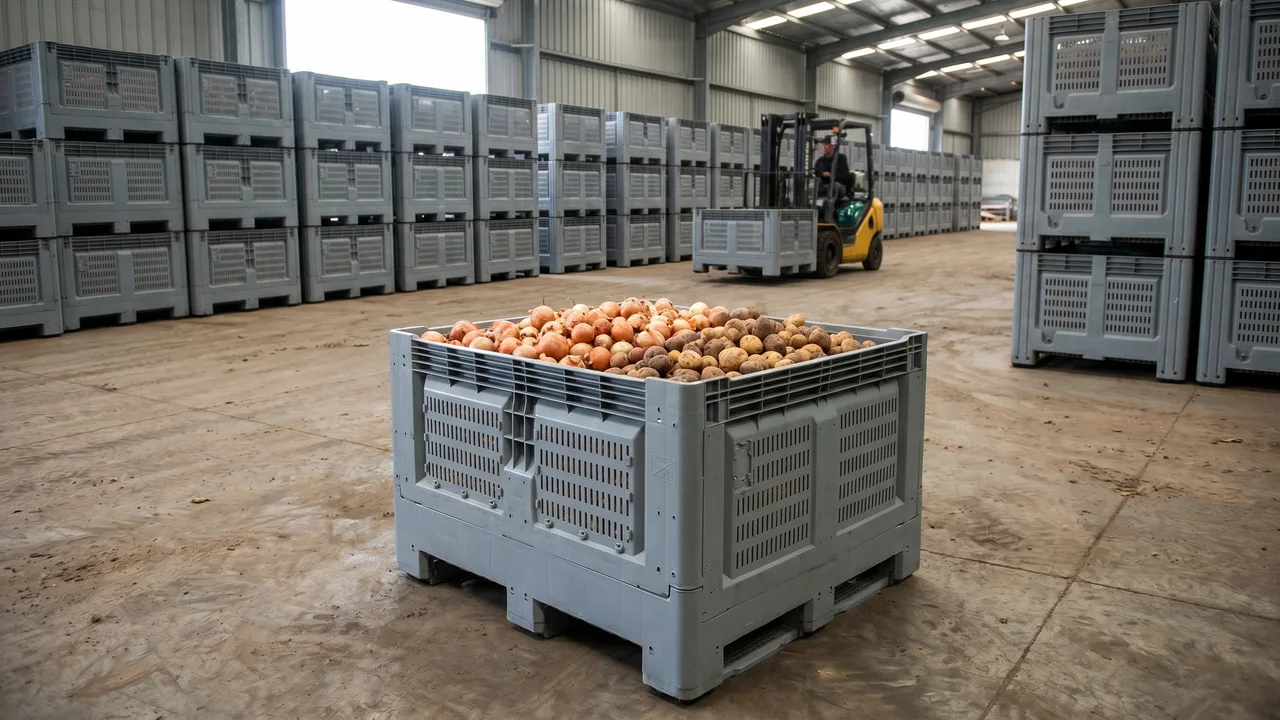
The fit here is the folding vented Euro bulk container, an HDPE bin on the standard 1200 x 800 mm Euro footprint standing 805 mm tall, with 1120 x 720 x 660 mm inside and 565 L of usable volume. Two features did the work. The vented walls let air move through the stack instead of sealing heat against the bulbs, which is exactly what onions in store need. And because it folds, the bin drops from 805 mm erected to just 293 mm collapsed a little over a 2.7:1 reduction. That lets roughly four folded bins ride home in the cube one erected bin would occupy, turning empty return legs and off-season storage from a cost into a rounding error. At 40 kg each in tough HDPE, these cycle for years, not for a single season like the cardboard they replace.
The rollout
We started the grower at the 104-unit minimum order enough to run a meaningful block of the harvest on the new bins while old timber stock was retired in stages, rather than betting the whole shed at once. The container takes 4-way forklift entry, so existing forklifts and pallet jacks could pick a bin from any side with no driver re-training. We specced the bottom support deliberately: the bin is offered on 2 skids, 3 skids or 4 feet, and we matched that to how the operator moves and stacks, since runner skids suit straight forklift-and-conveyor flow while feet give cleaner 4-way access in tight cool-room aisles. Filled to the brim each bin sits well within its 650 kg dynamic load, with 7000 kg of static strength underneath when block-stacked in store.
Industry fit
This is a produce bin first. For an agricultural packer feeding supermarket and food-distribution logistics, the Euro 1200 x 800 mm footprint is the language the whole chain already speaks, so bins drop straight onto standard pallets, into truck bays and through DC door openings without bespoke handling. The ventilation suits field-to-store crop that has to breathe onions, but equally potatoes and other hardy bulbs and roots while the food-grade HDPE wipes down between loads for the hygiene a retail program expects. One note we are always straight about: this bin carries a 7000 kg static and 650 kg dynamic rating but is not rated for beam racking, so it is built for floor and block stacking, not for pallet-racking beams.
Estimated result
The headline win is freight and storage on the empties. Collapsing four-to-one means return trucks and the off-season shed hold roughly a quarter of the cube they did on rigid bins, and on a busy onion lane that empty-leg saving alone typically pays back the bins within about a year. Against single-trip cardboard the maths compounds: a 40 kg HDPE bin that folds and runs season after season replaces a recurring consumable, while better airflow chips at the shrink that eats grower margin. We would put the combined effect in the order of a meaningful double-digit percent cut to per-bin handling cost over the bins' life. These are planning estimates only, not a quote: the real numbers turn on the grower's own throughput, store turn and freight lanes, which we size together before any order.