
How a Riverina onion grower-packer got more curing volume per footprint with a tall folding vented Euro box
A Riverina (NSW) onion grower-packer on Euro racking running long-season curing.

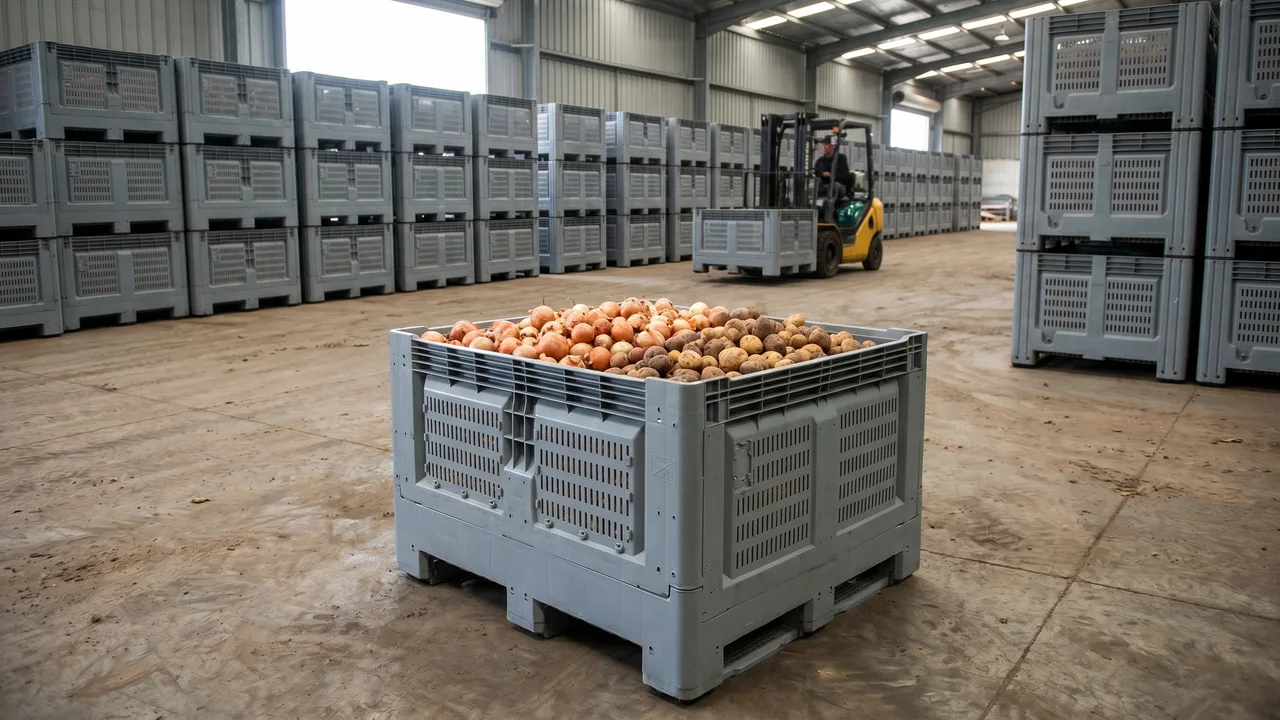
The operation
A Riverina onion grower-packer that had already standardised its store and transport on the Euro (1200×800) footprint wanted to squeeze more cured crop into the same shed without rebuilding its racking or buying a forklift fleet to suit a different pallet size. The constraint was familiar to anyone in storage onions: floor space and pallet positions are finite, curing demands airflow, and the off-season leaves you with a yard full of empty bins doing nothing but taking up room.
The problem with the old handling
Their standard-height vented bins worked, but they capped how much crop sat under each pallet position. To cure more tonnes they had to commit more floor — and floor was the thing they did not have. The shorter bins also left a lot of headroom unused in a tall store. And like every seasonal operator, they were storing rigid empties at full height through the back half of the year, which is the least productive way imaginable to use a shed.
Why this product
They adopted the tall folding vented Euro bulk container. The key number is the body height: 1200×800×978 mm external, with a 1120×720×833 mm internal cavity giving 695 litres — a meaningful step up in crop per footprint over a standard-height vented box, on exactly the same Euro footprint their racking already takes. The full-height venting carries curing and respiration heat away through the deeper bulb mass, which matters more, not less, as the column gets taller, because the centre is further from the surface. The all-HDPE build is food-grade, hoses clean and shrugs off the wash-down regime. A 7,000 kg static rating — among the strongest in the folding Euro range — lets them stack these tall boxes densely in the store, and the 750 kg dynamic rating handles a full box on the forks. Four-way entry suits busy intake. And then the off-season payoff: the box folds to 465 mm, so empties stack roughly three-to-one against erected height.
How the rollout went
Because the footprint and handling never changed, the taller boxes slotted into the existing operation without retraining or re-racking. At 47.5 kg empty they handle like the bins the crew already knew. The team filled higher per position and watched the curing performance, and the through-stack venting held up in the deeper mass. When the season wound down, collapsing the empties to 465 mm freed a large block of shed that would previously have been wall-to-wall rigid bins.
The estimated result
The grower-packer estimates that the higher fill per footprint, combined with the folding empty-return and storage profile, cut their combined storage and freight cost by an estimated 15–25% versus running shorter, rigid vented bins. We frame that as an estimate because the real saving depends on how full they run each box and how much empty movement a given season involves. The mechanism is simple, though: more crop per pallet position means fewer positions to cure the same tonnage, and a box that folds three-to-one means the off-season yard and any empty-return leg carry a fraction of the volume they used to. Against timber bins on a two-to-three-season replacement cycle, the decade-plus HDPE service life also steadily lowers the long-run spend. For an operator boxed in by floor space, getting more cured crop out of the same shed — without touching the racking — was the whole point.