
How a Goldfields gold operation consolidated remote freight into one folding jumbo bin and cut empty-leg cost
A Western Australian Goldfields gold operation.

The operator
This is a gold operation in Western Australia's Goldfields, running a remote processing site supplied over long haul distances from a regional base. Their procurement and warehouse team handles a steady flow of dense consumables and bulky spares out to site, and, as with every remote operation, the cost of the empty return leg is a constant drag on the logistics budget. They wanted to do two things at once: consolidate freight into fewer, larger handling units, and stop paying to truck full-height empties back across the Goldfields.
The problem with the old handling
Their dense consumables and parts were moving in a mix of smaller rigid containers and crates. That created two inefficiencies. First, fragmentation: a single delivery needed several separate boxes, multiplying handling moves at both ends and making loads harder to secure on a long haul. Second, the rigid units came back empty at full height, so the backhaul carried air at full freight cost, the classic remote-site penalty. They needed a container big enough to consolidate a load into a single move, strong enough for heavy point-loaded freight, and collapsible so the return leg stopped wasting truck volume.
Why this product
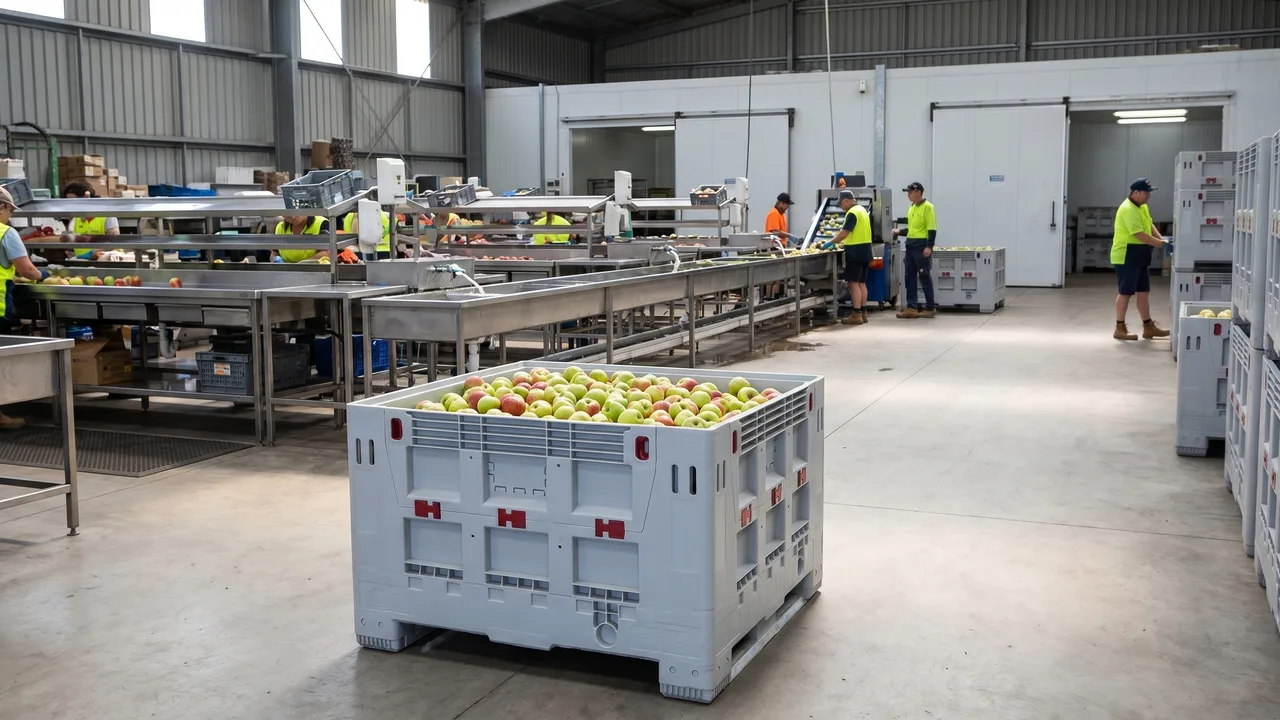
They specified the Folding Solid Jumbo Bulk Container (BPB-C1212S80): a wide 1200 x 1200 mm jumbo footprint, 805 mm tall, with an 880 L body moulded from HDPE and a 7,000 kg static rating. Every part of that spec maps to the job. The wide 1200 x 1200 body and 880 L volume let one jumbo box swallow loads that previously needed several smaller containers, cutting the number of units to handle, secure and track. The 7,000 kg static rating takes dense, point-loaded consumables that would deflect a lighter deck. The 4-way forklift entry suits busy loading at both the base and the remote store. And it collapses to a 293 mm folded height, so empties stack roughly three-to-one for the back-haul. The HDPE shell also shrugs off the site conditions that degrade timber crating.
The rollout
They began by mapping which of their multi-box loads could be consolidated into a single jumbo, then ran the bins on their highest-volume remote lane. Loads that used to leave as several crates now left as one jumbo container, which immediately simplified securing and reduced the move count at the remote store. On the return, the crew folded the empties flat and stacked them three-high for the trip back. The fold is a quick operation, so it added little to turnaround, and the consolidation effect was felt straight away in fewer forklift moves per delivery.
The estimated result
We frame the savings as estimates because they depend on haul length, how completely loads consolidate, and return-cycle discipline. On the empty leg, folding to 293 mm means roughly three collapsed jumbos travel in the footprint of one erected box, which on a long Goldfields haul we estimate removes on the order of 65% of the empty-return freight versus rigid crating. On top of that, consolidating multi-box loads into single jumbo containers cuts handling moves at both ends and tightens load security. We estimate the combination of fewer, larger reusable units plus a folding empty leg trims round-trip logistics cost on these remote runs by an estimated 20-30%, while the HDPE shell outlasts the timber crating it replaces in a harsh, abrasive site environment.