
A Riverina onion grower maximised curing volume per pallet with a tall folding vented jumbo
A Riverina onion grower-packer running large-volume curing and storage.

Curing volume capped by the footprint
A grower-packer in the New South Wales Riverina handled large volumes of bulb onions that needed curing and ventilated storage before grading and dispatch. Their constraint was floor area. Onions cure best when air can move through a deep, ventilated mass, but a standard-height vented box only holds so much crop per pallet position, and the packing shed and coolroom had a finite number of positions. To cure more onions they were effectively renting more floor, and at peak intake the shed simply ran out of room. They also wanted the bins to disappear out of season, a yard full of rigid vented boxes through the months when nothing is being cured is dead space and an awkward storage problem in its own right.
Why the tall 1080L folding vented jumbo
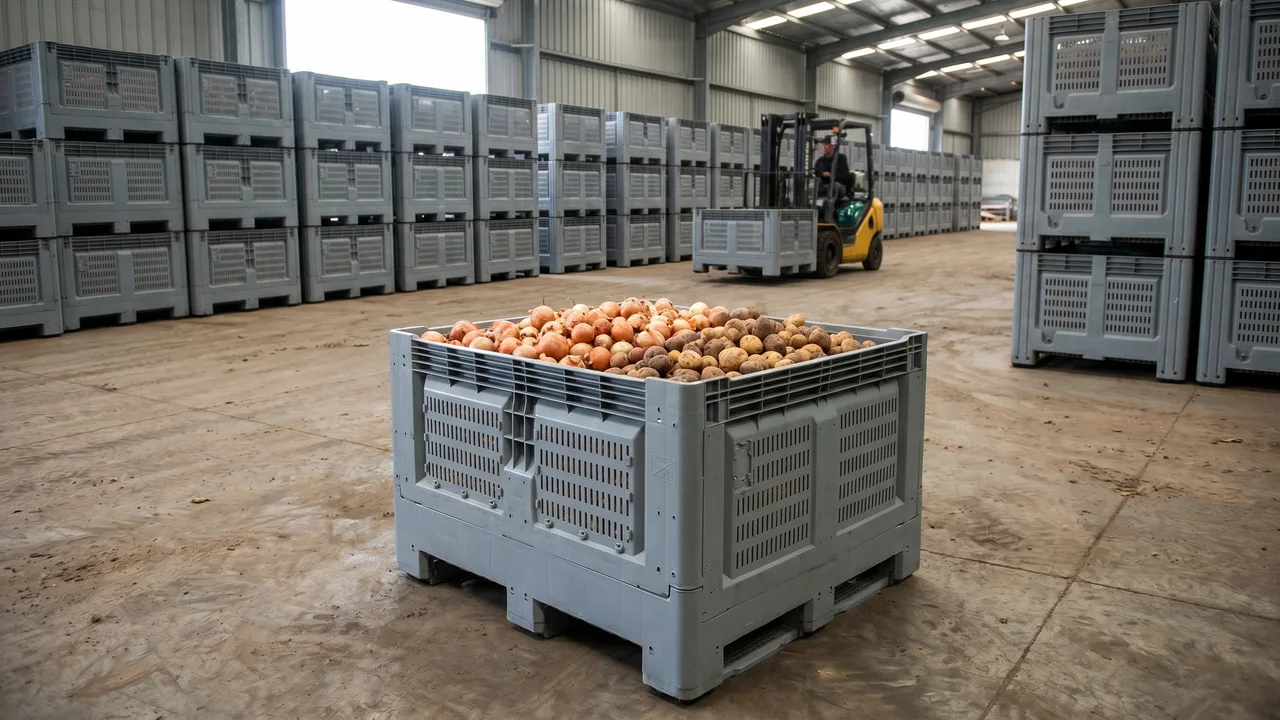
The answer was to go both taller and wider on the same pallet position, and to make the box fold away when not in use. The Folding Vented Jumbo Bulk Container (BPB-C1212V97) does exactly that. On a wide 1200x1200 mm jumbo footprint and a tall 978 mm body, it offers 1080 L of vented capacity, substantially more curing volume per pallet position than a standard vented box, which is precisely the lever this operation needed. Full-height venting carries curing and respiration heat away through the deeper bulb mass, so the extra depth does not compromise airflow. A 7000 kg static rating lets the boxes be stacked densely in the store under their own weight, and 4-way forklift entry keeps handling quick during a hectic intake. The decisive feature for the off-season problem is the fold: the unit collapses to just 465 mm, so empties stack roughly three-to-one and the bin fleet shrinks away to a fraction of its erected volume between crops.
Rollout through the season
The packer brought the jumbo boxes in to replace standard vented bins on its highest-volume curing lines. Crop was filled directly off the line into the taller units, which were then stacked into the curing store. Because each box cures more onions per position, the same store held more crop without adding floor. At the end of the curing season the crews folded the empties flat and stacked them away, freeing the yard space that rigid boxes used to occupy through the off months. The food-grade HDPE bins also handled the curing environment without the moisture problems of older timber boxes.
The estimated result
This case is really two savings stacked on the same unit. On storage, fitting more curing volume into each pallet position is estimated to have lifted crop held per position meaningfully, easing the floor-area squeeze at peak. On the off-season, with empties folding three-to-one, we estimate the collapse cut combined storage and empty-return volume by an estimated 15-25% versus running shorter rigid vented bins year-round. On the crop itself, full venting through a deep mass supports curing and is estimated to reduce stored-onion shrink, and even a few points of recovered crop value goes a long way on large volumes. We estimate the combination of higher fill, lower off-season footprint and reduced shrink recovers the container outlay within a couple of seasons of use, with the HDPE bins outlasting timber many times over thereafter. As with all these figures, they are planning estimates rather than a quoted return, actual results depend on incoming crop condition, store and shed layout, and how the curing program is run. But for an onion operation pinned by floor area, a taller, wider, foldable vented box attacks the constraint directly.