
A Sunshine Coast food packer standardises three pallet sizes into one custom medium-duty pallet
A Sunshine Coast contract food packer.

The operator
This story follows a contract food packer on Queensland's Sunshine Coast — a business that packs finished product for several different retail customers, each with its own pallet preferences. Running multiple customers off one site is good for the order book, but it had quietly created a handling problem on the dock.
The problem with the old handling
The packer was juggling three different pallet sizes to suit different retail customers. Three sizes meant three lots of stock to buy and store, constant risk of mis-picking the wrong pallet for a given order, and inconsistent stack stability in the racking because each size behaved a little differently. Timber pallets across all three sizes added the usual problems — splinters near food, variable quality, and a steady replacement cost. The despatch team was losing time sorting and chasing the right pallet, and mismatches occasionally reached the customer.
Why this product
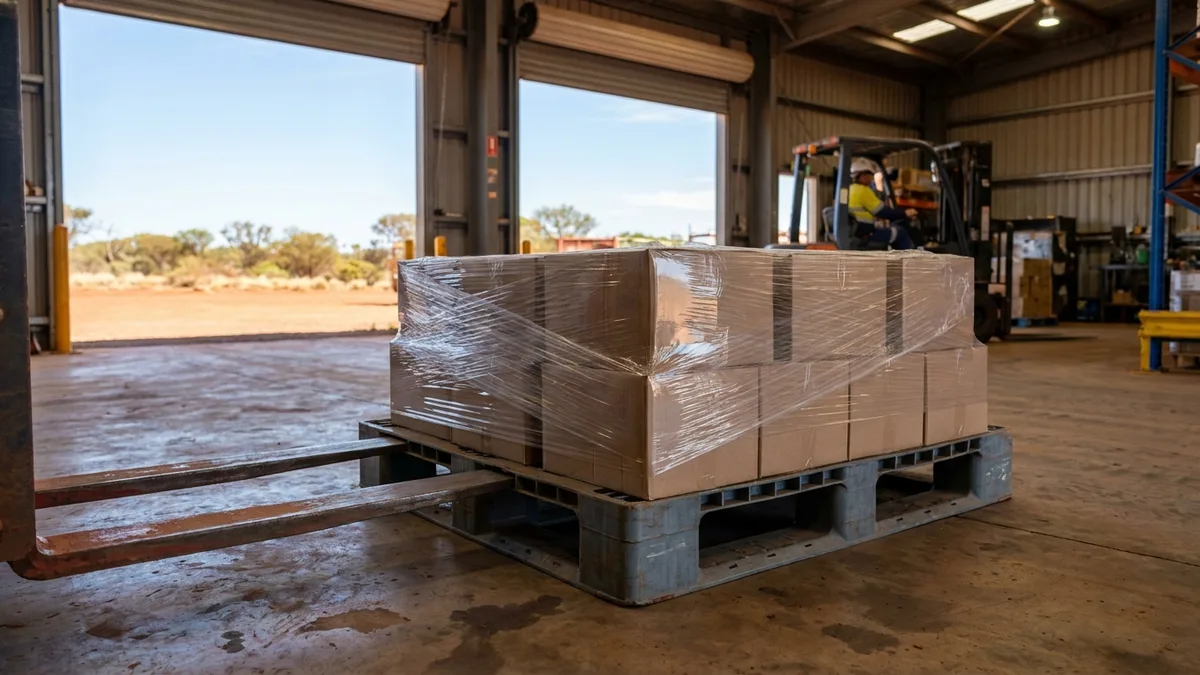
They tooled the BPB-CUSTOM-M Medium Duty Plastic Pallet: a custom pallet made to the packer's specification in a PC/PO/HDPE construction, designed around a single shared footprint that suited all of their lines. The point of the exercise was consolidation — one purpose-built spec that every customer's product could ship on — which simplified buying, simplified storage, and removed the daily question of which pallet goes with which order. As a medium-duty stackable plastic pallet, it gave consistent stack behaviour in the racking and a clean, food-appropriate deck that timber couldn't match.
A custom pallet is a fleet decision: with an MOQ of 200, the packer was standardising deliberately across the operation rather than buying a handful. The trade-off — one spec to rule them all — was exactly the outcome they wanted.
The PC/PO/HDPE construction was specified for the realities of food despatch. It gives a sealed, wipe-clean deck with no nails or splinters near product, and a medium-duty plastic pallet of this class holds a consistent deck height and skid pattern so that pallet wrappers, conveyors and truck loading all see the same dimensions every time — something three different timber sizes could never guarantee. By choosing one engineered footprint that worked for every retail customer rather than the lowest common denominator, the packer got predictable behaviour through the whole despatch chain, from wrap station to delivery.
How the rollout went
Because the shared footprint was chosen to suit every existing line, the new pallet slotted into the racking and despatch flow without forcing changes on the customer side. The immediate effect on the dock was less confusion: with one pallet instead of three, mis-picks dropped and the team stopped sorting through size variants.
The estimated result
The value is in simplification. Consolidating from three pallet sizes to one custom spec, we estimate, trimmed pallet inventory holdings by an estimated 10–15% — fewer SKUs to buy, hold and reorder — and cut the labour lost to sorting and chasing mismatched timber across despatch. Stack stability improved because every load now sat on the same engineered footprint. As a durable plastic pallet, it also displaces the recurring timber replacement the packer had been absorbing. These figures are planning estimates based on the consolidation the custom pallet enabled rather than a price quote — but for a multi-customer packer drowning in pallet variants, standardising on one purpose-built spec is a structural fix, not just a cosmetic one.