
How a Lockyer Valley carrot grower stopped wash-water mould and outlasted timber bins with a super-strong vented bulk container
A Lockyer Valley (SE Queensland) carrot grower-packer.

The operator
This is a family-run carrot and root-vegetable grower-packer in South-East Queensland's Lockyer Valley, supplying washed product into the Brisbane wholesale markets and a couple of supermarket programmes. Carrots come off the paddock, into cold store, then across a wash line before they are graded and packed, and the bulk bins that shuttle product between those steps are handled hard every single day. They came to us because two things kept eating margin: product spoiling in store, and the bins themselves wearing out faster than they should.
The problem with the old handling
Washed carrots were being moved from cold store to the wash line in solid-walled bins. The trouble with a solid bin on a washed crop is that it traps free water and warm, damp air against the root mass, so the bottom of every bin sat in a pool and bred mould before the line could catch up. On top of that, their older bins were timber, which soaks up wash-water, harbours bacteria in the grain, swells and splinters, and quietly fails the periodic food-safety swabs a supermarket programme demands. Timber on a daily hot-wash crop is effectively a consumable, it was being condemned and re-bought far too often.
Why this product
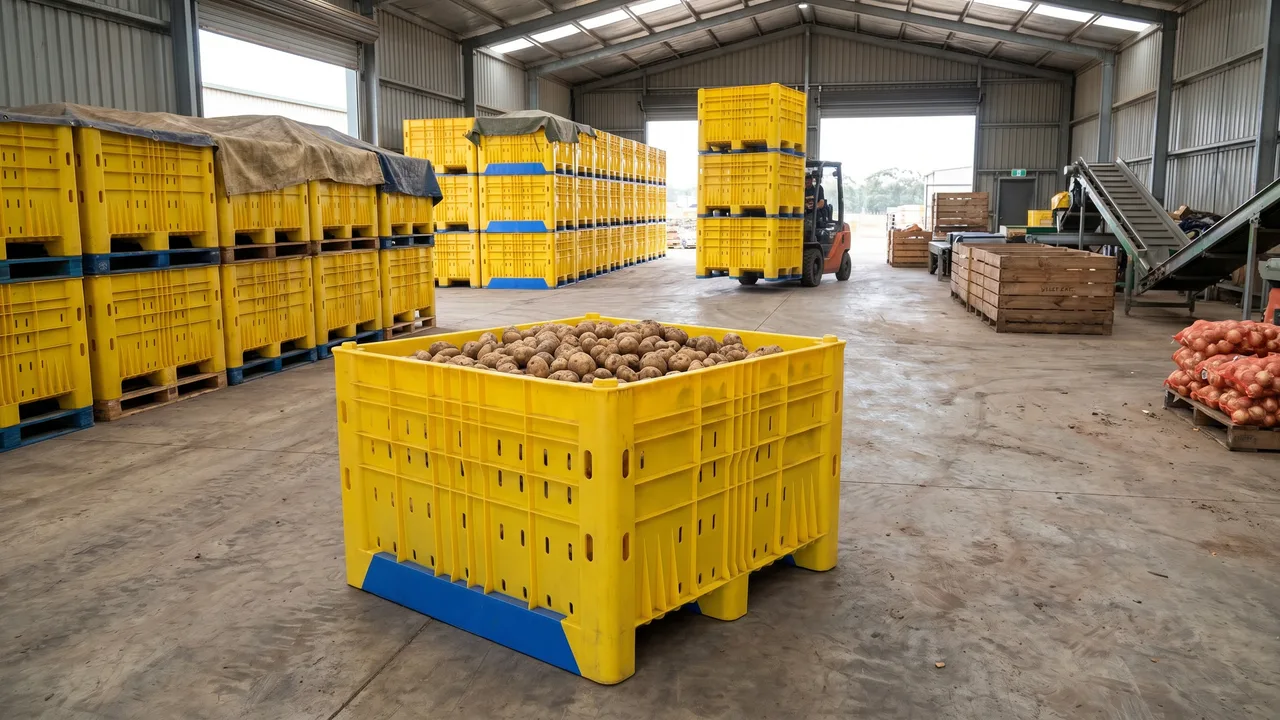
They moved to the Vented Plastic Bulk Container (BPB-D1120V78): a 1120 x 1120 x 780 mm Australian-Standard bin with a 700 L body moulded from food-grade HDPE and PP, rated to 4,000 kg static and 700 kg dynamic, and weighing just 39.5 kg empty. Every part of that spec maps to a washed-root operation. The floor and wall venting let free water drain straight out and keep air moving over the carrot mass instead of pooling against it, which is the single biggest lever on wash-line spoilage. The HDPE/PP body takes daily hot wash-down at 60-80 degrees C without degrading, swabs clean and has no grain to harbour bacteria, so it holds up to audit. The 4,000 kg static rating lets bins stack densely in the cold store, and at 39.5 kg the bin is light enough for a picker to reposition without a second person. It runs on a choice of two-skid, three-skid or nine-foot base, so it drops into their existing forklift handling.
The rollout
They brought a batch in ahead of the main season and ran it first on the cold-store-to-wash-line shuttle, which was where the moisture problem was worst. The difference was visible within days: water drained out of the vented floor instead of sitting under the load, and the base layer of carrots stopped arriving at the line soft and marked. The crew folded the new bins straight into the existing wash cycle, and because the HDPE shrugs off the hot-wash that was destroying timber, the bins came through the daily sanitation routine without swelling, splitting or failing swabs.
The estimated result
We frame these as estimates because spoilage and bin life both move with season, crop condition and how hard the wash line runs. On spoilage, draining free water and venting the root mass cuts the soft-and-mouldy losses that a solid bin creates in store, even a couple of percentage points recovered on a washed crop is meaningful money across a season. On bin life, a food-grade HDPE bin that survives daily 60-80 degree wash-down outlasts the timber it replaces several times over, with none of the rot, swelling or swab failures that were forcing timber renewal. Put together, we estimate the changeover recovers its cost within roughly two to three seasons, after which the bin keeps returning both the lower store spoilage and the avoided timber-replacement spend on every cycle.