
A Sunraysia Grape Packer Pulls Field Heat Out Faster With Vented Euro Bins
A Sunraysia table-grape packer in north-west Victoria.

The operation
This is a table-grape grower-packer in the Sunraysia district of north-west Victoria, harvesting through the hottest part of summer for both domestic supermarket programs and export. Bunches are hand-picked into field bins, carted to a packing shed, force-cooled, then packed to order. Speed of cooling is everything: grapes that go into the cool room warm and damp downgrade fast.
The problem with the old handling
The packer had been harvesting into solid-walled bins. Two things went wrong with that. Fruit sitting at the base of a solid bin sat in trapped warm air and its own condensation, so the bottom layers consistently graded down. And during force-cooling, solid walls slowed the airflow the whole point of a pre-cooler depends on, the cold air couldn't get through the load, so cooling took longer and ran less evenly through the bin.
On top of that, the bins they were using were on a seasonal renewal cycle. Timber and lesser-grade tubs in a wash-and-cool environment don't last, and there was a budgeted line every year for replacing them.
Why this container
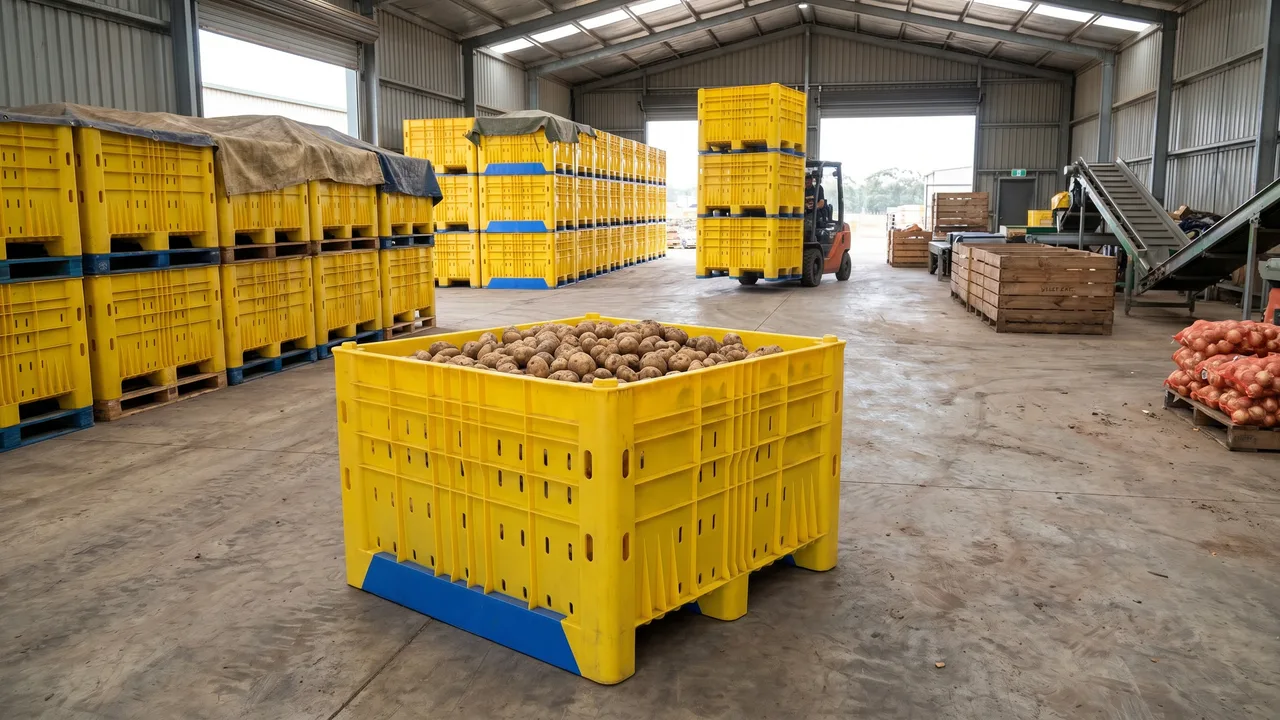
They moved to the BPB-D1208V74, billed as the strongest vented Euro-standard bulk container available. It is a 1200 x 800 mm footprint at 740 mm tall, moulded from food-grade HDPE and PP, rated to 4,000 kg static and 700 kg dynamic, with a 500-litre body and 4-way forklift entry. At just 31.5 kg empty it's light enough for a picker to reposition without a second person.
The vented walls and floor were the reason it was chosen. Open venting on all faces means force-cooling air passes straight through the fruit instead of stalling against a solid wall, so field heat comes out faster and more uniformly. The floor venting lets condensation drain away rather than pooling under the bottom bunches. The Euro 1200 x 800 footprint dropped straight onto their existing pallet handling and racking, so nothing downstream had to change, and the heavy-duty HDPE/PP build means it survives wash-down where their old tubs perished.
The rollout
Because this is a non-folding rigid bin with a meaningful minimum order of around 90 units, the packer committed to it as a fleet standard for their grape line rather than a trial. They sequenced the purchase so the new bins arrived ahead of the vintage and went straight into the harvest-to-cool flow. The 4-way entry meant forklift drivers could approach from any side in a busy shed, which mattered more than expected during peak intake when bins stack up at the cooler.
The result, estimated
The cooling improvement is the headline, and it should be read as an estimate. Pulling field heat out faster and more evenly through vented walls means less time at temperature-risk and less moisture sitting against the fruit. We estimate that quicker heat removal and reduced base-layer condensation cut downgraded fruit by an estimated 2-4% per pick, and on premium table grapes, a few percent of saved pack-out across a season is a large number relative to the cost of the bins.
The second effect is replacement. A food-grade HDPE/PP bin of this grade outlasts the timber and budget tubs it replaced several times over, so the annual bin-renewal line the packer had been carrying largely disappears. We'd put the long-run saving as the elimination of that recurring seasonal spend, with the bins paying for themselves through avoided replacement well inside their service life. Neither figure is a guarantee, pack-out depends on the season and the crop, but the direction is clear: faster cooling, less downgrade, and a bin that stops being a yearly cost.