
A Barossa Valley winery cuts vintage cleaning and bin replacement with the 1025 L solid ISO bulk container
A South Australian Barossa Valley winery and grape grower-processor moving must and pressings across the crush pad..

The operator and the problem
This operator is a mid-sized winery and grape grower-processor in South Australia's Barossa Valley, the kind of crush-pad business that takes in fruit from its own blocks and contract growers across a compressed vintage window. For years the must, pressings and skins moved around the pad in tall timber half-tonne bins. They worked, but they leaked juice down the seams, soaked up tannin and acid, and could not be properly sanitised between batches. By the back end of vintage the team was losing pad hours to scrubbing, fielding the odd hygiene query, and watching bins crack and get retired every few seasons. The brief was simple: a tall, food-safe, sanitisable bulk container that fits the ISO pallet system they already run and survives a decade of acidic, sticky vintage work.
Why this container
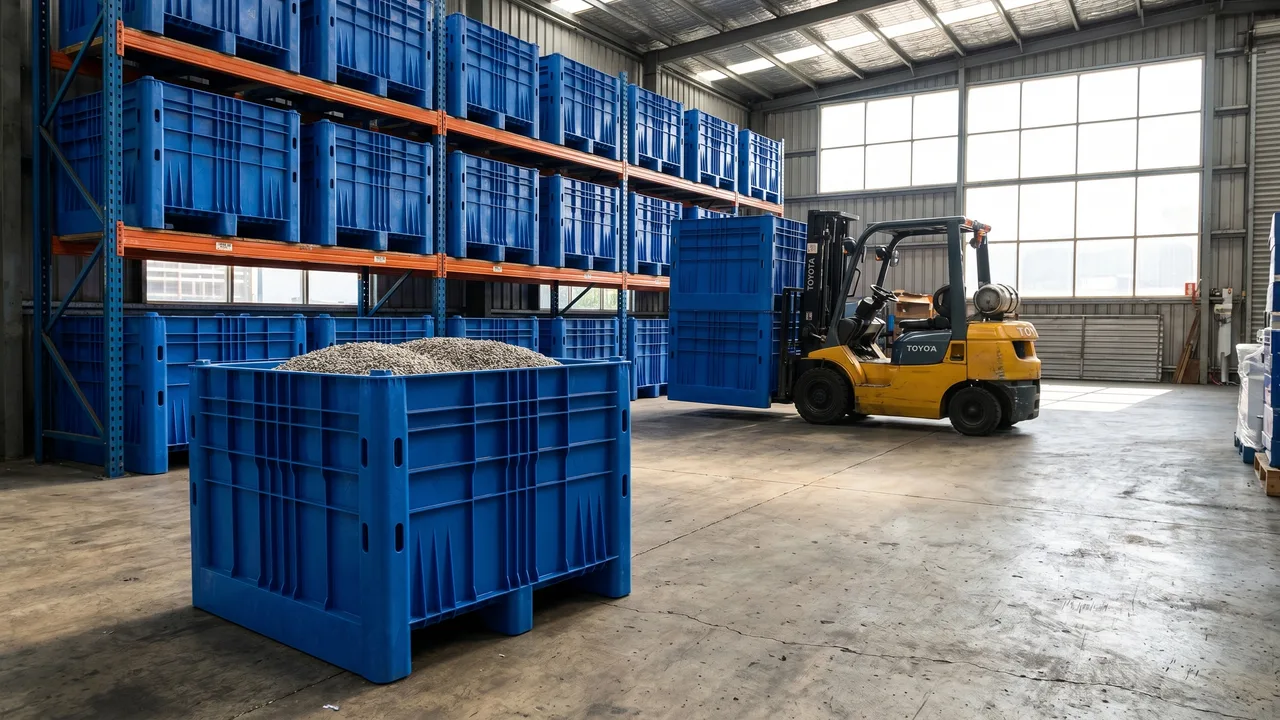
We put forward the solid ISO bulk container at 1200 x 1000 x 1140 mm. The footprint drops straight onto their existing 1200 x 1000 racking and transport, which mattered because they did not want to re-spec handling around a new box. Internally it measures 1128 x 928 x 985 mm for 1025 L of usable volume, so one container carries a genuine bulk batch of must per move rather than the part-loads the old timber bins managed. The walls are smooth, solid food-grade HDPE and PP, which wash and sanitise fully between ferments and shrug off the tannin staining that ruined the timber. It is rated to 4500 kg static and 750 kg dynamic, comfortably inside the weight of a full charge of liquid and solids, and at 54 kg empty it sits stable yet stays manageable on the pad. Australian food-contact guidance under AS 2070 favours smooth, non-absorbent, cleanable surfaces for this reason, which a moulded HDPE/PP wall meets far more cleanly than open-grain timber.
The rollout
The container offers 4-way forklift entry, the detail that won the pad team over: during a busy crush, drivers approach from whatever angle the queue allows, and 4-way access removes the shuffle that 2-way timber bins forced. It ships on a choice of bottom support, 2 skids, 3 skids or 9 feet, so they specified skids to match the tynes and pallet jacks already in the shed. Minimum order is 44 units, which suited a single-vintage changeover of their core bin fleet rather than a trickle of replacements. We staged the first run before the white harvest, ran them through ferment and press transfers, then a full hot-wash cycle, and confirmed the smooth walls came up clean with no trapped lees in the corners. With handling unchanged and the boxes proven over one vintage, the balance of the fleet went in ahead of the following season.
Industry fit
This is squarely a winemaking and grape-harvesting box, and it reads across to the food distribution, agriculture and meat-processing lines the same operator touches. The traits that matter to a winery matter to any wet, acidic, audited food process: solid leak-resistant walls that hold liquid and slurry, a food-grade surface that sanitises rather than absorbs, and a rigid HDPE/PP body that takes repeat hot-wash without degrading. The 1025 L capacity suits half-tonne-plus batches of must, and the tall 1140 mm profile lifts volume per pallet position so fewer moves clear the same tonnage through the press.
Estimated result
The headline gain is replacement spend. Where the timber bins were renewed every few vintages, a food-grade HDPE/PP container of this class is built for a decade-plus of service, so we estimate ten-year container spend falls in the order of 50%. On top of that, the smooth sanitisable walls cut juice loss from leaking seams and trim the pad hours previously lost to scrubbing and hygiene rework, while the 4-way handling shaves time off every transfer during the crush crunch. Taken together, a changeover like this typically pays back within roughly a season or two on avoided bin replacement and recovered labour. These are planning estimates only and the real numbers depend on the operator's own crush volumes, vintage length, wash regime and freight lanes.