
A pharmaceutical 3PL chooses a rackable, stackable folding IBC that collapses for the return leg
An Australian pharmaceutical logistics operator.

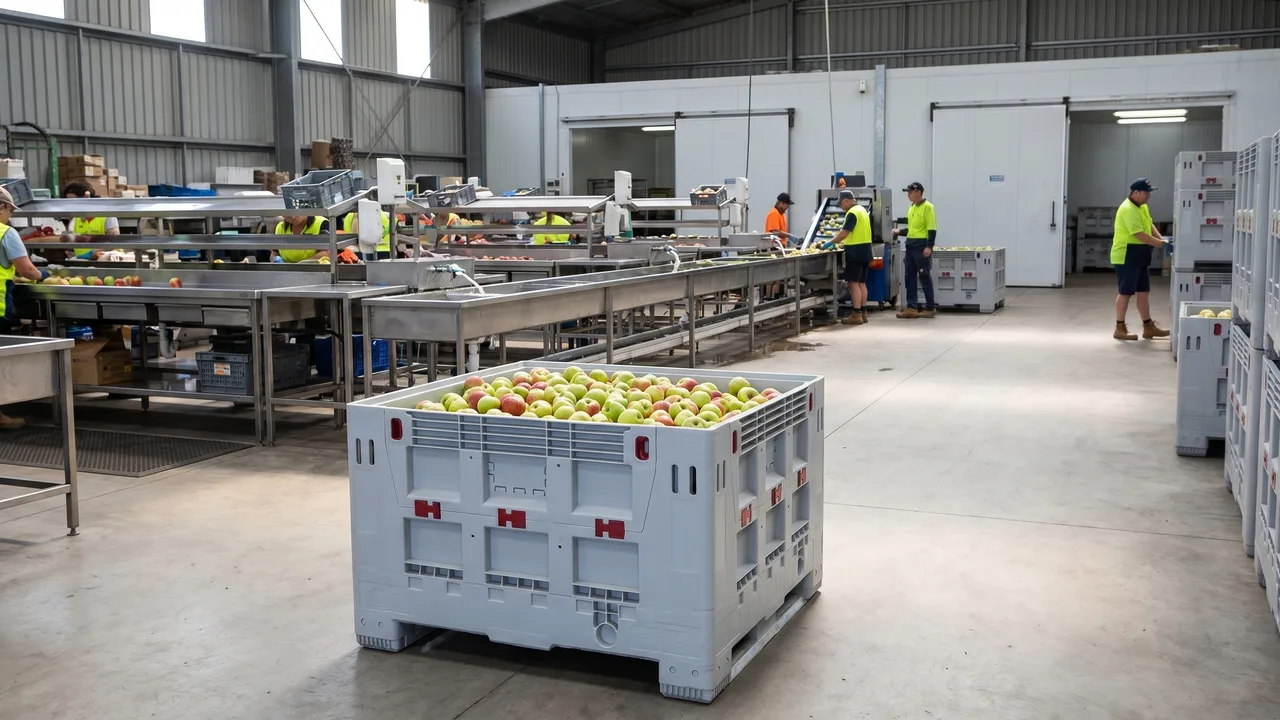
The operator
This case looks at a pharmaceutical logistics operator running active put-away and distribution for regulated healthcare stock. In a pharma DC, two things matter that don't always come together in one container: the unit has to go straight into beam racking for high-density storage, and — because empties cost money to move and store — it ideally collapses for the return leg. Most rigid IBCs give you one or the other.
The problem with the old handling
The operator's existing bulk containers were non-folding. That meant every empty took a full container's worth of space on the return truck and in the yard, and storage footprint in the DC was being consumed by bins that couldn't be flattened between cycles. They needed a container that was genuinely rackable — rated for beam storage, not just floor stacking — stackable when erected for active put-away, and collapsible for the empty leg, all while staying clean enough for a pharmaceutical environment.
Why this product
They chose the BPB-H121097FS Folding Solid Bulk Container, a solid double-wall collapsible IBC measuring 1200 × 1000 × 975 mm externally, moulded from PP with an 840 L capacity. Crucially, it carries a genuine racking rating of 600 kg — so loads kept to that figure go directly into beam storage — alongside a 3300 kg static and 1300 kg dynamic rating for stacked put-away and forklift work. The double-wall solid construction gives a clean, robust body suited to controlled storage, and the unit is both rackable and stackable when erected.
The folding action closed the loop: the container collapses to a folded height of 345 mm on its 8-feet base, so empties return flat rather than full-height. With 4-way forklift entry it handled cleanly in active put-away. The MOQ of 168 reflected a fleet-scale rollout across the operator's network.
The double-wall build matters in a regulated setting beyond just strength. A solid, smooth-walled PP container presents a clean, wipeable surface that suits the documentation and hygiene expectations of pharmaceutical handling far better than timber or open-mesh alternatives, and the rigid double skin holds its shape through repeated rack-in, rack-out cycles rather than bowing under stacked load. For stock that has to be put away, picked and returned many times over, that dimensional stability is part of what keeps the racking interface predictable shift after shift.
How the rollout went
On the standard 1200 × 1000 ISO footprint, the container went into the operator's existing beam racking and handling without re-engineering. The discipline that made it work — familiar to anyone racking plastic IBCs — was loading to the published 600 kg racking figure rather than the much higher static headline, which is the number that keeps beam storage within rating. Once that rule was set, the bins moved between rack, stack and collapsed-return states as a matter of routine.
The estimated result
The combination is the point. Because the unit is rack-ready, it earns its keep in dense beam storage; because it folds to 345 mm, the empty leg and idle-storage footprint shrink dramatically. We estimate that running this rackable, stackable, folding container in place of rigid non-folding boxes cut the operator's storage footprint and empty-return freight by an estimated 20–30%. As a durable reusable, it also displaces single-trip packaging across its service life. These are estimates grounded in the container's racking and fold specifications rather than a guaranteed dollar figure — but for a pharma 3PL juggling put-away density against empty-handling cost, a bin that does both removes a genuine trade-off.