
How a South Australian onion exporter cut coolroom shrink and empty-return freight with a lidded, folding vented bin
A South Australian (Riverland/Mallee) onion exporter.

The operator
This is a mid-sized onion grower-packer based in South Australia's onion belt, supplying both the domestic supermarket trade and an export programme into South-East Asia. Through the back half of the season they cure, hold and pack brown and red onions out of a single coolroom, and every pallet position in that room is fought over. They asked us to look at their bulk-handling because two costs kept creeping up: product written off in store, and the freight bill on empty bins moving back from their export consolidator.
The problem with the old handling
Their bulk onions were curing and being held in solid-walled timber bins. Two things went wrong with that setup. First, solid walls trap respiration heat and condensation in the centre of a deep bulb mass, so the middle of each bin sweated and a slice of every stored tonne went soft before it could be packed. Second, the bins could not be covered cleanly, so top layers picked up dust and the units could not be stacked tidily without crushing the crop below. On the logistics side, rigid bins came back from the consolidator at full height, occupying a full pallet footprint each whether they were carrying anything or not.
Why this product
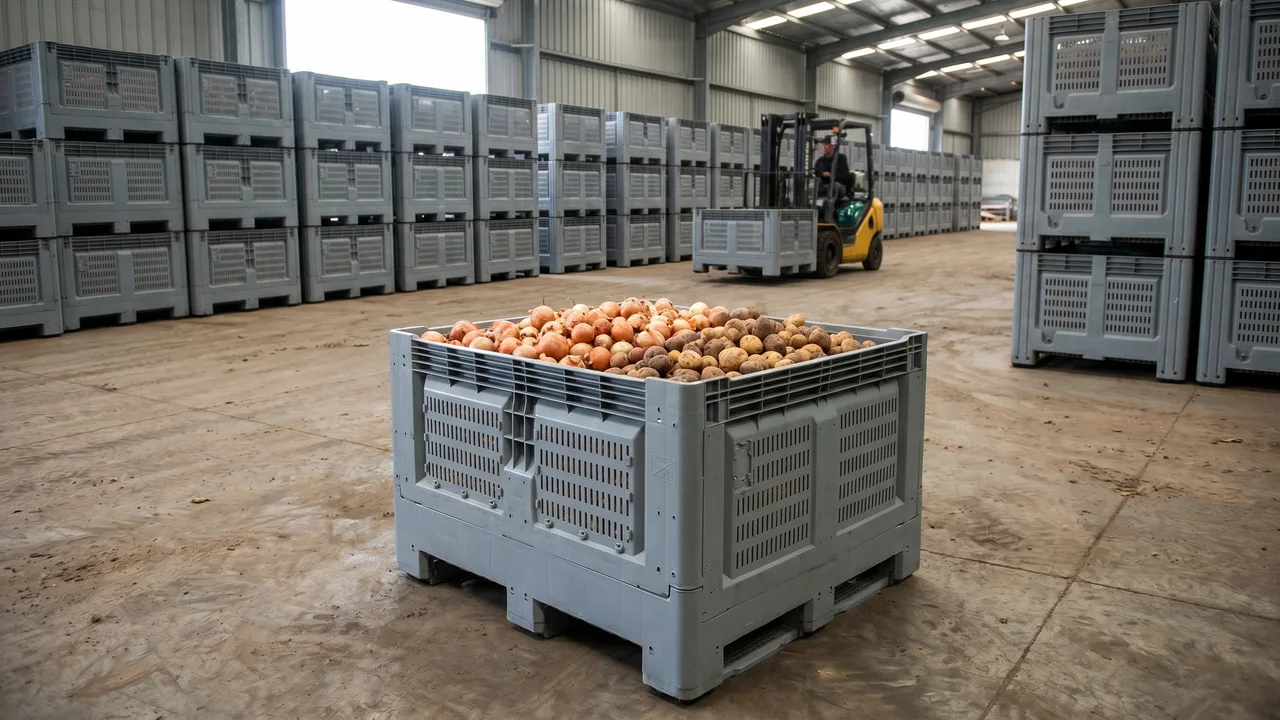
They standardised on the Folding Vented Pallet Box with Lid (BPB-K1165VL): an Australian-Standard footprint of 1162 x 1162 mm, 780 mm tall, with a 750 L body moulded from food-grade HDPE. Three things made it the right call for a curing-and-export operation. The full-height venting lets curing and respiration heat move out of the bulb mass instead of pooling, which is the single biggest lever on stored-onion shrink. The matching lid keeps the top layers clean and lets units stack square in the coolroom without bruising the crop underneath, which matters when you are holding onions for weeks at a time. And because it folds to a 280 mm collapsed height, the empties ship back at roughly a quarter of their erected volume.
The numbers underwrote the decision. The box is rated to 3,000 kg static and carries a genuine 500 kg racking figure, so loaded bins can be safely stored and racked rather than only floor-stacked, and at 45 kg empty a forklift handles it on its two-skid base all day. The MOQ of 8 meant they could buy a meaningful fleet without a warehouse-filling commitment.
The rollout
They brought the bins in ahead of the main harvest and ran them first through curing, where the venting effect was obvious within the first fortnight: the centre of each bin held condition far better than the timber it replaced. The lids went on for coolroom holding and stacking, and the crew quickly settled into a rhythm of erecting bins for fill and collapsing them flat the moment they were emptied at the consolidator. Folding is a few-seconds operation per bin, so it added nothing meaningful to handling time, and the flat empties freed a large block of return-truck space immediately.
The estimated result
We frame these as estimates, not guarantees, because shrink and freight both move with season, variety and store conditions. On stored-onion shrink, even a few percentage points of reduction on a crop held for weeks recovers more value per season than the bins cost, for an exporter holding many tonnes, that alone is the headline saving. On the empty-return leg, folding to 280 mm means roughly four collapsed bins travel in the floor space of one erected box, which we estimate strips around 70-75% off the volume freighted back from the consolidator. Stacked over an HDPE service life measured in a decade-plus against timber bins typically renewed every two to three seasons, we estimate the lidded folding bin recovers its changeover cost inside a couple of seasons, then keeps returning the curing-shrink and freight savings on every cycle after that.