
A Bacchus Marsh grower standardised bulky cut lines on the deepest locking folding crate
A Bacchus Marsh brassica and root-vegetable grower with a winery side-line.

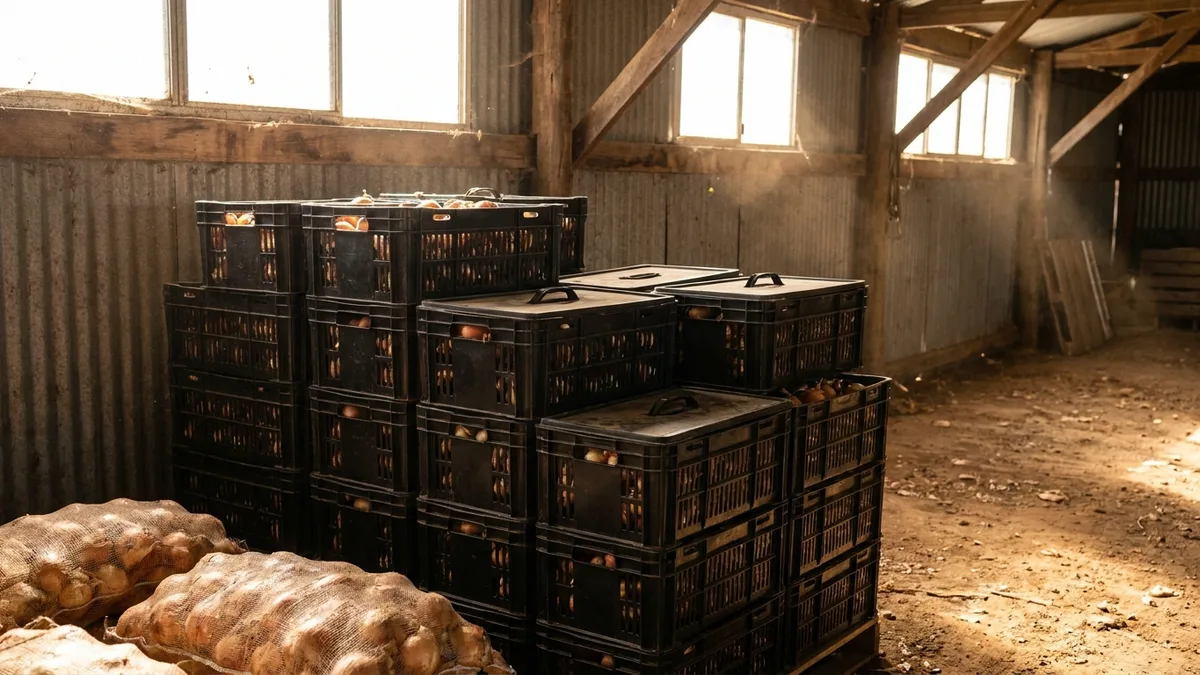
Bulky produce in boxes that did not fit
A grower at Bacchus Marsh, west of Melbourne, cut bulky brassica and root-vegetable lines and also moved fruit parcels to a small winery operation. The packing system was a muddle of box sizes. Big, leafy cut produce needs a deep crate to pack a useful load, but the grower was making do with a couple of legacy carton sizes that were either too shallow to hold a proper cut or too flimsy to stack, and a separate set of bins for the winery transfers. Mismatched packaging meant slower packing, unstable pallets, and money leaking out through single-trip cartons that were bought, filled once and thrown away. The grower wanted to standardise on one deep, sturdy, returnable crate that could handle the bulkiest cut lines and double for the winery work.
Why the deepest crate in the locking range
They standardised on the Folding Vented Plastic Crate (BPB-P5528FV), the deepest unit in the Australian-Standard locking range. At 550x367x285 mm it carries 48 L, enough depth to take a heavy cut load of cabbage, cauliflower or root veg in a single crate rather than spreading it across shallow trays. The advanced locking handles give a stable, secure stack for palletised dispatch, which fixed the unstable-pallet problem the old cartons created. Full-height venting sheds field heat from dense produce so the crop does not cook in the middle of the load, and the food-grade PP build suited the winery transfers as well as the vegetable lines. Critically for a returnable, the crate folds to just 60 mm, a near-flat collapse that lets empties stack many-to-one for the backhaul, which is where the freight saving on a returnable loop is won. One deep, lockable, foldable crate let the grower retire two legacy box sizes at once.
Rollout across cut lines and winery transfers
The grower rolled the crate out as the single standard across its bulky cut lines and its winery parcels. Pickers packed straight into the deep units in the paddock and on the line, the locking handles let pallets be built high and stable for dispatch, and at the far end the empties were folded flat for the return run. Consolidating onto one size simplified buying, storage and stacking, and removed the daily friction of matching the right box to the right line.
The estimated result
Standardising on a single returnable is estimated to have cut packaging cost by an estimated 25-30% per season versus the disposable cartons it replaced, the cartons were a recurring spend, the crate is a reusable asset. On freight, the near-flat 60 mm fold means empties travel at a fraction of erected volume, and we estimate the collapse cut empty-return freight by an estimated 70%, freeing trailer space on the leg back from the market. The grower expects to recover the changeover cost against avoided carton purchases within an estimated two to three seasons, after which the crate keeps saving on every cycle. There is also a quieter labour benefit: one consistent deep crate removed the sorting and de-nesting friction of juggling multiple box sizes. As always these are planning estimates rather than a guaranteed outcome, the realised saving depends on dispatch volumes, crate service life and how disciplined the returnable loop is. For a grower moving genuinely bulky produce, the deepest crate in the range that still folds flat hit both targets at once.