
How a Riverina citrus packer stopped carton crush with a 28L folding vented crate
A Riverina (NSW) mandarin and citrus packer on an ISO returnable-packaging loop.

The operation
A Riverina citrus packer supplying two retail distribution centres on an ISO returnable-packaging loop, moving mandarins and other citrus from the packing line into the cold chain and out to retail. Their throughput is high and seasonal, and like most fresh-produce packers their packaging was quietly costing them twice — once to buy it, once to deal with it at the far end.
The problem with the old handling
The crop was going out in single-trip cartons, and the cartons could not take the cold chain. Stacked three-high in the coolroom, the bottom boxes crushed under the weight and the chill, slumping the load and bruising fruit. Cartons also block airflow, so the pre-cooling air the packer pushed through a palletised load never properly reached the fruit in the middle — mandarins that should have been pulled down to temperature quickly held their field heat. And every carton was a disposable: bought new each run, then landfilled at the DC, which the retailer was increasingly unhappy about.
Why this product
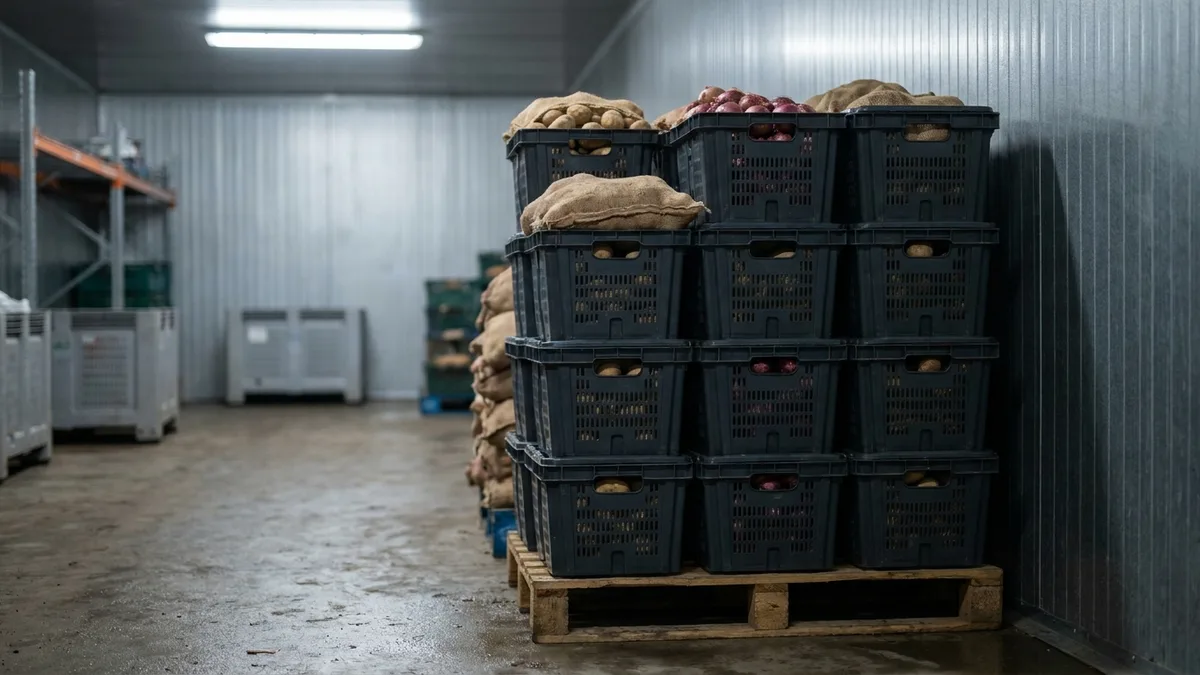
They moved to the 28-litre folding vented crate, built specifically for ISO return-packaging systems. The dimensions suit the job: 600×400×143 mm external, 570×370×133 mm internal, a standard 600×400 retail module that cross-stacks securely so a palletised load locks together instead of slumping. The vented walls let pre-cooling air move straight through the load, so the fruit holds temperature through the cold chain rather than cooking in a sealed box. The PP crate cross-stacks and stacks rigidly when erected, then — the part that fixes the reverse-logistics cost — folds flat for the empty backhaul, taking roughly a fifth of the truck space an erected crate needs. At just 1.52 kg each they are light to handle on a fast line, and as a returnable they cycle many times instead of being thrown away after one trip.
How the rollout went
Because the crate is a standard ISO returnable that the two DCs already handled, it dropped into the existing loop cleanly. The cross-stacking held the pallet square three-high and higher without the carton collapse they were used to, and the vented walls visibly helped the pre-cool. On the return leg the crew folds the empties flat and ships them back at a fraction of erected volume, then re-erects them for the next run. The single-use carton purchasing simply stopped on the lines that switched.
The estimated result
The packer estimates the move off single-trip cartons cut their annual packaging outlay by an estimated 30–40% per season, as the cost of repeatedly buying disposable boxes is replaced by a reusable crate amortised over an assumed multi-year service life. On the empty-return leg, folding the crates to roughly a fifth of erected volume is estimated to cut the backhaul freight on empties by around two-thirds, freeing trailer space that now carries saleable fruit instead of fresh air. These are estimates — the exact figures move with crop volume, trip frequency and how long each crate survives in service — but the direction is clear and the mechanism is concrete: no more crushed bottom layers, better in-load cooling, no landfill bill at the DC, and a flat-folding empty that stops the return run from wasting a whole truck on air.