
How a recycling processor ended torn-bag spillage with a tall solid Euro bulk container
A south-east Queensland plastics recycling and reprocessing operation.

The operation
This is a plastics reprocessor in south-east Queensland that buys in post-industrial and post-consumer scrap, shreds and washes it, and bulks up the clean regrind for sale to manufacturers. The whole margin in that business sits in the gap between what they pay for dirty scrap and what they sell clean regrind for, so material that ends up on the floor is money walking out the door. They run a Euro-pallet (1200×800) handling system end to end, which constrained what containers they could realistically adopt.
The problem with the old handling
Finished regrind was going into flexible bulk bags (FIBCs). On paper that is cheap, but in practice the bags were a constant headache. They tore on shredder housings and pallet corners, they slumped and bulged so they could not be stacked reliably, and a split bag meant a shift spent sweeping up saleable regrind and re-bagging it. Every torn bag was a triple cost: lost material, lost labour, and a single-use bag thrown away. They also got poor cube out of a slumping bag — it never held its shape, so every move carried less than it should.
Why this product
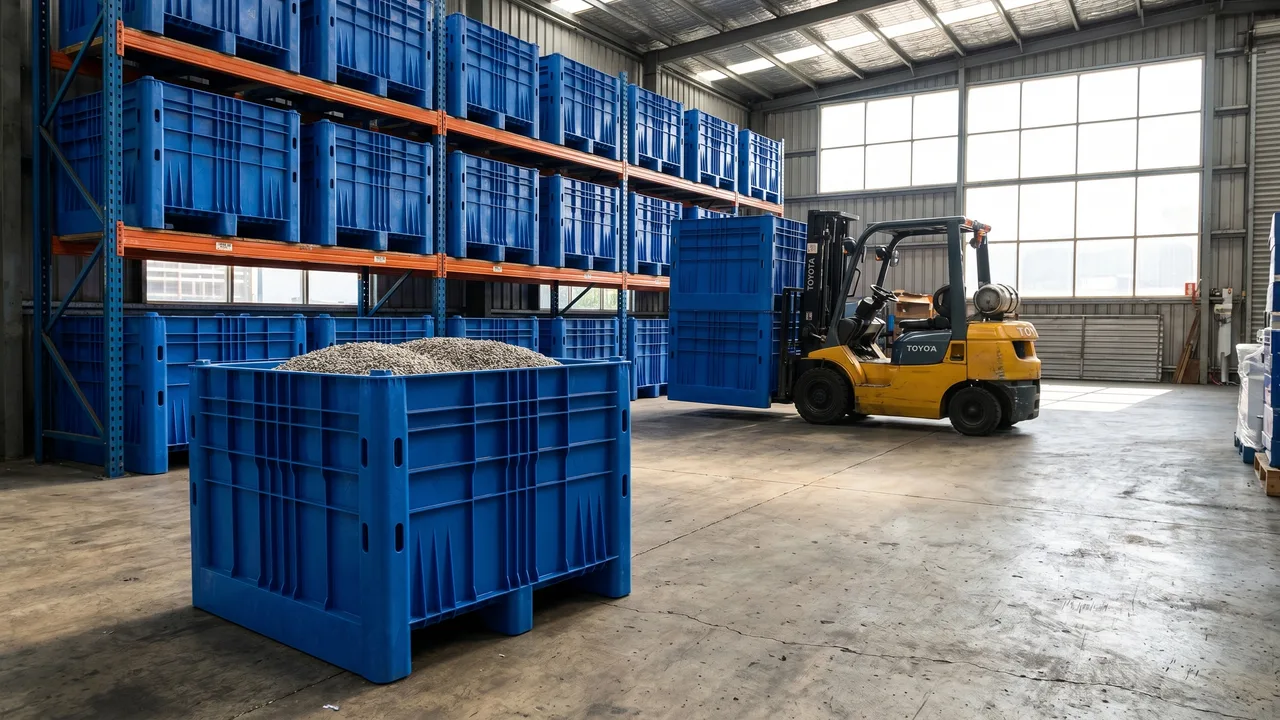
They moved to the tall solid Euro bulk container. The deciding factor was height: at 1200×800×1140 mm external with a 1120×720×1000 mm internal cavity, it delivers a full 800 litres on the same Euro footprint they were already handling, while still tunnelling a 4-way forklift from any side. More payload per floor position means fewer container moves to clear the same tonnage of regrind. The rigid, solid HDPE and PP walls were the real fix, though — there is nothing to tear, nothing to slump, and nothing to sweep up. The 4,000 kg static rating lets them stack the boxes in the warehouse rather than leaving FIBCs sitting in a single layer because they cannot be trusted on top of one another, and the 700 kg dynamic rating comfortably covers a full box of dense regrind on the forks. It sits on 2 skids, 3 skids or 4 feet depending on how they want it handled. As a durable reusable it cycles indefinitely instead of being binned after one fill.
How the rollout went
The changeover was straightforward because the footprint never changed — the boxes dropped straight into existing racking, transport and forklift routines. At 46 kg empty the container is easy enough to reposition, and the tall profile took a little getting used to at the fill point, but the crew adapted within a couple of runs once they saw they could fill higher without the load collapsing. The spillage that used to follow a torn bag essentially stopped, and the warehouse went from a sea of single-layer bags to neat stacked columns.
The estimated result
The processor estimates that the combination of higher payload per footprint — meaning fewer forklift movements to shift the same volume — and the elimination of torn-bag material loss and re-bagging labour cut their handling-and-shrink cost by an estimated 20–30%. That figure is deliberately framed as an estimate: the exact saving depends on how dense a given regrind stream is and how often bags were failing before, both of which vary by feedstock. What is not in doubt is that the single-use bag spend disappeared entirely, replaced by a reusable shell that keeps clean regrind clean and stackable. For a business whose entire profit is the cleanliness and yield of its material, taking spillage and double-handling out of the loop was the obvious win, and the taller-than-standard box let them do it without giving up a single Euro pallet position.