
A consumer-goods 3PL picks a lightweight high-cube folding ISO container for bulky, low-weight stock
An Australian consumer-goods third-party logistics operator.

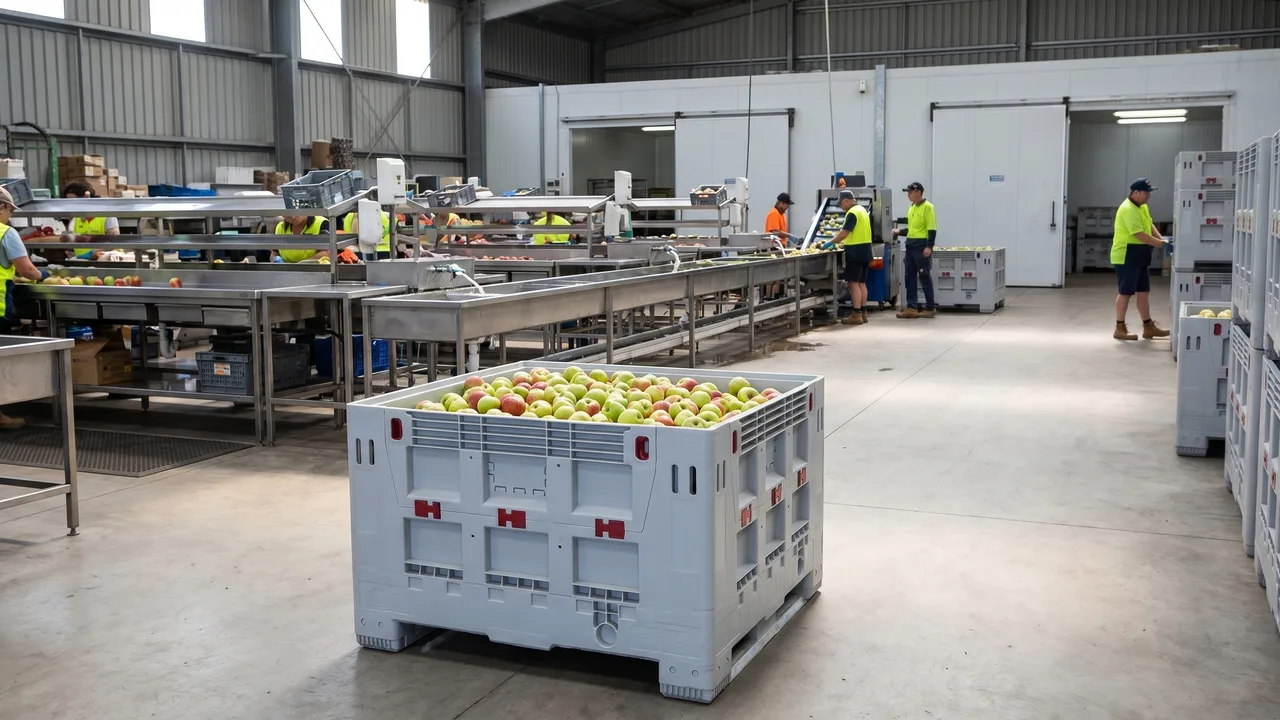
The operator
This story centres on a third-party logistics (3PL) provider handling bulky, low-density consumer goods — think homewares, packaged plastics and other voluminous, light products that fill a container long before they reach a weight limit. The 3PL operates on the ISO (1200 × 1000 mm) footprint across its racking and transport, and runs a returnable-container loop with several clients.
The problem with the old handling
For high-cube, low-weight stock, the wrong container is expensive in two directions. Heavy-walled IBCs were overkill — the goods never came close to the load ratings, so the bins were just hauling their own dead weight around — and single-trip cardboard was both a recurring cost and a poor protector of bulky items in a busy DC. The operator wanted maximum internal volume to capture voluminous stock, the lightest possible tare to keep freight weight down, and a container that collapsed for the empty return so it wasn't paying to ship air back to clients.
Why this product
They adopted the BPB-V121010-18 Folding Solid ISO Bulk Container with lid: a lightweight collapsible IBC measuring 1200 × 1000 × 1000 mm externally, moulded from PP, with an 850 L capacity and a 1200 kg static rating. The generous 850 L body was the draw — it swallows bulky, low-density goods that a shallower box would leave stacked precariously above the rim — while the included lid protects the contents in transit and lets units stack cleanly when erected. The light-weight load class was a deliberate match: these goods don't need a 7-tonne bin, so the lighter PP build keeps freight weight and handling effort down.
The decisive spec was the fold. At an empty weight of 29.4 kg the unit is easy for one person to erect and collapse, and it folds to just 240 mm — one of the flattest profiles in the range — giving roughly a four-to-one collapsed-return stack. As a PP container on a 9-feet base with 4-way forklift entry, it also handled cleanly in the DC.
How the rollout went
On the standard ISO footprint, the container slotted into the 3PL's existing racking and trailer loading patterns without modification. The MOQ of 160 suited a 3PL building out a pooled returnable fleet across multiple clients, and the closed-loop model — ship full, fold flat, return, re-use — was exactly the workflow the operator already ran for other formats, so adoption was straightforward.
The estimated result
The two wins map to the two pain points. On the empty return, the roughly four-to-one collapsed ratio is the headline: we estimate the fold cuts empty-leg freight by an estimated 70% against shipping rigid boxes back at full height. On packaging, running the high-cube unit as a reusable in a closed loop displaces recurring single-trip cardboard entirely, ending that cost line and the disposal that went with it. Because the 850 L body captures more bulky stock per pick than a shorter box, the operator also moves the same volume in fewer container handlings. All figures here are planning estimates tied to the container's dimensions and fold ratio rather than a quoted saving — but for low-density freight, a high-cube, low-tare, collapsible bin is close to the ideal tool.