
How a consumer-goods 3PL killed empty-leg freight on bulky stock with a high-cube, low-tare folding jumbo bin
An Australian consumer-goods third-party logistics (3PL) operator.

The operator
This is a third-party logistics operator handling bulky, low-density consumer goods, think homewares, packaging, foam and light plastic product, on a jumbo (1200 x 1200) footprint. The defining feature of their freight is that it cubes out long before it weighs out: a container fills with volume, not tonnage. They came to us because the boxes they were using were fighting that reality instead of working with it, on both the loaded and the empty leg.
The problem with the old handling
They were moving this voluminous stock in rigid boxes, and for low-density goods that is doubly wasteful. A heavy rigid box adds tare weight the freight has to carry for no benefit, since the load itself is light. Worse, on the return leg a rigid jumbo box comes back at full height, a metre of empty box per pallet position, so they were paying premium cube to freight air back to the depot every single run. For an operation whose whole problem is cube, shipping empty cube around was exactly the wrong failure mode.
Why this product
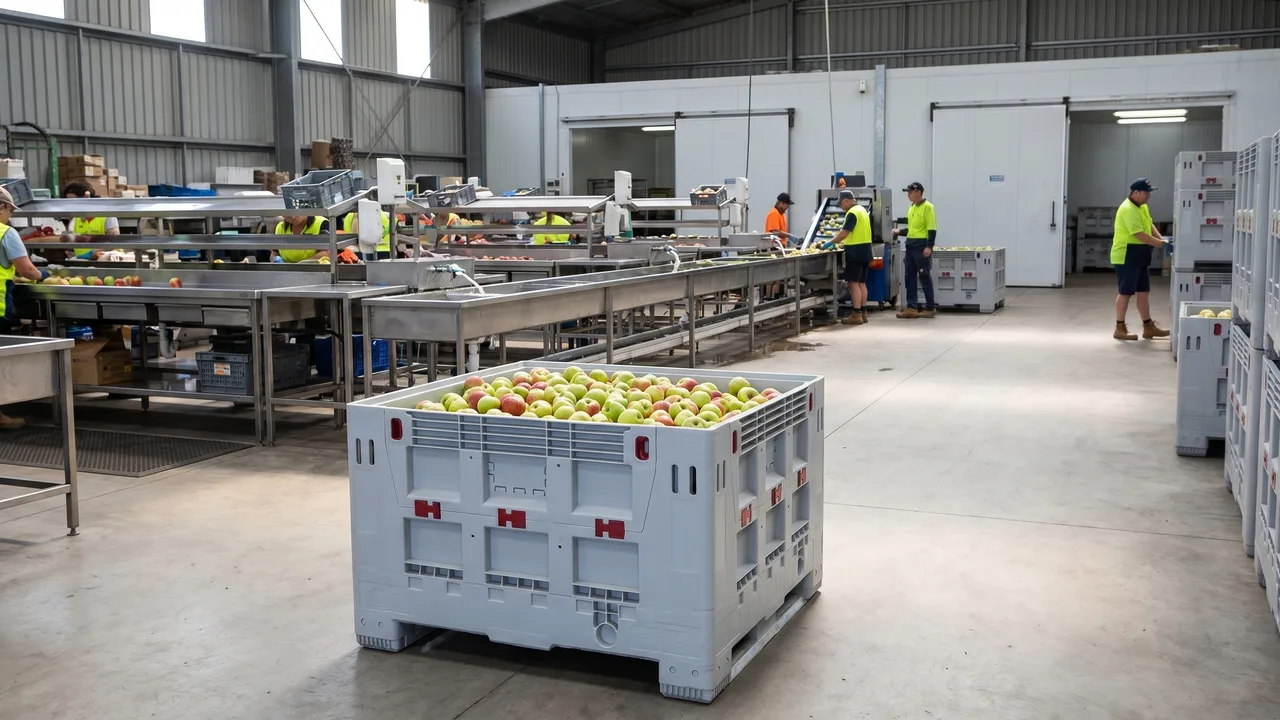
They adopted the lightweight folding solid Jumbo Bulk Container with lid (BPB-V121210-18): a 1200 x 1200 x 1000 mm container with a big 1,070 L body, moulded from PP, with 4-way forklift entry, a matching lid, and, the two specs that matter most here, a tare of just 32 kg and a folded height of only 240 mm, the flattest in the range. Every part of that suits bulky-light freight. The 1,070 L body swallows voluminous stock so each unit does real work; the low 32 kg PP tare keeps freight weight down on a load that is already light; the lid protects the goods in transit; and the 240 mm fold means empties stack roughly four-to-one for the return. It is rated to 1,400 kg static and 700 kg dynamic, ample for low-density consumer goods, and the 9-foot base gives clean forklift access. The 140-unit MOQ suited a fleet sized to a genuine closed loop.
The rollout
They ran the bins on a closed loop between their depot and a regular client. Erected and lidded, the jumbo bins captured far more of each light load per footprint than the operation expected, and the low tare was felt directly in the freight weight. The transformation was on the return: the bins dismantle and fold to a 240 mm flat, so the truck that used to come back carrying a wall of empty boxes now carried them stacked four-high in the same space. Crews took to the fold quickly, and the lids meant the same units could be used for protected, covered transit rather than needing a separate covered line.
The estimated result
These figures are estimates and move with lane length and fill discipline. The dominant lever is the fold to 240 mm: roughly four empties travel in the space of one erected box, which we estimate removes on the order of 70% of the empty-leg freight versus rigid boxes. The 32 kg tare trims weight cost on the loaded leg, and running a durable reusable in place of single-trip cardboard ends recurring packaging spend on a bulky product that chews through a lot of it. For a closed loop of light, voluminous goods, we estimate the high-cube, low-tare folding bin recovers its outlay inside about a year, then keeps saving on every return cycle.