
Cool-room bin stacking: airflow, bin feet and how high is safe

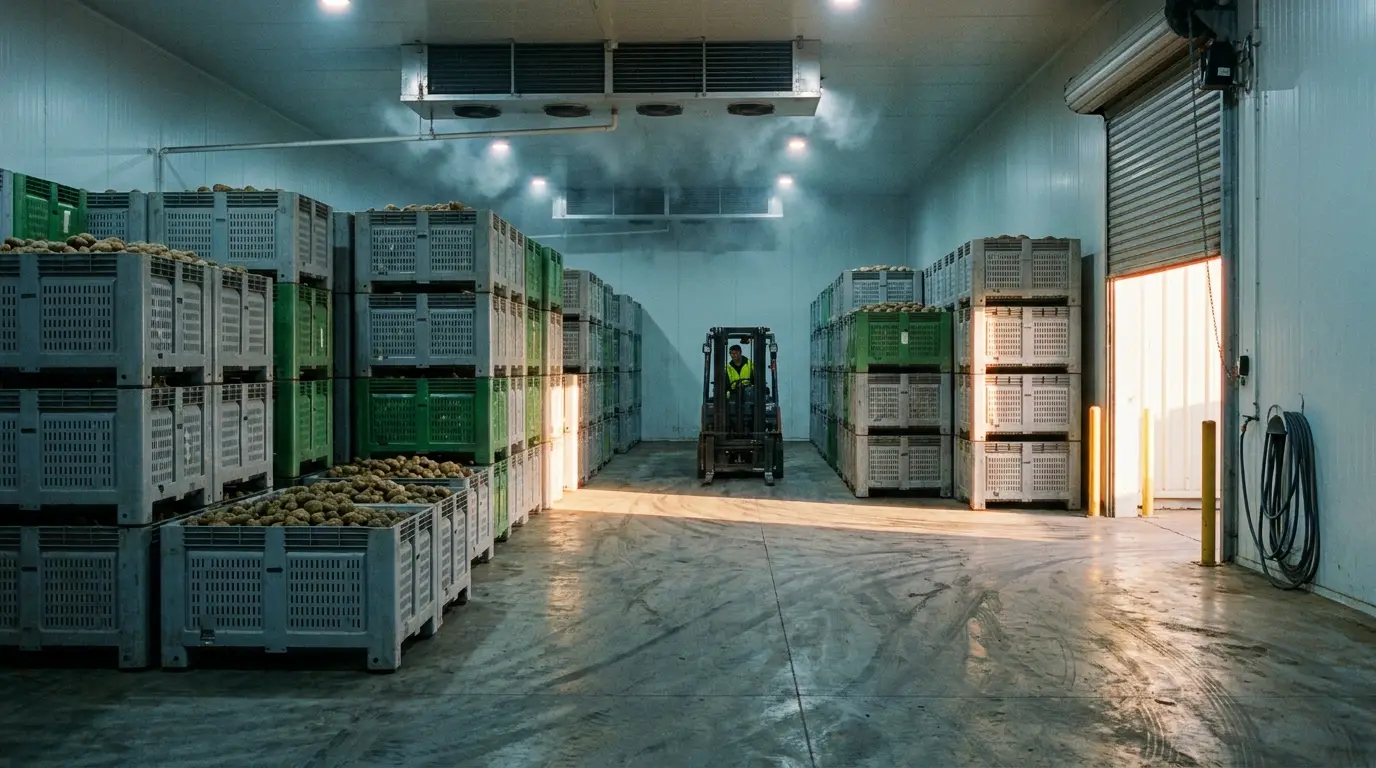
Ask how high you can stack bulk bins in a cool room and you will usually get an answer about strength. That is the wrong end of the problem. On almost every Australian cold store we see, the static rating of the bin is nowhere near the binding constraint - the ceiling, the evaporator throw and the flatness of the floor run out long before the bin does. What genuinely decides whether the stack works is whether cold air can get through it, and that is set by vent alignment, bin feet and the gaps you leave, not by the number on the spec sheet.
How high can you safely stack produce bins in a cool room?
Work down from the room, then check the bin. Start with clear height under the evaporators, subtract the space the coils need to throw air across the store without blasting the top layer, and you have your practical column height. Divide by bin height and you have your maximum stack. Only then do you check the arithmetic in the other direction: does the weight of that column sit comfortably inside the bottom bin's rated static (stacking) figure? In our worked table below, on four real Australian-standard bins, the answer is almost always yes with room to spare.
That sequence matters because it puts attention where the failures actually happen. A stack does not usually fail by crushing a bin. It fails by leaning, because the floor has a fall in it or a foot is sitting on a lump of dirt; by toppling during a lift, because the column was never square; or, most commonly and most expensively, it does not fail at all and simply fails to cool - and the loss shows up weeks later as sprouting, shrivel or rot in the bins that came out of the middle.
Why airflow decides the stack before strength does
Harvested produce is still alive. It respires, and respiration generates heat inside the bin, on top of the field heat it arrived with. Cooling is a race to pull that heat out before it costs storage life, and the penalty for losing the race is steep: the rate of deterioration of perishable produce rises roughly two- to three-fold for every 10 °C of temperature (UC Davis Postharvest Technology Center). A core of bins sitting 8 °C above room temperature for three days is not a minor inefficiency; it is a measurable slice of the shelf life you are being paid for.
The physics of a stack is unforgiving here. Air, like water, takes the path of least resistance, and a block of bins is a high-resistance path with a low-resistance bypass running right around it. Refrigerated air will happily circle the outside of a stack, register a beautiful room temperature on the wall probe, and never enter the load. Vents are necessary but not sufficient: they only work if a bin's vent openings line up with the bin above and below, and if there is a pressure difference across the load driving air in one face and out the other.
This is the practical test we give operators: if you cannot describe the route air takes into the middle of your stack and out again, there isn't one. A stack should be treated as a duct that you have designed, not as a pile you have made and hoped about.
"The number growers ask me for is stack height. The number that decides their season is vent alignment. I have walked into stores where the bins were perfect, the room was holding 3 °C, and the middle of the block was still carrying field heat a week after intake - because every column was stacked a hand-width out of square and none of the vents lined up."
- John Meir, Sales Leader, 20+ years in plastic materials handling
Room cooling vs forced-air: the stack has a different job
These two methods want opposite layouts, and mixing them up is the single most common cool-room stacking mistake we see. In room cooling, the store's fans circulate cold air and the load cools by whatever air finds its way in. Your job is to give it as much surface access as possible: leave gaps between columns, keep stacks off the walls, keep the floor return clear and keep the columns narrow enough that the centre is never far from a cooled face. Room cooling is slow by nature, which is fine for produce that is already cold, or for long-term holding after the initial pull-down.
In forced-air cooling, you use a fan to create a pressure difference across the load so air is pulled through the vents instead of past them. That means doing the reverse of everything above: rows butted tightly together, ends and tops sealed with a tarp or baffle, and every bypass path deliberately blocked so the fan has nowhere else to go. Because the air actually contacts the produce, forced-air pulls field heat out of a stack far faster than room cooling does (UC Davis Postharvest Technology Center). If your intake window is short and your crop arrives warm, this is the method that saves the season - and it demands vented bins with aligned openings to work at all.
The bin choice follows from this directly. Room-cooled long-term storage can tolerate a modest vent area. Forced-air pull-down cannot: it needs generous, aligned, unobstructed venting on the faces the air enters and leaves, which is why the crop-specific vent pattern matters as much as the bin's volume. We work through which crops need which in why potatoes and onions need vented bins and curing and storing onions.
The stack-height maths on real bins (worked table)
Here is the calculation done properly on four real Australian-standard bins from our range. The method: take the bin's volume, apply an assumed produce fill weight, add the bin's own tare, and see how many of those loaded bins the bottom bin's rated static (stacking) figure will carry. We have assumed a fill of 600 kg per cubic metre, which is in the range of a dense root crop; substitute your own weighbridge figure, because the point is the method, not our assumption.
| Bin | Volume | Static (stacking) rating | Assumed fill + tare = gross | Loaded bins the bottom bin carries | Height of that column |
|---|---|---|---|---|---|
| BPB-D1120V78 vented bulk container (1120×1120×780) | 700 L | 4,000 kg | 420 + 39.5 = ~460 kg | 8 above (9 high) | ~7.0 m |
| BPB-E1165FV folding vented pallet box (1162×1162×785) | 750 L | 3,000 kg | 450 + 53 = ~503 kg | 5 above (6 high) | ~4.7 m |
| BPB-K1165HV low folding vented pallet box (1162×1162×560) | 470 L | 2,800 kg | 282 + 44 = ~326 kg | 8 above (9 high) | ~5.0 m |
| BPB-1311V giant vented pallet box (1300×1150×1250) | 1,400 L | 7,000 kg | 840 + 68.5 = ~909 kg | 7 above (8 high) | ~10.0 m |
Read the last two columns together and the conclusion is blunt: every one of these bins out-stacks the building. A 7-metre column of vented bulk bins is not a cool-room layout, it is a silo. Unless you are running a very tall store with racking, the static rating is not your constraint and specifying a heavier bin "to stack higher" buys you nothing you can use.
Two honest caveats on that table. First, static ratings are established with the load evenly distributed on a flat, even surface. A stack that is out of square, sitting on a floor with a fall, or resting on grit under one foot no longer matches those conditions, so treat the rated figure as a ceiling with working margin under it, not a target. Second, the fill weights are illustrative planning figures to show the method; your crop, your moisture content and your fill practice will move them. The relationships hold; the absolute numbers are yours to measure. For crop-by-crop capacities, see our bin sizing chart and the produce megabin guide.
Bin feet, floors and what happens under the bottom bin
The space under a bin is not wasted space, it is a plenum. Foot design decides whether air can enter the base of the load and whether a forklift can approach from two directions or four. A three-runner base gives long, continuous air channels in one axis and two-way entry; a nine-leg base gives four-way entry and a cross-flow path, at the cost of a slightly less continuous channel. Neither is universally right - match it to how your forklifts approach the stack and which face you want air entering.
Underneath that, the floor is doing structural work that nobody specs. A loaded column concentrates several tonnes onto a handful of feet, and a cool-room slab that is 20 mm out of level over a bin footprint tilts the whole column. Every millimetre of lean at the base is multiplied up the stack. Grit, produce debris and ice under a single foot do the same thing faster. Sweep the lanes, keep the drains working, and never stack a tall column onto a surface you have not looked at - the storage and stacking duties in Safe Work Australia's guidance exist precisely because leaning stacks are how people get hurt.
Where bins go into racking rather than free-standing columns, the rules change again: the racking figure governs, the load has to be uniform across the beams, and Australian racking design and loading sits under AS 4084:2023. The mechanics of the three load numbers, and why the racking figure is usually the lowest, are worked through in pallet load ratings: static vs dynamic vs racking.
Vented, solid or folding: which bin stacks best cold?
For cold storage of respiring produce, vented is the default and solid is the exception. Vented walls and base are what make both cooling methods possible; a solid bin in a cool room is an insulated box you are trying to chill from the outside. Solid bins earn their place where the load is wet, liquid, fine, or needs protecting from air movement and moisture loss - not where the job is pulling heat out.
Folding bins add a second consideration that most stacking guides ignore: they have to stack loaded and collapse empty, and the folding mechanism is part of the load path. The trade is worth it when your empties travel - a bin folding to under 300 mm returns several times more units per truck than a fixed bin of the same footprint, which is the whole economics of a return leg. If your bins never leave the site, a fixed bin gives you a simpler load path for the same money. We compare the two in collapsible vs fixed bulk bins.
Whatever you choose, keep the fleet consistent. A cool room stacked with three different bin heights and two footprints cannot be laid out for airflow, because no two columns behave the same way. Standardising the bin is what makes a repeatable stacking pattern possible in the first place.
Laying out a cool room so every bin actually cools
Six checks turn a pile into a designed stack. One: know your cooling method, because room cooling wants gaps and forced-air wants seals. Two: stack square, so vent openings align column to column and the load path runs post-to-post. Three: keep the top of the stack clear of the evaporator discharge so you are not freezing the top layer while starving the middle. Four: leave the wall and floor return clear so air can complete a circuit. Five: keep the slab clean and level under every foot. Six: probe the middle of the block, not the room - the room temperature tells you what the fans are doing, not what the produce is doing.
Get those right and the bins do the rest. The bin spec that supports it is unglamorous: a consistent footprint, real vent area on the faces the air uses, a foot design matched to your forklift approach, and a published static rating with margin over your tallest realistic column. Browse the vented range in IBCs and bulk containers, see the whole fresh-produce line-up on our fresh produce hub or the full catalogue, or send your crop, throughput, cooling method and store dimensions for a spec-backed quote.
Common questions
How high can you stack produce bins in a cool room?
In practice the ceiling, not the bin, sets the limit. A loaded plastic bulk bin's static rating will usually carry five to eight loaded bins above it, which is a column four to seven metres tall, far more than a typical cool room's clear height under the evaporators. Work down from the room instead: leave clear space under the coils for the air throw, keep the top of the stack out of the discharge stream, and make sure the stack stays square on a flat floor. Then confirm the column weight sits inside the bottom bin's rated static (stacking) figure.
Why do the bins in the middle of a stack stay warm?
Because air took the easy path. In a room-cooled store the fans move air around the block of bins, not through it, so the outer faces cool quickly while the core of the stack holds field heat for days. Vented bins only help if the vents line up column to column and there is a route for air to enter one side and leave the other. If you need the centre cold fast, you need forced-air cooling, where the bypass paths are blocked and air is drawn through the vents.
Do vented bins need gaps between the stacks?
For room cooling, yes. Leave a gap between columns, off the walls and clear of the floor return so air can circulate on all faces. For forced-air cooling it is the reverse: you butt the rows tightly and seal the ends with a tarp or baffle so the fan has no bypass and must pull air through the vent openings. The two methods want opposite layouts, which is why copying someone else's stacking pattern without knowing their cooling method usually disappoints.
Does stacking bins higher damage the produce at the bottom?
Not if the bins are doing their job. A properly rated bulk bin transfers the column load through its corner posts and feet to the bin below, not through the produce inside it, which is exactly why bulk bins have a published static (stacking) rating and open-top field crates do not stack loaded. Damage shows up when the stack is out of square, sitting on an uneven floor, or when a bin outside its rating is put at the bottom of a tall column.
Is a vented bin always better than a solid bin in cold storage?
For crops that need to lose field heat and respiration heat, yes, venting is what makes cooling possible. Solid bins suit produce that needs protection from air movement and moisture loss, or wet and liquid loads. The deciding question is whether you are trying to move air through the load or keep it out. We work the comparison through in our guide to vented vs solid bulk bins.
What is the static rating on a bulk bin and does it apply when stacked?
The static figure is the load the bin will carry at rest, which for a stacked bulk bin is the weight of the loaded bins above it. It is measured on a flat, even surface with the load evenly distributed. A stack that is out of square, sitting on a rutted or sloping floor, or resting on debris under one foot, no longer matches those test conditions, so treat the rated figure as a ceiling and keep working margin under it.
Sources: temperature and rate of deterioration of perishables, and the relative speed of forced-air versus room cooling, University of California Davis Postharvest Technology Center (postharvest.ucdavis.edu); storage and stacking safety duties, Safe Work Australia (safeworkaustralia.gov.au); pallet racking design and loading, AS 4084:2023 Steel storage racking (Standards Australia). Bin volumes, tare weights, dimensions and static, dynamic and racking ratings are the manufacturer-tested figures for the specific models referenced and vary with load distribution, support conditions and temperature. The fill weights, column counts and stack heights in the worked table are planning estimates built on a stated assumed fill density to demonstrate the method, not published stacking limits or a recommendation for your store; confirm against your own measured fill weights, your floor and your clear height. Not a quote.