
Plastic pallets in the Pilbara: UV, heat & creep on remote sites

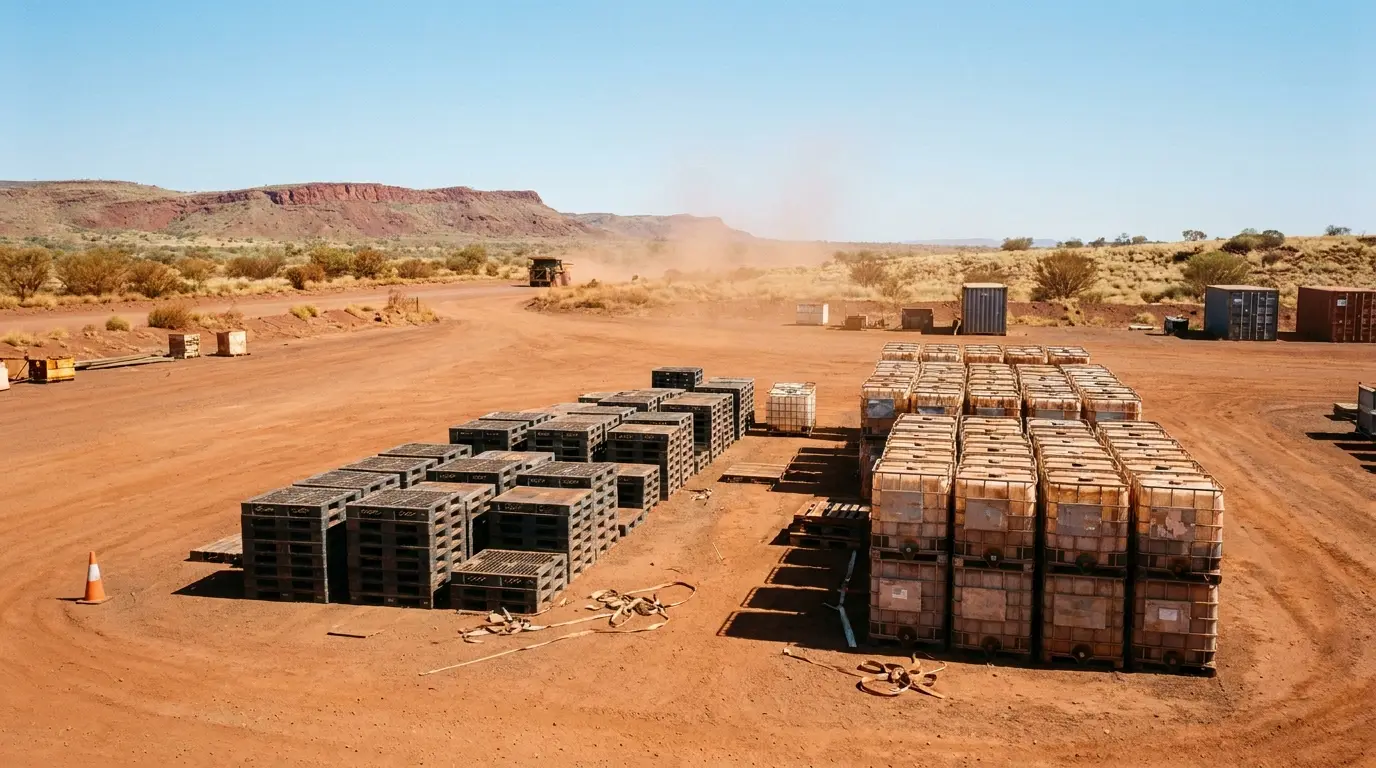
Buyers on remote sites usually ask the wrong question about plastic pallets. It isn't will it melt, because it won't. It's whether the pallet will still be tough in five years of relentless sun, and whether a deck carrying a sustained load in a 45 °C shed will slowly sag its way out of a rack. Those are two different failure modes, UV embrittlement and thermal creep, and they are the two things a hot-climate spec has to answer.
Will plastic pallets survive Pilbara heat and UV?
Yes, provided the pallet is genuinely UV-stabilised HDPE and you carry rack loads with margin. Heat and sunlight on a remote Australian site do not destroy a good plastic pallet; they punish a cheap one. The failure you actually see in a Pilbara or Bowen Basin laydown yard is a pallet that has quietly lost its impact resistance to years of UV and then splits on a knock it used to absorb, or a deck that has crept and lost shape under a heavy load left standing in a hot shed for months.
That makes this a specification problem rather than a material problem. The polymer is fine for the climate. What varies enormously between suppliers is the UV package (stabiliser and pigmentation), the wall thickness and rib structure that resist deflection, and how honestly the racking figure is quoted. Two pallets with identical headline numbers can diverge completely after three summers outdoors, and the spec sheet won't tell you which is which unless you ask directly.
How hot does a remote Australian site actually get?
Hot enough that it deserves to be a design input, not a footnote. On 13 January 2022, Onslow in the Pilbara reached 50.7 °C, equalling Australia's hottest recorded temperature, set 62 years earlier at Oodnadatta in South Australia on 2 January 1960 (Bureau of Meteorology). Mardie and Roebourne also passed 50 °C the same day. Those are air temperatures in the shade at a screened weather station, which matters: the surface temperature of a dark object sitting in full sun on a red-dirt hardstand runs well above the air around it.
The other half of the picture is duration, and that is where the Pilbara is genuinely exceptional. Marble Bar holds the Australian record for the longest run of days at or above 37.8 °C (100 °F): 160 consecutive days, from 31 October 1923 to 7 April 1924 (Bureau of Meteorology). A single 50 °C afternoon is a stress test. Five months of 38 °C-plus is a service condition, and it is sustained exposure, not the peak, that drives both UV damage and creep.
What does UV actually do to a plastic pallet?
Ultraviolet light carries enough energy to break the chemical bonds in a polymer chain. In polyethylene the damage starts at the exposed surface and works inward: chains scission, the material oxidises, and the top layer becomes progressively harder, more crystalline and less able to absorb energy. Visually you see fading, chalking and a dull powdery bloom that rubs off on your hand. Structurally you get embrittlement, a loss of impact resistance that is invisible until something hits the pallet.
This is why UV failure is so often misdiagnosed as an impact failure. The pallet cracks on a tine strike and gets blamed on the forklift operator, when the real cause is that four summers of sun removed the toughness that would have absorbed the hit. The mechanical side of that story is worked through in our guide to forklift abuse and pallet durability on a mine site; the point here is that the environment sets the pallet up for it.
"The pallets that come back to me from remote sites are almost never worn out. They are sun-cooked. You can pick it up in your hands, the surface chalks off, and the plastic has gone hard and glassy instead of tough. Nothing looks wrong until the day a fork nudges it and it splits like a biscuit. If a supplier can't tell you what the UV package is, you are buying a three-summer pallet."
John Meir, Sales Leader, 20+ years in plastic handling
The defence is carbon black. It absorbs across the solar spectrum and physically shields the polymer beneath it, which is why almost all long-life outdoor polyethylene is black or very dark. Australia's own pipe standards draw the same distinction: pipe-industry technical guidance for PE to AS/NZS 4130 notes that black, carbon-black-pigmented compounds are the ones suited to long-term outdoor exposure, while compounds without carbon black are not intended for extended exposure in direct sunlight (pipa.com.au). Same polymer family, same mechanism, same conclusion for a pallet that lives in a yard.
Two practical cautions. First, colour is an indicator, not a specification: a dark pallet made from poorly dispersed pigment is not automatically protected, and dispersion quality matters as much as loading. Second, shade beats chemistry. A stabilised pallet stored under a roof or a tarp between uses will comfortably outlive the same pallet parked in open sun for a decade, and that costs nothing to arrange.
| Degradation path | What's happening | Early warning signs | What actually fixes it |
|---|---|---|---|
| UV embrittlement (years) | Sunlight breaks surface polymer chains; the material oxidises and loses toughness | Fading, chalky bloom, dull glassy surface, cracks starting at corners and rib edges | UV-stabilised grade with carbon-black pigmentation; shaded or covered storage between uses |
| Thermal softening (immediate) | Polymer stiffness falls as temperature rises, so the same load deflects further right now | Noticeably more deck sag on hot afternoons than on cool mornings under the same load | Carry rack loads with margin; keep sustained loads out of uninsulated sheds where possible |
| Creep (weeks to months) | Sustained load causes slow, progressive deflection that doesn't fully recover; heat accelerates it | Permanent bow in the deck, pallet no longer sitting flat, load leaning in the rack | Margin under the rated racking figure, steel pallet-support bars, rotate long-term stored stock |
What is creep, and why does heat make it worse?
Creep is slow, progressive deformation under a constant load. Load a plastic deck to a weight it easily holds, walk away for three months, and come back to find it has deflected further than it did on day one, and that it does not fully spring back. It is a normal, predictable property of thermoplastics, and it is entirely different from an overload failure. Nothing breaks. The pallet just stops being the shape you need it to be, which in a rack is its own problem.
Temperature drives it. As a polyolefin warms, its stiffness falls and its molecular chains slide past each other more readily, so the same load produces more deflection and the deflection accumulates faster. A pallet that behaves impeccably at 20 °C in a Melbourne distribution centre and a pallet holding the same load at 45 °C in an uninsulated shed on a remote site are not doing the same job, even though the spec sheet is identical.
Which brings us to the number that misleads people. Static, dynamic and racking ratings are derived from defined tests, internationally the ISO 8611 series: Part 1 sets the test methods (nominal load, maximum working load and durability comparison), Part 2 the performance requirements, Part 3 the procedure for determining maximum working loads (iso.org). Those are short-duration tests at normal ambient temperature with a uniformly distributed load. None of those three conditions describes a heavy load sitting for six months in a hot yard. The rating isn't wrong; it just isn't answering your question. Our companion guide to pallet load ratings: static vs dynamic vs racking unpacks what each figure does and doesn't promise, and Australian pallet racking itself is governed by AS 4084:2023 (safeworkaustralia.gov.au).
How much margin should a hot-site rack load keep? (worked table)
There is no published Australian derating table for plastic pallets in heat, and anyone who hands you one has invented it. What you can do is hold a deliberate margin and make it explicit in the spec conversation. The table below takes real Australian-Standard and ISO pallets from our range and shows what a 30% planning margin looks like on each. Treat the right-hand column as a planning device for sustained hot-store loads, to be confirmed with the supplier and your rack engineer, not as a published rating.
| Pallet | Rated racking (kg) | Planning load at 30% margin (kg) | Weight (kg) | Where it fits on a hot remote site |
|---|---|---|---|---|
| Medium-duty AU standard, 1160×1160 HDPE (BPB-E1160V) | 2,000 | ~1,400 | 17.6 | Best strength-to-weight of the AU-standard decks; freight-friendly on long remote runs |
| Heavy-duty AU standard, 1165×1165 HDPE (BPB-E1165LS) | 2,000 | ~1,400 | 24.3 | Full-perimeter base and anti-slip top; the general-purpose site workhorse |
| Heavy-duty ISO, 1200×1000 HDPE (BPB-720) | 1,000 | ~700 | 24.5 | Export lane and sea-container work; note the rack figure is half the AU-standard decks |
| Heavy-duty Euro, 1200×800 HDPE (BPB-888) | 850 | ~600 | 18 | High 3,500 kg dynamic for forklift work, but the lowest rack figure here, watch dense loads |
Two things fall out of that table that catch buyers on remote sites. First, the rack figure is not proportional to the static figure: BPB-888 and BPB-E1160V both carry 10,000 kg static, and their racking figures differ by more than 2×. Second, once you apply a margin for sustained heat, a footprint decision made for export reasons can quietly halve the weight you can safely rack. Where the load is also point-loaded rather than uniform, as ore samples, core trays and drums usually are, treat the rated figure as a hard ceiling and add steel pallet-support bars.
How do I spec a pallet for a hot, remote site?
Spec to five facts and you will not get this wrong. One: UV stabilisation. Ask what the UV package is and get the answer in writing; "suitable for outdoor use" is marketing, a stabilised carbon-black-pigmented HDPE grade is a specification. Two: the racking figure at your beam span, with a deliberate margin for sustained load in heat. Three: load profile, uniform or point-loaded, because every published rating assumes uniform. Four: base construction, a full-perimeter base or heavy skids give you more structure against both deflection and the knocks that a sun-aged deck no longer forgives. Five: pigmentation and storage, dark plastic and a roof between uses buy you years for almost nothing.
Then match the unit to the job. Dense ore samples, reagent drums and core trays want a heavy-duty rackable deck with margin; the wider case for moving a remote fleet off timber is in plastic vs timber pallets for mining, and if the load is chemical rather than mineral, start with HDPE chemical compatibility for mine-site reagents. Browse the mining range or the mining industry hub, compare decks across the plastic pallet range or the full catalogue, or send your load, quantity and freight postcode for a spec-backed quote.
Common questions
Do plastic pallets melt in the Pilbara?
No. Ambient heat on an Australian mine site, even at Australia's record 50.7 °C, is nowhere near the melting range of HDPE or PP. The real heat problems are different and slower: the polymer becomes less stiff as it warms, so a deck under sustained rack load deflects further and keeps deflecting over time (creep), and years of ultraviolet exposure make the surface brittle. A pallet that fails on a hot site almost always fails from creep or embrittlement, not melting.
What does UV do to a plastic pallet?
Ultraviolet light breaks polymer chains at the surface. The visible signs are fading, chalking and a dull, powdery finish; the invisible sign is a steady loss of impact resistance. The pallet still looks structurally fine, then a routine tine strike or a drop that it shrugged off in year one cracks it in year five. Carbon-black pigmentation is the standard defence, which is why long-life outdoor polyethylene is almost always black or very dark.
Are black plastic pallets more UV resistant?
Generally yes, and it is a material fact rather than a styling choice. Carbon black absorbs across the solar spectrum and shields the polymer beneath it, which is why it is the standard UV stabiliser for polyethylene. Australian pipe-industry guidance draws the same line for PE pipe under AS/NZS 4130: black, carbon-black-pigmented compounds are the ones intended for long-term outdoor exposure, while compounds without carbon black are not intended for extended direct sunlight. Ask for the UV grade in writing, though, because colour alone is not a specification.
Should I derate a pallet racking rating in hot conditions?
Treat the rated figure as a ceiling and keep margin under it. Published static, dynamic and racking numbers come from defined tests (the ISO 8611 series) at normal ambient temperature, over short durations, with a uniform load. A hot laydown yard or an uninsulated shed adds sustained load at elevated temperature, which is exactly the condition that increases creep deflection. Confirm the figure at your actual beam span with the supplier and your rack engineer, and plan to well inside it.
How long should a plastic pallet last on a remote mine site?
A properly UV-stabilised heavy-duty HDPE pallet in a closed loop is a multi-year asset even in the north-west, and it will typically outlast several timber pallets over the same period. The variables that shorten that life are unstabilised or thin-walled plastic, permanent open-air storage with no shade, sustained rack load in an uninsulated shed, and rough handling. Cover three of those four and the pallet is usually not the thing that wears out first.
Sources: Onslow 50.7 °C on 13 January 2022, equalling the Australian record set at Oodnadatta on 2 January 1960, Bureau of Meteorology, Western Australia in January 2022 (bom.gov.au); longest Australian sequence of days at or above 37.8 °C, Marble Bar, 31 October 1923 to 7 April 1924 (160 days), Bureau of Meteorology climate extremes and records (bom.gov.au); carbon-black pigmentation and long-term outdoor exposure of polyethylene, Australian pipe-industry technical guidance for PE to AS/NZS 4130, Plastics Industry Pipe Association of Australia (pipa.com.au); pallet test methods, nominal and maximum working loads, ISO 8611 series (iso.org); pallet racking design and loading, AS 4084:2023 Steel storage racking (Standards Australia; Safe Work Australia guidance). Load figures are manufacturer-tested ratings for the specific pallet models referenced and vary with load distribution, beam span and temperature; they are determined at normal ambient temperature under uniform load. The 30% planning margin in the table above is a planning device to illustrate how to hold margin for sustained load in heat, not a published derating standard, confirm any rack loading with the supplier and a qualified rack engineer. Not a quote.