
Bulk bag (FIBC) pallets for mine sites: does a 1300 × 1100 base beat a 1165?

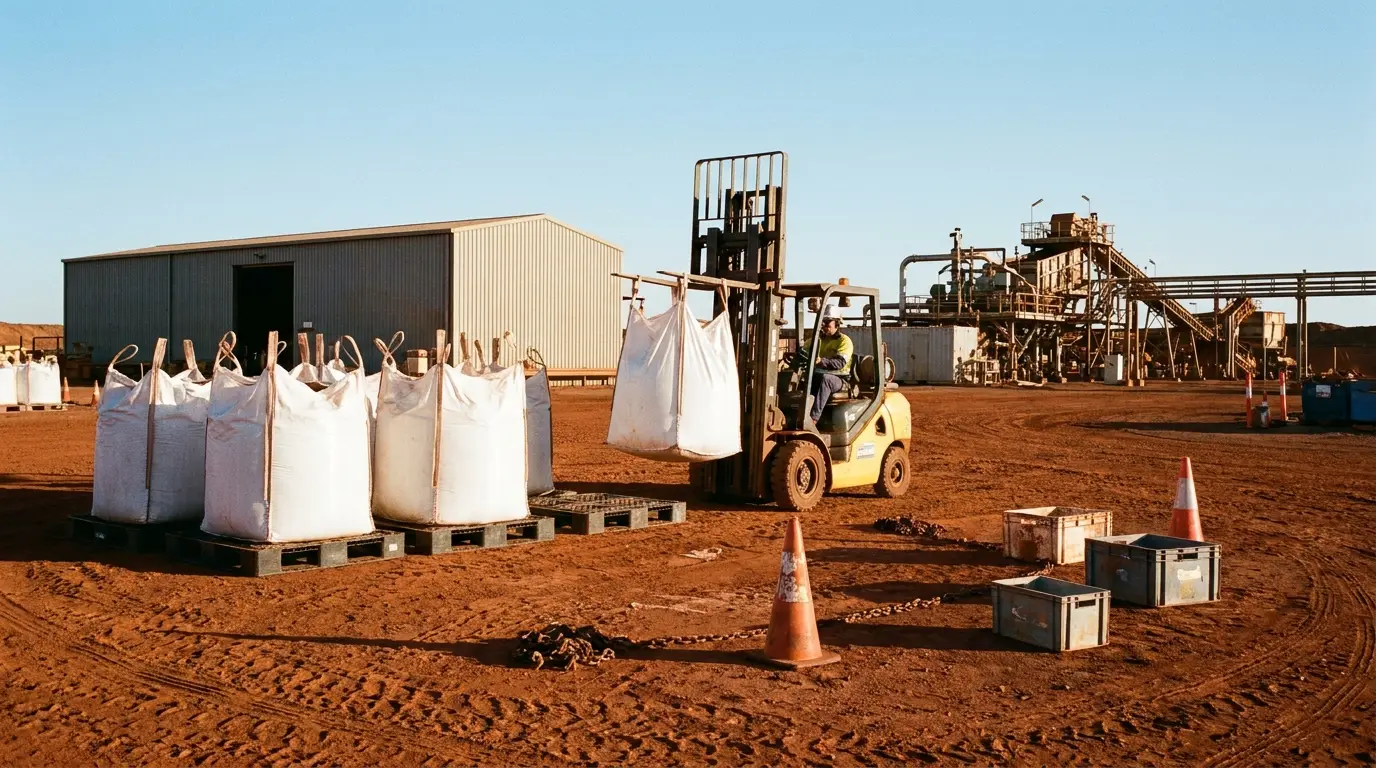
A significant share of what arrives at an Australian mine site turns up in a one-tonne flexible intermediate bulk container - flocculant, lime, cement, grinding media, blasting consumables, filter aid. Almost none of it arrives with any thought given to the pallet underneath, and the pallet is usually specified from the bag's printed base dimension. That number is a manufacturing dimension of an empty, flat bag. It is not the footprint the pallet has to carry, and the gap between the two is where bags sag, decks get overloaded at their edges, and loads snag coming off a truck.
What pallet should a one-tonne bulk bag sit on?
The short answer: a deck that contains the bag's filled footprint on both axes, with clearance, and with load ratings that cover the filled bag weight in the way you actually handle it. Everything else - material, tare, entry type, colour - is secondary to those two facts. Get the footprint wrong and no amount of load rating saves you, because the rating was measured with the load sitting on the deck, not hanging off it.
In practice that pushes most one-tonne bag work onto either a full-size Australian-standard 1165 × 1165 deck or an oversize 1300 × 1100 bulk-bag base. Which of the two is right is not a question of "bigger is better", because those two footprints are not nested: the oversize base is 135 mm longer and 65 mm narrower than the square. The rest of this article works the geometry through so you can answer it for your actual product rather than by reputation.
Why overhang, not weight, is what fails first
A one-tonne bag is well inside the dynamic rating of any serious plastic pallet, which is why weight is rarely the thing that bites. Overhang is. Pallet load ratings are established under standardised test methods - internationally, ISO 8611 for flat pallets - and those methods apply a uniformly distributed load resting on the deck. A bag whose filled footprint spills past the perimeter breaks that assumption in three ways at once.
Structurally, the overhanging mass is carried by the outermost deck members as a cantilever rather than by the deck as a whole, concentrating stress exactly where the pallet has least material. Operationally, an overhanging bag catches - on rack uprights, on the neighbouring load, on the mast when a driver approaches slightly off-square - and a snagged bag is a torn bag. Dynamically, an FIBC is already an unstable unit load: soft-sided, tall relative to its base, with a centre of gravity that shifts as the contents settle. Letting it hang over the edge raises the effective centre of gravity and reduces the base that resists tipping.
There is a fourth cost that shows up in the injury statistics rather than the maintenance budget. Bags that will not sit square get manhandled - shoved, dragged, re-slung, wrestled into place by hand. Body stressing is consistently the most common mechanism of serious workers' compensation claims in Australia, at around a third of them (Safe Work Australia). A load that sits square first time is a load nobody has to fight.
"Nearly every torn bag I get asked about traces back to a footprint mismatch, not a strength problem. The bag was fine, the pallet was fine, and the two of them were 40 mm apart on one axis. Measure a filled bag off your own truck before you buy a hundred pallets - it takes five minutes and it is the only measurement that matters."
- John Meir, Sales Leader, 20+ years in plastic materials handling
The number nobody specs from: the filled footprint
An FIBC is a fabric container. Its stated base dimension is the flat, made dimension of an empty bag; once it is filled, the sides bulge and the base spreads, and it keeps spreading as the contents settle in transit and vibrate down on a haul road. How much depends on the fabric, whether the bag has baffles, the fill level, the flow characteristics of the product and how long it has been sitting. A dense, free-flowing reagent in an unbaffled bag spreads a great deal more than a baffled bag of something cohesive.
The design and test requirements for FIBCs carrying non-dangerous goods are set out in ISO 21898, which is where the bag's safe working load and the factors it is proved against come from. What no standard can give you is your bag's settled footprint with your product in it, and that is the number the pallet has to answer. So measure it: take a filled bag as it arrives, on the ground, after transport, and measure the widest point on both axes. That measurement, not the spec sheet, is what you match a deck to.
For the worked table below we have used an illustrative spread of 8% on each axis over the flat base dimension, purely to show the method. Your bags may spread more or less. Substitute your own measurement and the arithmetic does the rest.
Worked overhang table: FIBC bases on 1165 × 1165 vs 1300 × 1100
Clearance is shown per side. Positive numbers mean the deck contains the bag; negative numbers mean it hangs over. Note that the 1300 × 1100 base is assessed on both of its dimensions, because its narrow axis is smaller than a 1165 square.
| FIBC flat base | Filled footprint (+8%) | On 1165 × 1165 (per side) | On 1300 × 1100, long axis | On 1300 × 1100, narrow axis |
|---|---|---|---|---|
| 900 × 900 mm | ~972 × 972 mm | +96 mm, comfortable | +164 mm | +64 mm |
| 1,000 × 1,000 mm | ~1,080 × 1,080 mm | +42 mm, workable | +110 mm | +10 mm, no margin |
| 1,050 × 1,050 mm | ~1,134 × 1,134 mm | +15 mm, marginal | +83 mm | -17 mm, overhangs |
| 1,100 × 1,100 mm | ~1,188 × 1,188 mm | -11 mm, overhangs both axes | +56 mm | -44 mm, overhangs |
Three conclusions fall out of that table, and only one of them is the one people expect.
First: the oversize base is not a universal upgrade. It buys 67 mm a side on the long axis and gives back 32 mm a side on the narrow one. For a bag that spreads square - which most unbaffled one-tonne bags do - the square 1165 deck contains it better at every size in the table. The 1300 × 1100 wins when the load is genuinely long: bags that settle into an oval, staged pairs, or product landed on the deck alongside the bag.
Second: both footprints run out at around a 1,050 mm flat base. Once a bag's made dimension reaches 1,050 mm, an 8% spread has consumed effectively all the clearance on a standard deck. Above that you are into genuinely oversize decks or you are accepting overhang as a managed risk, with the load kept off racking and handled with care.
Third: the spread assumption is doing all the work. Change 8% to 4% and the 1,050 mm bag sits comfortably on a 1165. Change it to 12% and even the 1,000 mm bag is marginal. This is exactly why the measurement of a real filled bag beats every rule of thumb, including ours.
Where the 1300 × 1100 base earns its keep on a mine site
Set the footprint argument aside and the oversize bulk-bag base has three genuine advantages on a remote site. Tare weight: a low-profile bag base can weigh under half what a heavy-duty rackable deck weighs, which matters when you are freighting empties thousands of kilometres and when store hands are moving them by hand - directly relevant given how much of the serious-injury burden is body stressing. Length for settled loads: where product genuinely settles long, the extra 135 mm is exactly the clearance the load needs. Cost per position for a one-way or low-cycle job: a bag delivered, emptied and the base returned or stored is not asking for a 10,000 kg static deck.
The honest counterpoint is what a light bulk-bag base does not do. It is built as a floor and transport pallet, not a rack pallet, and where no racking figure is published it does not belong in a rack at any load. It has less deck material to resist a hard tine strike, and mine-site forklift handling is not gentle - our guide to forklift abuse and pallet durability on a mine site covers what actually breaks decks. And in sustained heat and UV, thinner sections creep and embrittle faster than heavy ones, which we work through in plastic pallets in the Pilbara.
So the pattern that works on most sites is a split fleet: oversize low-tare bases for inbound bag traffic that is emptied and does not rack, and heavy-duty rackable 1165 decks for anything that goes into the store, carries drums or kegs, or gets re-handled repeatedly. Trying to make one pallet do both jobs is how you end up either paying for racking ratings you never use or racking something that was never rated for it.
Load ratings for reagents, lime and grinding media
Three numbers govern, and for bag work the dynamic figure usually leads because the defining moment is a filled bag being lifted and driven. Static is what the deck holds at rest, dynamic is what it holds moving on tines, and racking is what it holds bridging two beams with nothing beneath the middle. Racking is almost always the lowest of the three, and Australian racking design and loading is governed by AS 4084:2023 (see Safe Work Australia's storage racking guidance). The full mechanics are in pallet load ratings: static vs dynamic vs racking.
Two mine-specific adjustments to the standard advice. Density: grinding media, lime and mineral concentrates are heavy in a small volume, so a "one-tonne" bag of media occupies far less footprint than a one-tonne bag of a light reagent and concentrates its mass over a smaller part of the deck - the opposite of the uniformly distributed load the rating assumes. Chemistry: a split bag puts reagent directly onto the deck, so confirm the pallet material against the product's safety data sheet before you standardise. We keep a general reference in HDPE chemical compatibility for mine-site reagents, and where a spill has to be contained rather than merely tolerated, the duties and hardware are covered in mine-site spill containment.
How to brief a supplier for bulk-bag handling
Five facts get you the right pallet the first time. One: the measured filled footprint of your bag on both axes, taken off a real delivery. Two: the filled bag weight. Three: whether the load ever goes into racking - if yes, you need a published racking figure at your beam span. Four: how it is handled, meaning tine entry directions, whether it is slung from loops or lifted from the deck, and whether it is stacked. Five: the product itself, so material compatibility and wash-down can be checked.
With those five you can compare decks honestly rather than by footprint reputation. Browse the range in plastic pallets and the lower-cost options in used pallets, see the full mine-site line-up on our mining hub, or read the broader material case in plastic vs timber pallets for mining. When you are ready, send your bag dimensions, filled weight, handling method and freight postcode for a spec-backed quote.
Common questions
What size pallet do you need for a one-tonne bulk bag?
Size it to the bag's filled footprint, not the flat base dimension on the spec sheet, and check both axes. A bag with a 1,000 mm square base will typically present a noticeably larger footprint once it is filled and has settled, so a nominal 1,000 mm bag is realistically a 1165 × 1165 or larger job. Measure a filled bag of your actual product, in the state it arrives, then choose the deck that contains it on both axes with clearance to spare.
Is a 1300 × 1100 bulk bag pallet better than a standard 1165 × 1165?
It depends which way your bag spreads. A 1300 × 1100 base is 135 mm longer than a 1165 square but 65 mm narrower, so it gains room on one axis and loses it on the other. It is the better choice for loads that settle long, for staging bags in a line, and where a low-tare base is wanted for handling and freight. For a bag that spreads square, a square 1165 deck often contains it better. Compare the filled footprint against both dimensions before deciding.
Why is bulk bag overhang a problem?
Because the deck stops supporting the load at its edge. Published pallet ratings assume the load sits on the deck and is evenly distributed, so a bag hanging over the perimeter puts weight where there is no structure under it, concentrates stress on the outer deck members, and lets the bag sag against the pallet edge. Practically, an overhanging bag also catches on rack uprights, neighbouring loads and forklift tines, and it raises the effective centre of gravity of an already tall, soft, top-heavy unit load.
Can you rack a bulk bag on a plastic pallet?
Only on a pallet with a published racking rating, at or below that rating, and with the load contained inside the deck footprint. Racking is the lowest of the three pallet load figures because the deck bridges two beams with nothing under the middle. Low-tare bulk-bag bases are commonly built as floor and transport pallets rather than rack pallets and may carry no published racking figure at all, in which case they should not go in a rack. Australian racking design and loading sits under AS 4084:2023.
Are plastic pallets suitable for mine-site reagent bags?
Yes, and they solve problems timber does not: no nails or splinters to become foreign-object debris around plant and conveyors, no timber pest pathway, a non-porous surface that will not absorb spilled reagent, and a wash-down capability for changeovers between products. Confirm the chemical compatibility of the pallet material against the product's safety data sheet, and match the pallet's load ratings to the filled bag weight.
Sources: serious workers' compensation claims by mechanism of injury, Safe Work Australia statistics (safeworkaustralia.gov.au); storage racking duties, Safe Work Australia (safeworkaustralia.gov.au); pallet racking design and loading, AS 4084:2023 Steel storage racking (Standards Australia); pallet test methods for flat pallets, ISO 8611; design and test requirements for flexible intermediate bulk containers for non-dangerous goods, ISO 21898; Australian standard pallet dimensions, AS 4068 / ISO 6780. Pallet dimensions, tare weights and static, dynamic and racking ratings are the manufacturer-tested figures for the specific models referenced and vary with load distribution, support conditions and temperature. FIBC base dimensions and the 8% filled-spread assumption in the worked table are illustrative planning figures used to demonstrate the method, not published bag specifications or a substitute for measuring your own filled bags; confirm every dimension against your actual bags and the product safety data sheet. Not a quote.