
Field harvest bins vs packhouse bins: why one bin rarely does both jobs

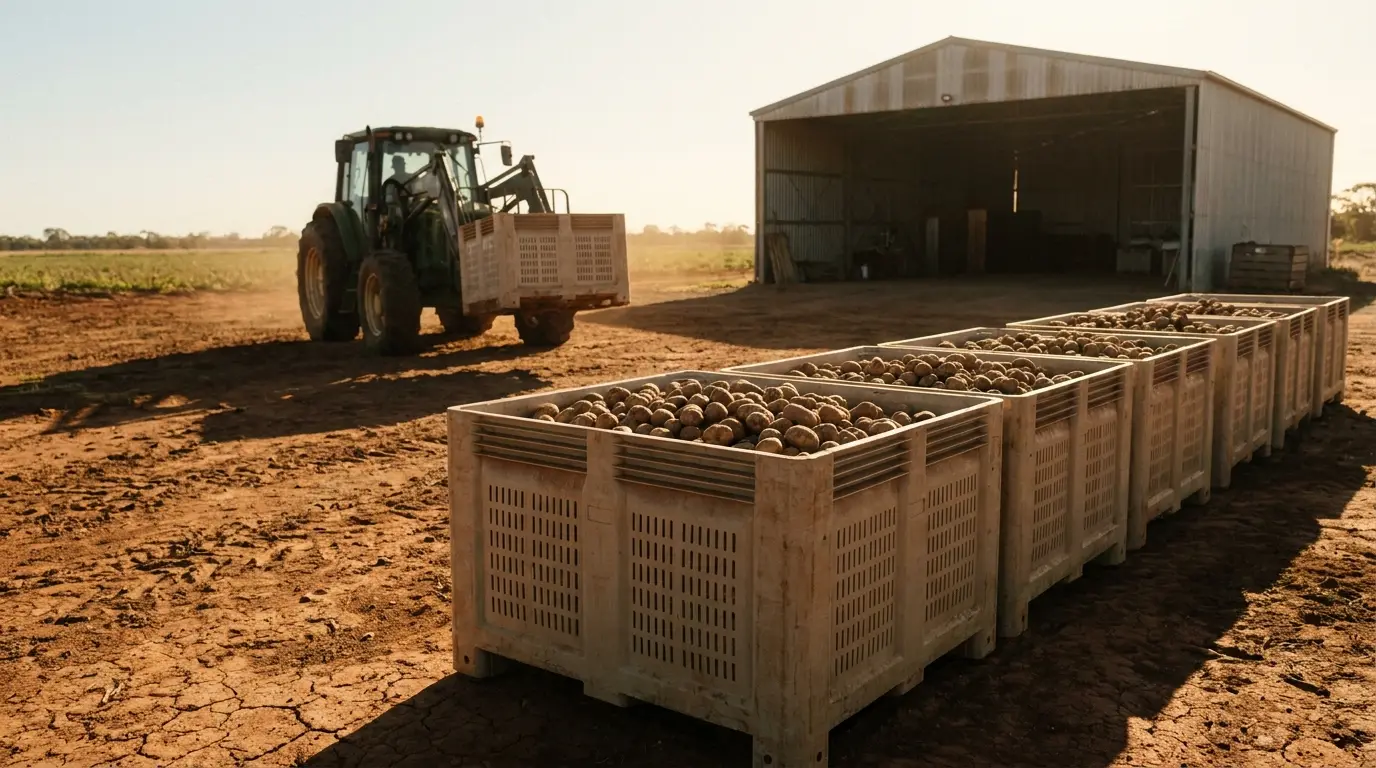
Most growers buy one bin and ask it to do two jobs. It goes to the paddock full of soil and stones, comes back to the shed, gets washed, gets stacked in the store, then travels back empty to start again. That works right up until it doesn't, and when it stops working the symptom is rarely dramatic, it is a hinge that jams with grit, a bin that cannot go in the rack, or a return truck carrying air. This is the honest version of the field-bin-versus-packhouse-bin question: what actually separates the two, what the split costs, and when one fleet is genuinely the right answer.
Do I need two bin fleets, or will one do both jobs?
Answer three questions and the decision makes itself. Do empties travel far? If yes, folding wins the return leg decisively. Does the store rack? If yes, you need a published racking figure, and not every bin has one. Is there a real wash regime between crops? If yes, moving parts and hinge pockets become something a cleaning procedure has to account for. Two or three yeses, and a split fleet, rugged one-piece bins for the paddock and folding rackable boxes for the shed and store, pays for itself. Zero or one, and a single fleet is the simpler, cheaper answer.
What is worth discarding is the folklore version of this decision, which says field bins are "tough" and packhouse bins are "clean". Both are the same polymer families, both take a forklift, and both wash. The genuine functional separation is narrower and much more useful: moving parts and rackability. Everything else is a preference; those two are constraints.
What the paddock does to a bin that a packhouse never does
Four things, and only one of them is impact. Grit. Soil, stones and crop debris arrive with the product and work into every gap. On a one-piece bin there is nowhere for them to go; on a folding box they collect in hinge pockets and corner-post channels, which is where jamming starts. Uneven ground. A bin set down on a soft or rutted headland is loaded across three corners rather than four, so the base is stressed in ways a flat shed floor never reproduces. Sun. Bins that live outdoors accumulate UV hours continuously, which is a slow embrittlement path rather than a sudden failure. Variable drop height. Filling from a harvester or a tractor-mounted elevator is less controlled than a packing line, and drop height is the single biggest bruising variable in the whole chain.
The packhouse asks for a completely different list: a surface that a wash cycle can reach, dimensional consistency so the bin sits square on a tipper cradle and in a rack, a published racking figure, and a small folded footprint for the return leg. Notice that almost nothing on the paddock list appears on the shed list, and vice versa. That is why a compromise bin is genuinely a compromise, it is not that it fails at either job, it is that it is carrying features it does not need at each end.
Both of those lists sit inside a bigger number worth keeping in view. ABARES surveyed a weighted sample of 2,761 Australian horticulture farms, representative of 10,645 nationally, and found crop loss and waste averaged 20% of production in 2023–24, down from 25% in 2022–23 when heavy rain and flooding hit production. It ranged from 8% for pineapples to 37% for mangoes (ABARES, agriculture.gov.au). Weather, market conditions and quality specifications drive most of that. Handling is the slice you can actually engineer, which is exactly why it is worth spending twenty minutes on the bin spec rather than defaulting to whatever is in the yard.
The spec nobody reads: litres carried per kilogram of bin
Volume and tare weight are both on every spec sheet, and almost nobody divides one by the other. Do it and you get the bin's carrying efficiency: how many litres of product it moves for every kilogram of bin you have to buy, lift, wash, store and freight. It is the cleanest single number for comparing a one-piece field bin against a folding packhouse box, because it prices the hinge.
| Vented bin (footprint · height) | Type | Volume | Tare | Litres / kg | Racking |
|---|---|---|---|---|---|
| Giant vented pallet box (1300×1150 · 1,250 mm) | One-piece | 1,400 L | 68.5 kg | 20.4 | 1,000 kg |
| Vented bulk container, AU std (1120×1120 · 780 mm) | One-piece | 700 L | 39.5 kg | 17.7 | Not published |
| Folding vented pallet box, AU std (1162×1162 · 780 mm) | Folding | 750 L | 45 kg | 16.7 | 500 kg |
| Vented ISO bulk container (1200×1000 · 740 mm) | One-piece | 605 L | 37.5 kg | 16.1 | Not published |
| Folding vented pallet box, 4-way (1162×1162 · 785 mm) | Folding | 750 L | 53 kg | 14.2 | 500 kg |
| Low folding vented half-bin (1162×1162 · 560 mm) | Folding | 470 L | 44 kg | 10.7 | 350 kg |
The pattern is real but it is not a law, and it is worth stating both halves. One-piece bins run 16.1 to 20.4 litres per kilogram; folding boxes run 10.7 to 16.7. The hinge costs you carrying efficiency, roughly a fifth to a third at the extremes. But the best folding box in the table beats the worst one-piece bin, so the spread within each group is nearly as wide as the gap between them. Do the division on the specific models you are considering rather than reasoning from the category.
Two practical readings. If your bins are mostly standing full, in a store or on a truck, carrying efficiency is the number that matters and a one-piece bin usually wins. If your bins spend a meaningful share of their life travelling empty, foldability wins that back on the return leg and then some, we work that side through in collapsible vs fixed bulk bins: the return-freight maths, and the numbers there are the counterweight to this table. The half-bin at the bottom is the clearest case of buying something other than efficiency: at 10.7 litres per kilogram it is the least efficient carrier in the range, and it is bought for ergonomics and part-load flexibility, not for volume.
The other split: which bins publish a racking figure
This is the constraint that catches people, because it is an absence rather than a number. Of the six vented bins above, two publish no racking figure at all, and both are one-piece bins. That does not make them weak, one of them carries 4,000 kg static and the other 5,000 kg. It means they are specified as floor, stack and transport units, and a bin without a published racking figure should not be put on beams, full stop.
The reason is mechanical rather than bureaucratic. Racking is the load case where the unit bridges two beams with nothing under the middle, so the base has to do all the structural work in bending, and it is almost always the lowest of the three figures. A bin designed to sit on a flat floor or nest into a stack has never been asked to do that. Where the figures do exist across this group they range from 350 to 1,000 kg, so even among rackable bins the spread is nearly threefold. Australian racking design and loading sits under AS 4084:2023, and Safe Work Australia publishes guidance on storage racking duties (safeworkaustralia.gov.au).
So the practical sequencing is: decide the store before you buy the field bin. If the crop ends up in a racked cool store, every bin in the loop needs a racking figure that covers your load at your beam span, which quietly rules out part of the one-piece range. If it ends up floor-stacked, you are governed by static and stacking instead, and the geometry of that is worked through in cool-room bin stacking.
"The call I get every autumn is 'these bins won't go in the new racking'. Nothing is wrong with the bins. They were bought for the paddock five years ago, they have never had a racking figure, and the shed changed underneath them. Decide what the store looks like first, then buy the bin that has to end up in it."
Two-way or four-way entry, the paddock catch
Here is where the tidy story breaks, and it is worth knowing before you build a spec around it. You would assume the field bin is the one with four-way forklift entry, because a tractor-mounted forklift in a paddock approaches from whatever angle the row allows, while a shed has fixed aisles. In practice the range does not split that way at all. In the group above, the one-piece Australian-standard field bin is 2-way, while one of the folding packhouse boxes is 4-way. Entry is a function of the base design of the specific model, not of which end of the chain it was designed for.
Treat it as an independent variable, then. If handling in the paddock is genuinely multi-directional, or if your store layout means bins get approached from the end and the side, put 4-way entry on the requirement list explicitly and check it per model. If your handling is consistently one-directional, 2-way is not a compromise and you should not pay attention to it. The failure mode is assuming it correlates with ruggedness, and discovering on delivery day that it doesn't.
When one fleet genuinely does both
Plenty of operations should not split, and it is worth saying so plainly rather than selling twice the bins. One fleet is the right answer when the paddock is close to the shed, so empties never accumulate return-freight cost; when the store is floor-stacked rather than racked, so no racking figure is required anywhere in the loop; when you run one crop, so the wash regime between runs is a rinse rather than a validated sanitation cycle; and when the fleet is small enough that holding two spare pools is more inventory than the saving justifies.
If that is you, buy the bin the hardest stage demands and accept it is over-specified for the easy one. Usually that means a one-piece vented bin with enough static rating for the store stack, and you take the return-freight hit on the empty leg. The mistake in the other direction, buying a folding box because it looks more capable and then running it through the paddock, is more expensive: grit in the hinges is a maintenance problem that gets worse every season, and you have paid in litres per kilogram for a folding feature you never use.
Whichever way you go, venting is a separate axis from all of this, and it is decided by the crop rather than the stage, we cover that in vented vs solid bulk bins. If you are sizing rather than staging, the produce megabin guide maps real capacities to footprints, and if the field fleet is where you would rather buy used, second-hand vs new bulk bins covers what to check.
How to brief a supplier for a two-stage fleet
Send six facts and you will get a fleet rather than a product list. 1. The crop and its bulk density, because that is what turns litres into kilograms and decides which static rating you actually need. 2. Whether the store racks, and the beam span, since that is the hard filter. 3. How far empties travel, in kilometres and loads per season, which prices the folding decision. 4. The wash regime, rinse, hot wash or sanitiser, and whether it runs between crops or between loads. 5. Handling, tractor forklift or shed forklift, and whether approach is one-directional. 6. Whether bins live outdoors, because sustained UV exposure is an asset-life question and it belongs in the plan, not in a surprise five years later.
From there the split writes itself: one-piece, high litres-per-kilogram, no moving parts for the paddock; folding, published racking figure, wash-friendly for the shed and store. If the answers say one fleet, you will see it in the brief immediately. Browse the full IBC and bulk container range, see the crop and cold-chain context across our fresh produce pages, work through the whole catalogue, or send your crop, volumes, store layout and freight postcode for a spec-backed quote.
Common questions
What is the difference between a field harvest bin and a packhouse bin?
A field bin is built to survive being loaded on uneven ground, filled with product that arrives with soil and stones, and left in the sun, so it is normally a one-piece fixed-wall bin with no hinges or moving parts for grit to jam. A packhouse bin lives indoors on a flat floor, gets washed between runs, often has to go into a rack, and travels back empty, so it is normally a folding box with a published racking figure. The functional difference is moving parts and rackability, not toughness, both are the same polymer family and both survive a forklift.
Can I use one bin for both harvest and the packing shed?
Yes on a short, simple operation, and plenty of growers do. One fleet works when the paddock is close to the shed, the crop goes straight from harvest into a floor-stacked store rather than a rack, empties do not travel far enough for return freight to matter, and the wash regime is a rinse rather than a full sanitation cycle. It stops working when any of those change. The moment empties are trucked long distances, or the store racks, or a food-safety programme requires a validated wash between crops, a single compromise bin starts losing on both ends at once.
Why do folding bins carry fewer litres per kilogram?
Because the hinge has to be paid for in material. A folding box needs thicker wall sections, hinge pillars and corner posts to hold its shape when erected, and those add tare weight without adding internal volume. Across the vented range in our catalogue the one-piece bins run 16.1 to 20.4 litres per kilogram of bin, while the folding boxes run 10.7 to 16.7. The spread inside each group is nearly as wide as the gap between them, so check the specific model rather than assuming, but the direction of the trade-off is consistent.
Do field bins need a racking rating?
Only if they are going into a rack, and many never do. A bin in a floor-stacked cool store or a paddock row is carrying its load through the bins below it, which is governed by the static and stacking figures, not the racking one. The trap is buying a bin for the paddock and later deciding to rack it in the store, because two of the three one-piece vented bins in our range publish no racking figure at all. Where no racking figure is published, treat the bin as a floor and transport unit and do not put it on beams.
Does bin choice really affect post-harvest loss?
It is one lever among several, and it should not be oversold. ABARES found crop loss and waste on Australian horticulture farms averaged 20% of production in 2023–24 (agriculture.gov.au), driven by weather, market conditions, quality specifications and labour as well as handling. What a bin controls is the handling share: drop height and internal surface finish affect bruising, venting affects heat and moisture in store, and a sanitisable surface affects carry-over between crops. Those are real, but they sit inside a much larger picture.
Sources: crop loss and waste on Australian horticulture farms (20% of production in 2023–24, down from 25% in 2022–23; 8% for pineapples to 37% for mangoes; weighted sample of 2,761 farms representative of 10,645), ABARES, Australian Government Department of Agriculture, Fisheries and Forestry (agriculture.gov.au); storage racking duties and guidance, Safe Work Australia (safeworkaustralia.gov.au); racking design and loading, AS 4084:2023 Steel storage racking (Standards Australia). Volume, tare weight, folded height, forklift entry and static/dynamic/racking figures are the published manufacturer specifications for the specific models referenced; litres-per-kilogram figures are calculated directly from those published volume and tare figures. Load ratings vary with load distribution, beam span and temperature, and a bin with no published racking figure should not be placed on beams. ABARES loss figures describe total on-farm crop loss and waste from all causes, not loss attributable to bin choice. Not a quote.