
Hygienic plastic pallets for food and pharma: open deck, closed deck & washability

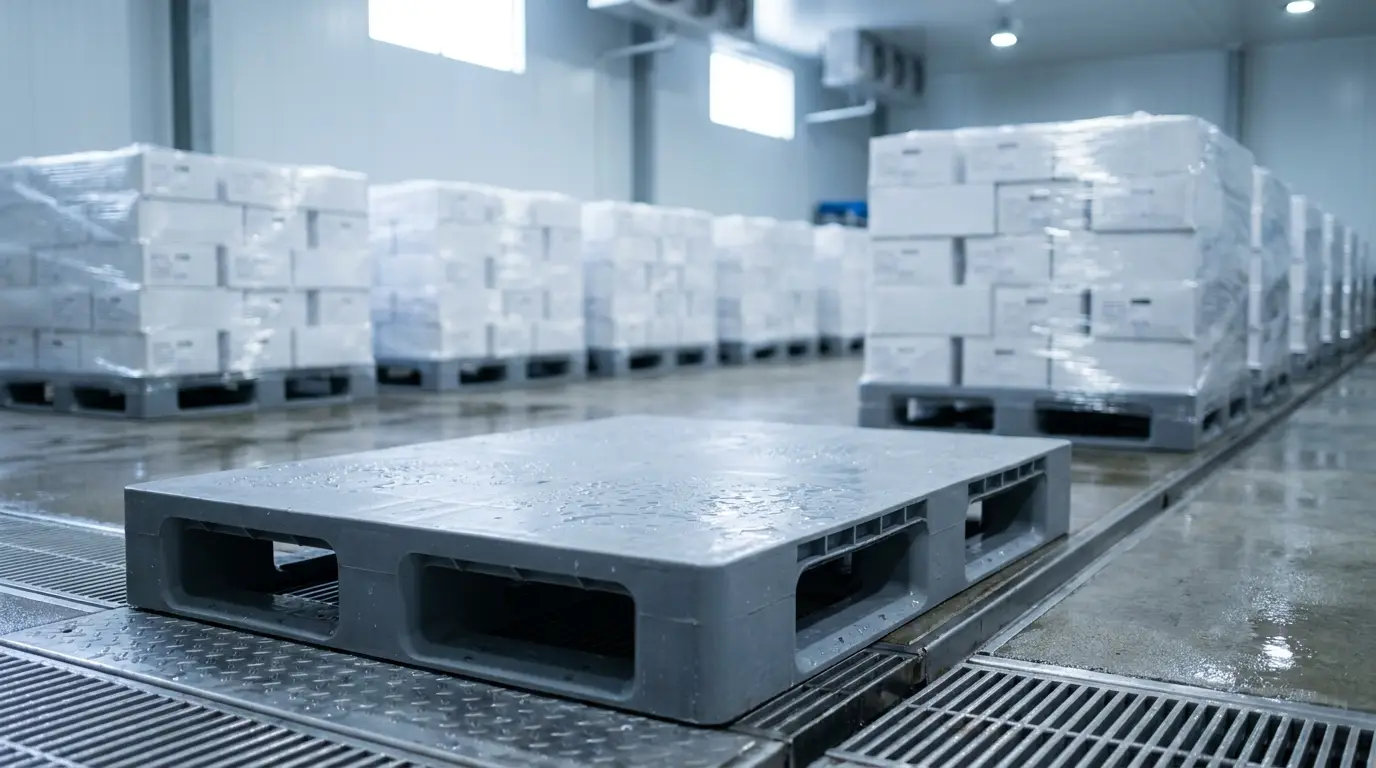
"Food grade" is the phrase buyers ask for, but it is not the phrase that passes an audit. A pallet made from a perfectly acceptable food-contact polymer can still fail a wash-down sign-off, because the thing that decides whether a pallet stays clean is not what it is made of, it is how the deck is shaped. This is a practical guide to open-deck versus closed-deck plastic pallets for food and pharmaceutical work: what "hygienic" actually means in geometry, why cleanability is a physical constraint rather than a chemical one, what a closed deck really costs you, and the five facts that let a supplier spec one properly.
Which pallet deck do I need for a food or pharma line?
Match the deck to the zone, not to the industry name. In a dry warehouse moving sealed cartons, a conventional open-deck rackable pallet is entirely appropriate and lighter to handle. In a wet processing area, a high-care zone, a cold store where condensation runs, or anywhere product is exposed or primary packaging is in direct contact, you want a closed (solid) top deck that a hose, detergent and sanitiser can physically reach across its whole surface.
The reason to be disciplined about this is cost in both directions. Over-specify and you buy heavier, more expensive decks for a job that never touches food, and you add kilograms to every manual handling task and every freight load. Under-specify and you put a pallet with blind cavities into a zone where an auditor will ask you to demonstrate how you clean it, and you will not have a good answer. The rest of this article gives you the mechanism, the numbers and the questions so you can place that line accurately in your own facility.
What actually makes a pallet "hygienic"?
Five features, and none of them is the material. A closed top deck with no open pockets, so residue has nowhere to lodge. Radiused internal corners rather than sharp junctions, because a square internal corner is where a brush stops and a biofilm starts. No fasteners, inserts or metal, so there are no crevices at a joint and no foreign-object risk. A base that drains, because standing water in an underside cavity is a microbial reservoir and a slip hazard when the pallet is lifted. And one moulded piece, because every seam is a place a cleaning validation has to account for.
Notice what is absent from that list: any certificate. There is no Australian standard that awards a pallet a "hygienic" grade, and no supplier can hand you one. What a supplier can do is tell you the deck type, the bottom-support design, the material, and the wash conditions the unit is built to tolerate. The rest, whether your specific cleaning procedure achieves the outcome the Food Standards Code asks for, is validated in your facility, on your line, with your chemicals. Be sceptical of anyone who sells you a certificate instead of a geometry.
"Buyers ring up asking for a food-grade pallet and describe the polymer. Then you ask what the wash bay actually does, and it turns out they are steam-cleaning a deck with forty blind pockets in it. The polymer was never the problem. The problem is that nobody can get a brush into the pallet they already own."
Why a deck you cannot clean cannot be sanitised
This is the whole argument in one sentence, and it comes straight from the regulator. FSANZ's guidance to food businesses is that "you need to clean items before you sanitise them" (foodstandards.gov.au). Cleaning and sanitising are two separate steps: cleaning removes visible soil with water and detergent, sanitising then reduces the surviving microorganisms. Sanitisers do not work reliably in the presence of food residue. So a surface you cannot get clean is a surface you cannot get sanitised, and the fanciest chemical in the wash bay will not rescue a pocket a brush never reached.
That is why deck geometry is a food-safety control and not a cosmetic preference. Under Standard 3.2.2, Australian food businesses must keep premises, fixtures, fittings, equipment and food transport vehicles clean and sanitary, and the Code defines "sanitise" as applying heat, chemicals or other processes so that microorganisms on a surface are reduced to a level that does not compromise the safety of the food it may contact (foodstandards.gov.au). Standard 3.2.3 covers food premises and equipment alongside it. None of these nominate a pallet model. They set an outcome, and then an auditor asks you to demonstrate it on the equipment you actually own.
The stakes behind that paperwork are not trivial. FSANZ estimates foodborne illness costs the Australian economy around $3 billion each year, up from $2.81 billion in 2023, and that about a quarter of Australia's annual gastroenteritis cases are linked to contaminated food (FSANZ, July 2025). A pallet is a small part of that picture. It is also one of the cheapest parts to get right, and one of the few that an auditor can physically pick up and turn over.
What a closed deck really costs (four-deck comparison)
Buyers usually assume a solid deck means a stronger pallet, or that a hygienic deck must be the heavy end of the range. Neither holds. The table below compares four real ISO 1200 × 1000 decks from our own catalogue, so the comparison is like-for-like on footprint. Every figure is the published specification for that model, not an estimate.
| ISO 1200 × 1000 deck | Deck / base | Tare | Static (kg) | Dynamic (kg) | Racking (kg) |
|---|---|---|---|---|---|
| Heavy duty hygienic ISO (BPB-W1210USHD) | Solid flat deck · 3 skids | 29 kg | 6,000 | 1,300 | 1,000 |
| Heavy duty ISO (BPB-720) | Open deck · full perimeter base | 24.5 kg | 8,000 | 2,000 | 1,000 |
| Heavy duty ISO, 3 skids (BPB-955) | Open deck · 3 skids, wide centre foot | 17.15 kg | 4,000 | 2,000 | 1,000 |
| Medium duty ISO (BPB-750) | Open deck · cruciform perimeter base | 18.5 kg | 5,000 | 1,250 | 1,100 |
Three things fall out of that, and all three are useful at a spec meeting.
First, racking barely separates them. Three of the four rack at exactly 1,000 kg and the fourth at 1,100 kg. The number buyers argue about hardest is the number that discriminates least across this group. If your load racks, all four are in the conversation, so let hygiene and handling decide.
Second, the closed deck costs mass, not capacity. The solid-deck hygienic pallet is the heaviest unit here at 29 kg, about 69% heavier than the 17.15 kg open-deck heavy-duty on the same footprint and the same 1,000 kg racking figure. That is the real price of a surface you can clean: material goes into a continuous closed skin instead of into visible structural ribs. Pay it in kilograms on the manual-handling assessment and on the freight docket, and stop expecting it back in load rating.
Third, you cannot read strength off the deck. The 24.5 kg open deck carries 8,000 kg static; the heavier 29 kg closed deck carries 6,000. A solid top is not a proxy for a strong pallet. Read the three numbers, and read them at your beam span, the mechanics are worked through in our guide to static vs dynamic vs racking load ratings. Pallet test methods sit under ISO 8611 and Australian racking design under AS 4084:2023.
When an open deck is the better hygiene call
Counter-intuitively, there are wet-area jobs where an open deck is the more hygienic choice, because a closed deck is only an advantage if water can get off it as well as onto it. A solid top holds a film of wash water and any condensate that lands on it. In a chilled room, that film is exactly the standing moisture your food-safety plan is trying to eliminate, and a deck with drainage slots sheds it in seconds. If your process ends with a rinse and the pallet goes straight back into service without a drying step, an open deck that drains can beat a solid one that puddles.
Open decks also win on weight, which matters more than it looks. Every kilogram of tare is a kilogram someone lifts when a pallet is stripped and stacked, and a kilogram of freight on every load. Across the four decks above, choosing the open-deck heavy-duty over the solid-deck hygienic saves nearly 12 kg per pallet at identical racking capacity. On a fleet, that is a real manual-handling and logistics difference for a hygiene benefit you may not need in a dry zone.
The honest rule: closed deck for exposed product and high-care zones; open deck for packaged product, dry zones and anywhere drainage beats surface continuity. If you are also choosing the material rather than the geometry, our companion piece on food-grade plastic, HDPE, PP and HACCP covers that half of the question, and if recycled content is on the table, note the food-contact caveats set out in recycled vs virgin HDPE pallets.
Does pharma need a different pallet from food?
Usually not a different pallet, but a different regime around it. Pharmaceutical and cleanroom operations run under GMP-style quality systems where the controlling documents are your own: qualification records, cleaning validation, particulate and segregation controls, change control on any equipment substitution. The pallet is one item inside that system. What the system asks of it is the same short list as high-care food, a surface that can be cleaned and evidenced, no shedding, no fasteners, no absorbency, and dimensional consistency so automation and racking behave predictably.
Two practical differences do show up. Segregation is stricter: dedicated pallets that never leave a classified area, often colour-separated, rather than a pooled fleet cycling through unknown environments, which is one reason pharma buyers tend to own rather than pool (we compare the models in pooling vs buying plastic pallets). And change control means you cannot quietly swap a deck design mid-programme, so lock the specification and the supply before you qualify it. We will tell you the deck type, dimensions, material and load figures for any unit in the range; the qualification itself is yours to run, and any supplier claiming to have pre-validated your process for you should be treated with suspicion.
How to spec a hygienic pallet
Send five facts and you will get a defensible answer rather than a catalogue dump. 1. The wash regime, cold rinse, hot wash, chemical sanitiser, steam, and the temperature and dwell it runs at. 2. Whether it racks, and the beam span if it does, since racking capacity is span-dependent and your rack, not the pallet, often sets the ceiling. 3. Load mass and profile, uniform or point-loaded, because every published rating assumes a uniform load. 4. Contact status, whether product is exposed, in primary packaging, or fully sealed in cartons. 5. Zone, dry warehouse, wet process area, chiller, or classified high-care.
From there the choice is mechanical. Exposed product plus an aggressive wash points to a closed flat deck. Packaged product in a dry racked store points to an open-deck rackable, lighter and cheaper to run. Chilled and wet with no drying step points to drainage over surface continuity. If bins rather than pallets are the food-contact item in your process, the same logic applies one layer up, and the wash side is worked through in our hot-wash and sanitation SOP for reusable produce bins. Browse the full plastic pallet range or the whole catalogue, see the food and produce context on our fresh produce pages, or send your wash regime, load and quantity for a spec-backed quote.
Common questions
What is a hygienic plastic pallet?
A hygienic plastic pallet is one whose deck and base are designed to be cleaned, rather than one made of a special material. In practice that means a closed (solid) top deck with no open pockets or blind cavities where product residue, water and biofilm can sit, smooth radiused edges instead of sharp internal corners, no fasteners or metal inserts, and a base that sheds water rather than trapping it. It is a geometry choice, not a certification you can buy. There is no Australian standard that grants a pallet a "hygienic" rating, so judge it on whether your own wash regime can physically reach every surface.
Is a closed-deck pallet stronger than an open-deck one?
No, and that is the most common wrong assumption. Across four real ISO 1200 × 1000 decks in our range, the solid-deck hygienic pallet is rated 6,000 kg static while an open-deck heavy-duty on the same footprint is rated 8,000 kg, and their racking figures are identical at 1,000 kg. A closed deck buys you cleanability. It does not buy you capacity, and it does not automatically save weight, the solid-deck unit in that comparison is the heaviest of the four. Always read the three load numbers rather than inferring strength from the look of the deck.
Can plastic pallets go into a hot wash or steam clean?
Generally yes, which is the core practical advantage over timber, but confirm the temperature ceiling for the specific material with your supplier before you commit a fleet to a wash line. HDPE and PP are non-porous, do not absorb water, fats or cleaning chemicals, and can be pressure-washed and chemically sanitised repeatedly without degrading the way wood does. The constraint is not usually the wash, it is the sustained temperature and any load applied while the pallet is still warm. Our hot-wash and sanitation SOP works through the same question for reusable bins.
Do I need a food-grade pallet if the food is already packaged?
Not necessarily, and this is where a lot of over-specification happens. If the product is sealed in cartons or shrink-wrap and the pallet never touches open food, the pallet is transit equipment and your duty is to keep it clean and free of contamination sources such as splinters, nails, pooled water and pests. Open or exposed product, primary packaging in direct contact, wet processing areas and audited high-care zones are where a closed, washable deck starts earning its keep. Decide by contact and zone, not by the word "food" on the invoice.
What do food safety standards actually require of a pallet?
Australian food businesses operate under the Food Safety Standards in Chapter 3 of the Food Standards Code. Standard 3.2.2 requires businesses to keep premises, fixtures, fittings, equipment and food transport vehicles clean and sanitary, and defines "sanitise" as applying heat, chemicals or other processes so that microorganisms on a surface are reduced to a level that does not compromise the safety of the food it may contact (foodstandards.gov.au). The Code sets the outcome; it does not nominate a pallet model. That is why auditors look at whether your cleaning procedure can actually reach the equipment you have chosen.
Sources: cost of foodborne illness in Australia (around $3 billion annually, up from $2.81 billion in 2023) and the share of gastroenteritis cases linked to contaminated food, Food Standards Australia New Zealand, 2 July 2025 (foodstandards.gov.au); cleaning before sanitising, FSANZ cleaning and sanitising guidance for food businesses (foodstandards.gov.au); duties on premises, fixtures, fittings, equipment and food transport vehicles and the definition of "sanitise", Australia New Zealand Food Standards Code Standard 3.2.2 (Food Safety Practices and General Requirements) with Standard 3.2.3 (Food Premises and Equipment), Chapter 3 Food Safety Standards (foodstandards.gov.au); pallet test methods, ISO 8611 (Pallets for materials handling, Flat pallets); racking design and loading, AS 4084:2023 Steel storage racking (Standards Australia). Deck type, tare weight and static/dynamic/racking figures are the published manufacturer specifications for the specific models referenced and vary with load distribution, beam span and temperature. No Australian standard awards a pallet a "hygienic" grade; cleaning validation is the responsibility of the food or pharmaceutical business and must be demonstrated on its own line. Not a quote.