
Recycled vs virgin HDPE pallets: strength, food contact & the honest trade-offs

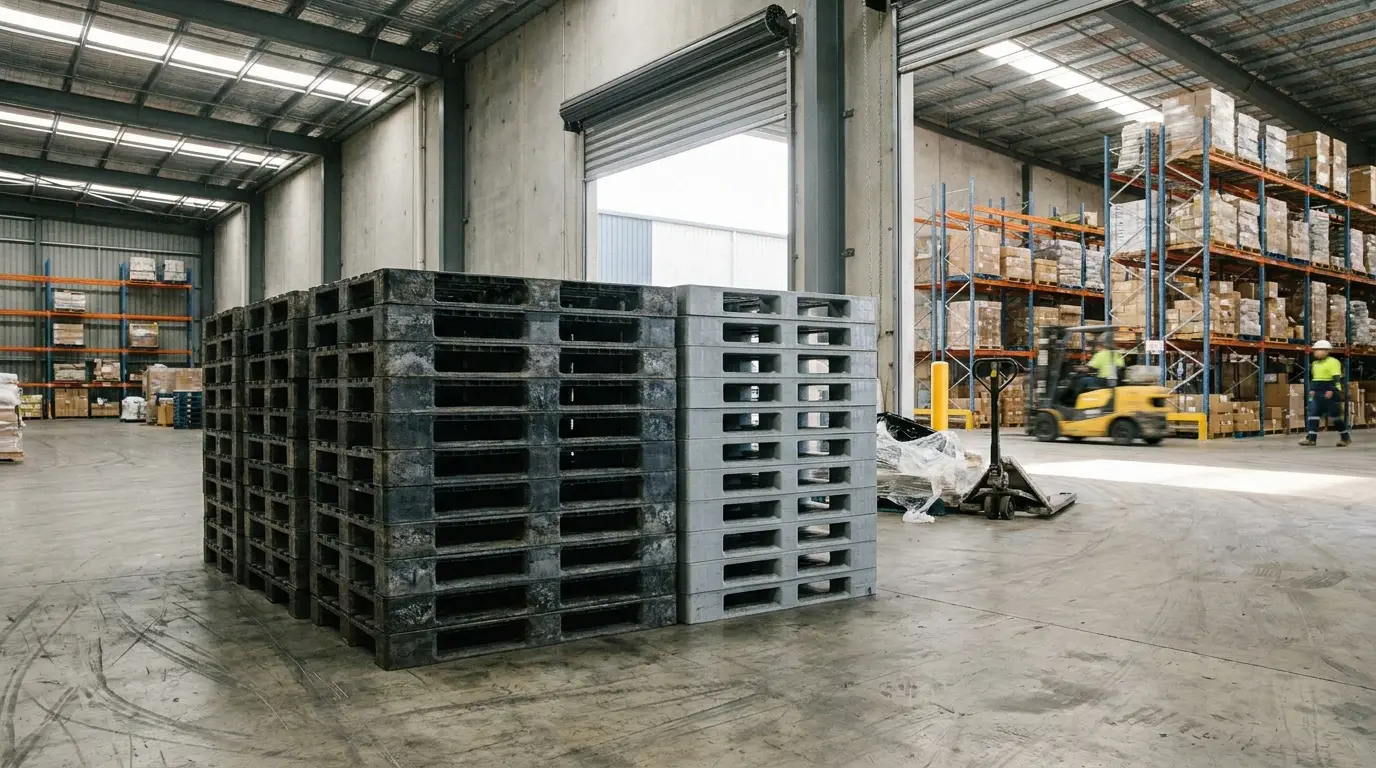
"Recycled" has become a marketing word, which makes it hard to buy against. Some suppliers use it as a virtue signal and hope nobody asks about strength; some buyers hear it and assume they're being offered seconds. Both are wrong. In moulded HDPE handling gear the recycled-versus-virgin decision comes down to three real constraints, and only one of them is a hard stop.
Recycled or virgin HDPE, which should you buy?
For almost all pallet, crate and bulk-bin work, buy on the tested rating and take the recycled content. Recycled HDPE is the right default for industrial handling: it performs, it costs less than virgin, and it puts recyclate to work in a long-life asset instead of a single-use one. Reserve virgin resin for the cases that genuinely need it, which are direct food contact, light or specific colours, and a handful of high-consistency technical applications.
The reason this gets confused is that people compare the wrong things. A recycled pallet and a virgin pallet are not two grades of the same product; they are two feedstocks feeding the same engineering. What decides whether a deck holds 2,000 kg in a rack is its geometry, wall thickness, rib structure and base design, then the polymer grade, then the feedstock, in that order. A thick, well-ribbed recycled deck comfortably out-performs a thin virgin one, and no amount of virgin resin rescues a bad mould.
Does recycled HDPE make a weaker pallet?
Not in the way buyers fear, and we can settle it with our own catalogue rather than an argument. The heavy-duty 1165×1165 Australian-Standard deck below is moulded from recycled material and carries 10,000 kg static, 2,000 kg dynamic and 2,000 kg racking at 24.3 kg. The medium-duty 1160×1160 deck further down is also recycled and carries the same three figures at 17.6 kg. Those are the highest rack figures in our flat-pallet range. If recycled content were the limiting factor, that could not be true.
The reason is that ratings are measured, not inferred. Internationally, flat-pallet performance is established through the ISO 8611 series: Part 1 sets the test methods, Part 2 the performance requirements, Part 3 the procedure for determining maximum working loads (iso.org). A pallet that has been tested to a figure has been tested to that figure. The feedstock question is upstream of the test, and the test doesn't care about the polymer's history, only its behaviour. Our guide to pallet load ratings: static vs dynamic vs racking works through what each number actually promises.
Where recycled polymer does differ is in the properties that don't appear on a spec sheet. Reprocessed HDPE has already been through a heat history, and it arrives as a blend of sources with different melt-flow characteristics, so as a class it shows more batch-to-batch variability and typically less reserve in the ductile properties, impact resistance and elongation before break, than a controlled virgin grade. Good manufacturers manage this by controlling the feedstock stream and designing margin into the part. It is a quality-assurance question about your supplier, not a reason to avoid the material.
"I get asked whether the recycled pallet is the cheap one. It isn't, it's the same mould, the same rack rating, and it's the one I'd put in a mine laydown yard because it's dark and it handles the sun. The only time I steer someone to virgin is when the product touches the plastic, or they need a colour. Everything else is habit."
John Meir, Sales Leader, 20+ years in plastic handling
Where recycled content genuinely stops: food contact
This is the one hard line, and the national packaging body draws it explicitly. Australia's 2025 National Packaging Targets include 50% average recycled content across all packaging, alongside 100% reusable, recyclable or compostable packaging, 70% of plastic packaging recycled or composted, and phasing out problematic single-use plastics. APCO notes that the recycled-content target covers all sectors including business-to-business and tertiary packaging, which is exactly where pallets, crates and bulk bins live, but that constraints vary by sector, sharpest in food and beverage, "particularly in relation to food contact" (apco.org.au). On reported progress, average post-consumer recycled content across packaging sits at 44% against the 50% target, and just 20% of plastic packaging is recycled or composted against the 70% target, with a revised target date being set.
The distinction that matters operationally is food logistics versus direct food contact. A pallet carrying stretch-wrapped cartons, bagged product or sealed crates is a logistics asset; the food never touches it, and recycled content is a non-issue. A crate that holds loose produce, or a bin that unwashed potatoes sit in for weeks, is a food-contact surface, and there the specification changes: ask for a virgin food-contact grade with evidence against AS 2070 (Plastics materials for food contact use, the joint Standards Australia / Standards New Zealand standard covering plastics for food-contact applications) and against the packaging requirements of the FSANZ Food Standards Code, which require a food business to use packaging that is fit for purpose and won't contaminate the food.
The underlying reason is traceability, not toxicity. Virgin resin has a known, documented composition. A mixed post-consumer stream does not, unless the recycling process itself has been assessed and controlled to keep non-food-grade material out, which is why food-grade recyclate is a specialised, closed-loop product rather than the default. For a full walk-through of the terminology, including what "food grade" does and doesn't mean on a spec sheet, see food-grade plastic: HDPE, PP and HACCP.
Colour, cold and consistency: the honest trade-offs
Colour is the trade-off nobody warns you about. You cannot colour-match mixed regrind, so recycled decks come in dark greys and blacks and that's the end of the conversation. If you run colour-coded fleets, segregate allergen lines by colour, or need a light unit for visual inspection, you need virgin resin. The upside is real, though: recycled pallets are pigmented with carbon black, which is the standard UV stabiliser for polyethylene, so the dark deck is usually the better performer in a yard that sits in the sun. We work that through in plastic pallets in the Pilbara: UV, heat and creep.
Cold-impact margin is the one to think hardest about. All polyolefins get less ductile as temperature falls, and because recycled feedstock carries less reserve in its ductile properties, a hard knock in a chiller, a freezer or a frosty early-morning start is where the difference between feedstocks is most likely to show. If your fleet lives below zero and gets handled roughly, say so at quote time and ask specifically about impact performance at temperature rather than accepting an ambient figure.
Consistency is a supplier question. The variability in reprocessed polymer is managed, or not, by whoever controls the feedstock stream. The practical test is whether a supplier can tell you what their recycled stream is, whether they mould to a tested rating batch after batch, and whether they will stand behind the figure. A supplier who can answer those three questions has solved the consistency problem; one who only says "it's recycled" has not.
Recycled vs virgin: the decision table
The table below is the honest version, property by property, with no thumb on the scale either way.
| Property | Recycled HDPE | Virgin HDPE | What it means for you |
|---|---|---|---|
| Rated static / dynamic / racking load | Equal, our recycled AU-standard decks carry 10,000 / 2,000 / 2,000 kg | Equal, set by design not feedstock | Compare tested ratings, ignore the feedstock label |
| Batch-to-batch consistency | More variable, depends on feedstock control | Highly consistent, documented composition | Ask how the supplier controls the recyclate stream |
| Ductile reserve / cold impact | Generally less reserve, matters below zero | More reserve, better for chilled and frozen handling | Declare freezer or chiller duty at quote time |
| Direct food contact | Not the default, needs assessed food-grade recyclate | Standard choice, specify against AS 2070 | The one genuine hard stop for recycled content |
| Food logistics (wrapped or boxed loads) | Fully suitable | Fully suitable | No reason to pay for virgin here |
| Colour options | Dark greys and blacks only | Any colour, colour-coding possible | Colour-coded fleets require virgin |
| UV / outdoor life | Usually better, carbon-black pigmented by default | Depends on the UV package specified | Recycled is often the smarter outdoor choice |
| Purchase cost | Lower, gap moves with recyclate supply | Higher, tracks virgin resin markets | Ask for the ratio at quote time, not a fixed figure |
| Recycled-content reporting (APCO) | Contributes directly | Contributes nothing to the content target | Relevant if you report against the national targets |
Read down the "what it means for you" column and the pattern is clear: recycled content costs you colour and a slice of cold-impact margin, and it buys you a lower unit cost, better default UV performance and a line in your recycled-content reporting. The load ratings, the part everyone worries about, are not part of the trade.
How do I specify recycled content on a quote?
Put five things in the enquiry and you'll get a comparable answer from anyone. One: the tested rating you need, static, dynamic and racking, at your beam span. Two: whether anything touches food directly, because that single answer decides feedstock. Three: service temperature, particularly any chiller or freezer duty. Four: colour requirements, if you genuinely have any. Five: whether you report recycled content against the national targets, so the supplier can tell you what the deck actually contains rather than guessing at what you want to hear.
Two closing points of proportion. First, reuse beats recycled content: the biggest environmental and cost win in handling gear is buying an asset that does hundreds of trips instead of one, and recycled feedstock is a bonus on top of that, not a substitute for it. We make that case in are plastic pallets recyclable?. Second, if the cost gap is what's driving the question, compare a recycled new deck against a second-hand unit before you decide, they solve the same budget problem differently.
For the mining side of the fleet, start at the mining range; for packhouse and cold-chain work, the fresh produce range. Compare decks across the plastic pallet range or the full catalogue, or send your load, quantity and freight postcode for a spec-backed quote, and tell us if recycled content is a reporting requirement so we spec to it.
Common questions
Are recycled plastic pallets as strong as virgin ones?
For general handling, racking and transport work, yes. Strength in a plastic pallet comes mostly from geometry, wall thickness, rib design and base construction, and a well-made recycled-HDPE pallet is engineered and tested to the same figures as a virgin one. Two of the Australian-Standard heavy and medium-duty decks in our range are moulded from recycled material and both carry 10,000 kg static, 2,000 kg dynamic and 2,000 kg racking. Ask for the tested rating and compare that, not the feedstock.
Can you use recycled plastic pallets for food?
For food logistics, yes, very widely, and that is different from direct food contact. A pallet under a stretch-wrapped, boxed or bagged load is not touching the food. Where product sits directly against the plastic, specify a virgin food-contact grade and ask for evidence against AS 2070 (Plastics materials for food contact use) and your own food-safety scheme. APCO itself flags food contact as the main constraint on recycled content. See our guide to food-grade plastic for what the terminology actually means.
Why are recycled plastic pallets always black or dark grey?
Because you cannot colour-match mixed regrind. Recycled feedstock arrives as a blend of colours, so the only reliable finish is a dark one, and manufacturers add carbon black to pigment it consistently. That has a genuine upside: carbon black is the standard UV stabiliser for polyethylene, so a dark recycled deck is usually the better choice for a pallet that lives outdoors. If you need light colours or colour-coded fleets, you need virgin resin.
Is recycled HDPE cheaper than virgin?
Recycled-content decks generally sit below the equivalent virgin-resin deck, and the gap moves with recyclate supply and resin markets rather than staying fixed. Treat it as a ratio to ask for at quote time, alongside the tested rating and the minimum order quantity, rather than a published number. On a reusable asset the more important economics are trips and service life, not the day-one gap.
Does buying recycled-content pallets help meet Australian packaging targets?
It contributes, and it is one of the easier lines to move. Australia's 2025 National Packaging Targets include 50% average recycled content across packaging, and APCO's reported progress is 44%, with the target date now under revision. Business-to-business and tertiary packaging, which is where pallets, crates and bulk bins sit, is explicitly in scope. Reuse still beats recycling as a first move, which we cover separately.
Sources: Australia's 2025 National Packaging Targets, including 50% average recycled content across all packaging, the scope note covering business-to-business and tertiary packaging, the food-contact constraint on recycled content, and reported progress of 44% average post-consumer recycled content and 20% of plastic packaging recycled or composted, Australian Packaging Covenant Organisation (apco.org.au); flat-pallet test methods, performance requirements and maximum working loads, ISO 8611 series (iso.org); plastics for food contact, AS 2070 Plastics materials for food contact use (joint Standards Australia / Standards New Zealand standard); packaging requirements for food businesses, FSANZ Australia New Zealand Food Standards Code, Standard 3.2.2. Load figures are manufacturer-tested ratings for the specific pallet models referenced and vary with load distribution, beam span and temperature. Comments on batch variability, ductile reserve and cold-impact behaviour describe general polymer behaviour for reprocessed versus virgin polyolefins and are not a rating for any specific product, confirm requirements for your application with a spec-backed quote. Cost comparisons are relative only. Not a quote.