
RC chip trays and sample storage: palletising an exploration archive

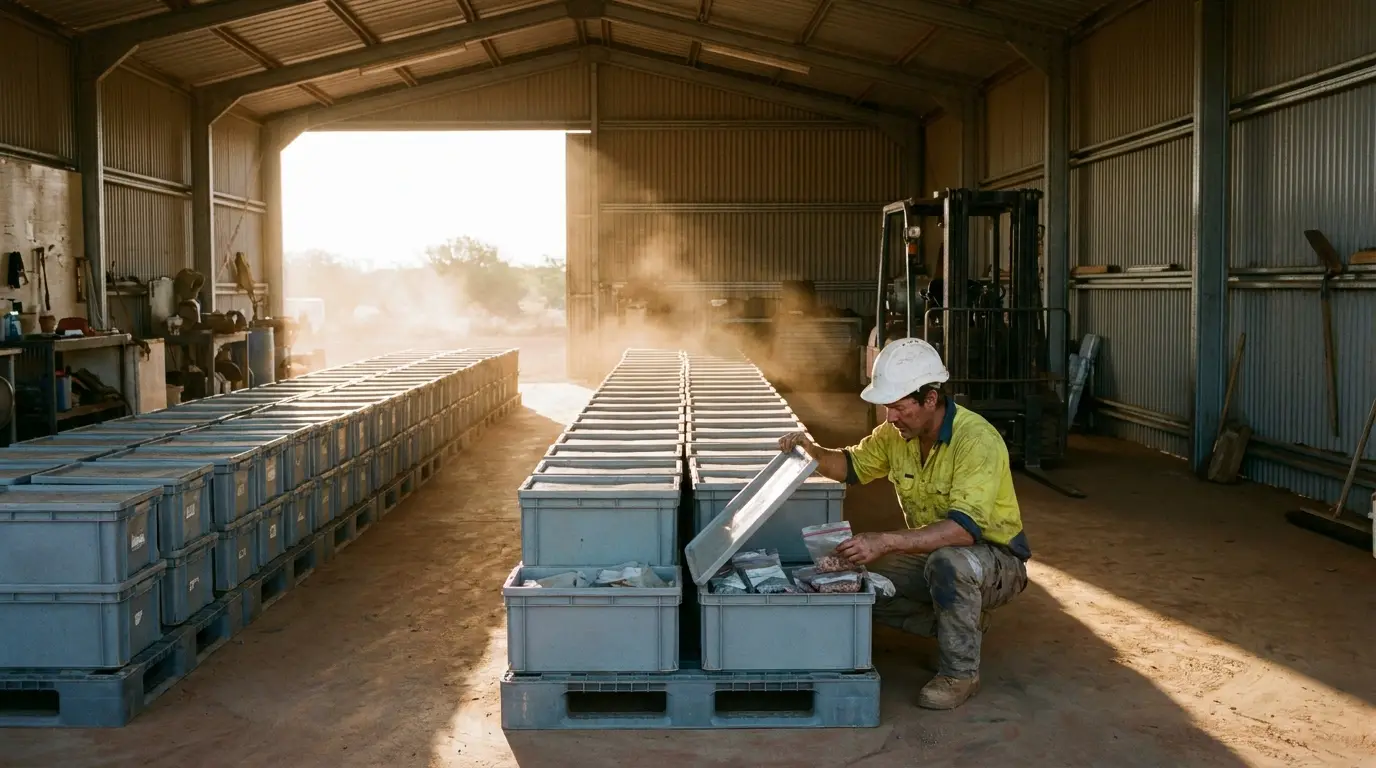
Every storage guide on this site so far has been about diamond core: tray sizes, tray handling, shed layout. Reverse-circulation drilling produces something structurally different, and it is stored badly on most sites as a result. A diamond program gives you a manageable number of large, standard trays. An RC program gives you thousands of small units, chip trays, calico bags, pulps and coarse rejects, and the whole storage cost turns on how efficiently those units palletise. This guide works that problem, and lands on a finding most Australian sites will not like about their crates.
What is different about storing RC samples?
Three things, and each one inverts a rule that works for core. Unit count: core arrives as a modest number of large trays that are themselves the storage unit; RC arrives as a very large number of small containers that must be grouped into something a forklift can move. Streams: a single sampled interval typically leaves behind more than one physical item to keep, a retained chip sample and a pulp or reject, so the archive grows faster than the metre count suggests. Material behaviour: core is a solid cylinder that stays where you put it, while RC material is loose, dusty and mobile, so containment and lot segregation become storage requirements rather than housekeeping.
The practical consequence is that RC storage is a packing and retrieval problem. Nothing you buy will be near its load limit; a crate of rock chips is heavy but not structurally demanding, and the pallet under it is rarely the binding constraint. What binds is floor area, rack positions and whether anyone can find lot 14,207 in four years. That is why this guide spends its arithmetic on geometry rather than on load ratings, and why the sizing of core trays and their bases is deliberately left to the existing guides on drill core tray sizes and drill core tray handling.
How much material does an RC program generate?
Australia drills a great deal, and it is drilling more. The ABS reported 3,120.1 km of metres drilled for the March 2026 quarter on a seasonally adjusted basis, a rise of 9.3% (264.8 km) on the previous quarter (Mineral and Petroleum Exploration, Australia, abs.gov.au). More telling for a sample store is where that money goes: in the same release, mineral exploration expenditure on existing deposits was $733.6m against $215.7m on new deposits, so roughly 77% of the spend went into ground that is already known.
One honest caveat before anyone builds a business case on it: ABS does not publish a split between diamond and reverse-circulation metres, and we are not going to invent one. What the release does establish is that the national metre count is large and growing, and that the majority of the spend sits in brownfields work, which is the drilling that runs at tight sample spacing and generates high unit counts rather than a handful of deep, headline holes. If your program looks like that, your storage problem is a counting problem.
"The sample shed always gets designed last, and always gets designed for the core. Then two seasons of RC lands on the pad in whatever crates were in the shipping container that week, four different footprints, none of them matching the pallet, and the whole lot gets stacked on the floor because it will not rack. Pick the crate before the first hole, not after the fifth."
- John Meir, Sales Leader, 20+ years in plastic materials handling
The crate footprint problem nobody checks
Here is the finding. The 600×400 mm crate that everyone treats as the industry standard is a metric packaging module, descended from the ISO 3394 module family that is built around the 1200×1000 and 1200×800 footprints. On those decks it tiles perfectly. On the Australian 1165×1165 pallet it does not close at all, because two 600 mm crates need 1,200 mm of deck and you only have 1,165 mm.
The table below is an exhaustive packing check of real crate footprints from our range against the three pallet decks Australian sites actually run, counting maximum crates per layer with both orientations allowed, and the percentage of the deck footprint they occupy.
| Crate footprint (mm) | 1165×1165 (AU) | 1200×1000 (ISO) | 1200×800 (Euro) |
|---|---|---|---|
| 600×400 | 4 — 70.7% | 5 — 100% | 4 — 100% |
| 577×385 | 6 — 98.2% | 5 — 92.6% | 4 — 92.6% |
| 568×380 | 6 — 95.4% | 5 — 89.9% | 4 — 89.9% |
| 430×323 | 8 — 81.9% | 8 — 92.6% | 6 — 86.8% |
| 645×413 | 4 — 78.5% | 3 — 66.6% | 2 — 55.5% |
Read the first two rows against each other, because that is the whole article in two lines. On an Australian deck, a 577×385 crate fits six per layer using 98.2% of the footprint, while the 600×400 fits four using 70.7%. The 577 crate is about 4% shorter and 4% narrower, and it gives you 50% more crates per layer. Three columns of 385 mm come to 1,155 mm and two rows of 577 mm come to 1,154 mm, both inside 1,165. Two rows of 600 come to 1,200 and do not.
The inverse is true as well, which is why this is a genuine trade rather than a universal answer. Move the same crates onto an ISO 1200×1000 deck and the 600×400 goes to a perfect 100% while the 577×385 falls to 92.6%. So the right crate genuinely depends on which pallet your site standardised on, and the reason so many Australian sample sheds are inefficient is that they inherited a crate designed for a deck they do not use. If you are choosing footprints from scratch, our guides to why the Australian pallet is 1165×1165 and CHEP vs Euro vs Australian pallet sizes cover the wider consequences.
Litres of archive per pallet position (worked table)
Crates per layer is only half of it. What a sample shed is actually rationed by is pallet positions, so the number to optimise is litres of archive per position, which combines footprint efficiency with how the crate height divides into your stack. The table below works that out for real crates in our range, all on an Australian 1165×1165 deck, to a stated 1,300 mm crate stack above the pallet.
| Crate | Size (mm) | Body | Per layer | Layers in 1,300 mm | Crates / position | Litres / position |
|---|---|---|---|---|---|---|
| BPB-C5721UFV | 577×385×211 (41 L) | vented, folding | 6 | 6 | 36 | 1,476 L |
| BPB-C5638S | 568×380×323 (50 L) | solid | 6 | 4 | 24 | 1,200 L |
| BPB-AP4D | 430×323×210 (22 L) | solid | 8 | 6 | 48 | 1,056 L |
| BPB-6424U | 600×400×240 (50 L) | vented | 4 | 5 | 20 | 1,000 L |
| BPB-AP10 | 645×413×276 (52 L) | solid | 4 | 4 | 16 | 832 L |
| BPB-AP15 | 645×413×397 (68 L) | solid | 4 | 3 | 12 | 816 L |
The spread is 816 L to 1,476 L per pallet position, an 81% difference on identical pallets at an identical stack height, decided entirely by which crate the site bought. And the direction is counter-intuitive: BPB-AP15 is the largest crate in the comparison at 68 L and it produces the smallest archive per position, because its 645×413 footprint only manages four per layer on an Australian deck and its 397 mm height divides into 1,300 mm just three times, wasting 109 mm of clear stack.
Put that against a program. Assume 20,000 m of RC sampled at one-metre intervals and, as a stated planning figure, 1.5 litres of retained material per interval once chips and pulps are counted; that is 30,000 L of archive. At 1,476 L per position it needs 21 positions. At 816 L it needs 37. Sixteen extra rack positions, for one program, from a crate decision made once. Multiply by however many seasons your archive has to survive, and put the resulting floor area against the layout arithmetic in core shed layout: floor, aisles and retrieval time.
Solid or vented? Fines, dust and cross-contamination
The table has an awkward result in it that has to be dealt with honestly: the highest litres-per-position crate, BPB-C5721UFV, is a vented crate, and vented is the wrong body for rock samples. Vented crates exist to move air through perishable product. Rock chips, pulps and coarse rejects do not want air; they shed fines, and a vented wall or floor lets those fines migrate onto whatever is stacked underneath. In an archive you may re-assay years later, that is a chain-of-custody problem, not a tidiness problem.
So the real comparison for RC is solid bodies only, and on an Australian deck that shortlist ranks: BPB-C5638S at 1,200 L per position, BPB-AP4D at 1,056 L, then the 645×413 solid crates at 816–832 L. The security crate wins that comparison twice over, because a solid, lidded, tamper-evident body is exactly what a retained sample wants, and its 568×380 footprint happens to be one of the best fits on the Australian deck at 95.4%. It is unusual for the container that is right on integrity grounds to also be the one that is right on geometry, and it is worth taking when it happens.
Two things this does not settle. Folding and nesting features are worth very little in a sample archive, because the crates arrive once and stay full, so do not pay for a fold ratio you will never use; the trade-offs are in stackable, nestable or folding crates. And bulk metallurgical samples and coarse rejects held in volume belong in a rigid bulk container rather than a crate, which is covered under the bulk-sample section of drill core tray handling.
Pallet base, tare weight and racking the archive
Under the crates, the pallet does two jobs: it makes a stack of small units into one forklift move, and it decides whether the archive can go into a rack at all. For a long-life sample store, a rackable Australian-footprint plastic pallet is the sensible default. A full-perimeter base like the BPB-E1165LS spreads the load along the beams and gives a stable seat on a dusty, uneven pad; a three-skid deck such as the 1160×1160 BPB-E1160V carries the same published 10,000 / 2,000 / 2,000 kg figures at 17.6 kg instead of 24.3 kg, which matters once you multiply it across a few hundred positions.
Count the tare honestly, because crates are not free weight. Twenty-four solid crates at 2.4 kg is 57.6 kg of container before a single sample goes in, and 36 vented crates at 1.75 kg is 63 kg. Add the pallet and a 200-position archive is carrying somewhere around 16–18 tonnes of empty container around its samples. That is not a structural problem for the racking figure, but it is real freight on the way in and real mass in the building.
The racking rules are the same ones that govern any Australian rack. Design, installation and load signage sit under AS 4084:2023 (Steel storage racking), and the general duties around loading, inspection, damage and stability sit under work health and safety law (safeworkaustralia.gov.au). Size to the pallet's published racking figure at your actual beam span rather than the flattering static number, and remember that a slab feels concentrated upright reactions rather than an average load per square metre, so a rack supplier and a structural engineer make that call, not a spreadsheet.
How do I brief a supplier on RC sample storage?
Five facts, and the first one is the one most briefs omit. Tell a supplier: the pallet footprint your site already runs, because that decides the crate before anything else does; the expected unit count per season, not just the metres; whether the material is retained chips, pulps, rejects or all three, which decides solid versus vented and lidded versus open; your clear stack height under the beam or under the roof; and whether the archive racks or floor-stacks, which decides whether the pallet needs a published racking figure at all.
Then standardise and stop. One crate footprint, one crate height, one pallet footprint, across the whole program. A sample archive fails on retrieval far more often than it fails on strength, and a mixed fleet of crate sizes is what makes retrieval impossible, because nothing stacks square, nothing racks predictably and no two positions hold the same count. If you are also handling drill core on the same pad, keep both on the same pallet family so one rack layout and one tine setting serve the lot.
Browse the range in plastic crates, rackable decks in plastic pallets, bulk units in IBCs & bulk containers, everything we supply into resources in the mining and resources range and the wider catalogue, or send your pallet footprint, expected unit count and freight postcode for a spec-backed quote.
Common questions
How should RC chip trays and samples be stored?
In solid-bodied, stackable crates on a rackable plastic pallet, with the crate footprint chosen to suit the pallet you already run. RC produces very high unit counts of small items, chip trays, calico bags, pulps and rejects, so the storage cost is driven by how efficiently those units palletise rather than by the strength of any one container. Standardise on one crate and one pallet footprint across the whole program, because a mixed fleet is what makes a sample archive un-rackable.
Why is a 600 x 400 crate a poor fit on an Australian pallet?
Because 600×400 is a metric packaging module built around the 1200×1000 and 1200×800 footprints, where it tiles perfectly. Two 600 mm crates need 1,200 mm of deck and the Australian pallet is 1,165 mm, so the module simply does not close. The best arrangement on a 1165×1165 deck is a four-crate pinwheel using 70.7% of the footprint, against 100% on an ISO 1200×1000. On an Australian site, a 577×385 or 568×380 crate fits six per layer instead.
Should RC sample crates be vented or solid?
Solid. RC chips, pulps and rejects shed fines, and a vented crate lets those fines fall through onto whatever is stacked below it, which is a cross-contamination risk in an archive you may re-assay years later. Vented bodies exist to move air through perishable product; a rock sample does not need air, it needs containment and a clean chain of custody. If you must use a vented crate for other reasons, line it or bag every lot.
How many sample crates fit on a pallet?
On an Australian 1165×1165 deck, four 600×400 crates per layer, six 577×385 or 568×380 crates, or eight 430×323 crates. How many layers you get depends on crate height and the stack height your racking and forklift allow. Working to a 1,300 mm crate stack, our range delivers between 12 and 48 crates per pallet position, and between 816 and 1,476 litres of archive, on identical pallets, see the worked table on this page.
Do I need a rackable pallet under a sample archive?
If the archive goes into a rack, yes, and you need to size on the published racking figure rather than the static one. Sample material is dense and the tare of the crates themselves is not trivial: 24 solid crates weigh about 58 kg before a single sample goes in. Australian racking is designed and loaded under AS 4084:2023 and the storage duties sit under work health and safety law, so confirm the rack figure at your actual beam span.
How long do exploration samples need to be kept?
Longer than most programs plan for. Coarse rejects and pulps get pulled for re-assay, umpire assays, metallurgical testwork and due diligence years after the hole was drilled, and a sample you cannot find or cannot prove the identity of is functionally a sample you did not keep. That is a labelling, segregation and retrieval problem more than a container-strength problem, which is why crate standardisation and a single palletised module matter more here than raw load rating.
Sources: metres drilled and mineral exploration expenditure by new and existing deposits, Australian Bureau of Statistics, Mineral and Petroleum Exploration, Australia, March quarter 2026 (abs.gov.au) — the release reports metres drilled and expenditure but does not publish a split between diamond and reverse-circulation drilling; packaging module dimensions, ISO 3394; pallet racking design and loading, AS 4084:2023 Steel storage racking (Standards Australia) with storage racking duties per Safe Work Australia (safeworkaustralia.gov.au); pallet dimensions, AS 4068 and ISO 6780. Crate and pallet dimensions, volumes, tare weights and load ratings are the published figures for the specific models named and are current at the time of writing; confirm on the quote. Crates-per-layer counts and footprint percentages are an exhaustive axis-aligned packing check of published external dimensions with both orientations allowed, and assume no overhang and no strapping allowance. Litres-per-position, program-volume and tare figures are arithmetic on those dimensions and on the stated assumptions (1,300 mm crate stack; 20,000 m sampled at one-metre intervals; 1.5 L retained per interval), presented as a planning method, not a published storage standard. Not a quote.