
Apple and pear bins: bin depth, drop height and bruise-free handling

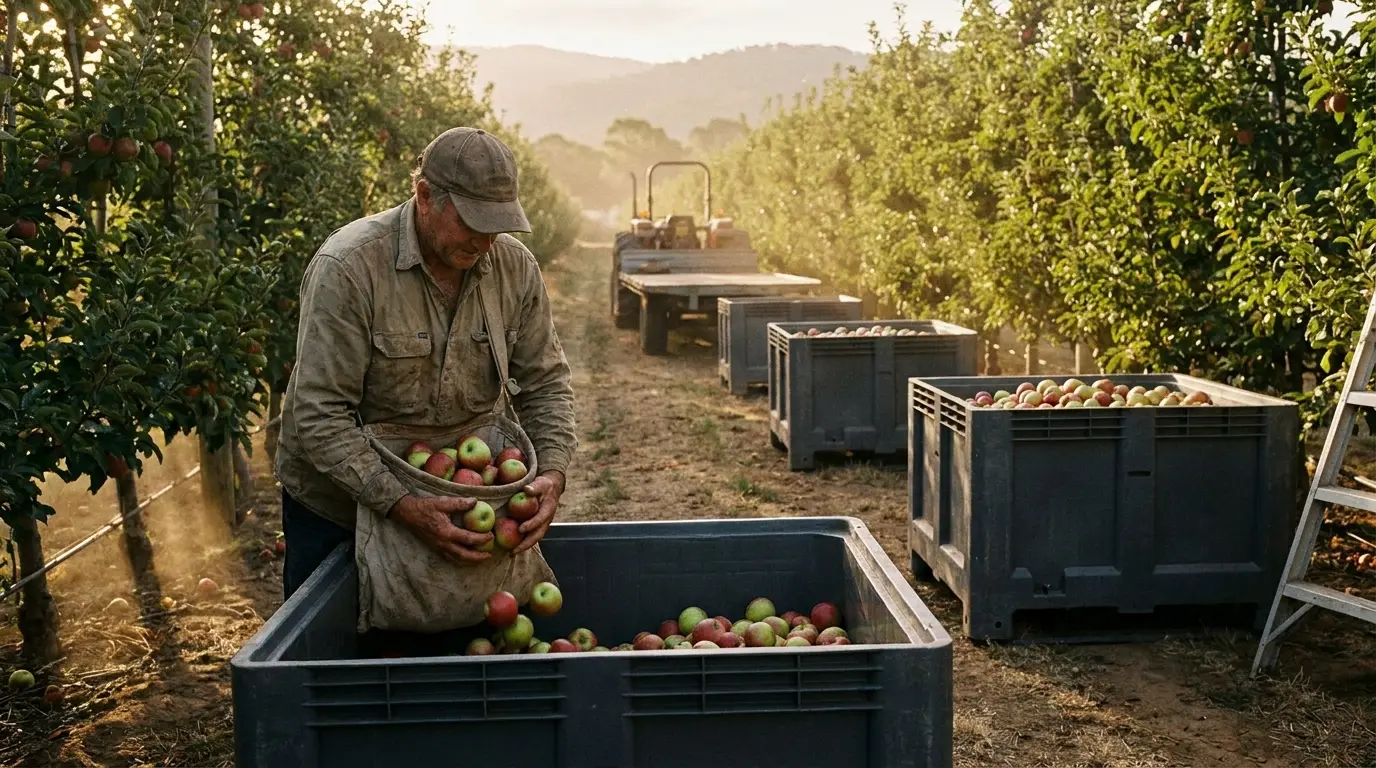
Every bin spec sheet for apples and pears leads with the same numbers: footprint, litres, load rating. None of them lead with the number that decides how much of your crop grades out as bruised, which is the internal depth of the bin, because that is exactly how far the first apple falls onto a hard floor. This is a pome-fruit handling guide built around that one measurement, with cited drop-test evidence, a worked table across our real vented range, and an honest account of why buying shallower bins is a weaker fix than it first appears.
Which bin should apples and pears go into?
A vented plastic bulk bin, sized to your existing forklift and store, with the shallowest internal depth you can tolerate at the point where fruit is tipped or dropped, and a smooth, radiused interior with no fasteners. That is the short version. Pome fruit is a bruising crop with a long storage life, so the bin has two jobs that pull in different directions: be gentle at fill, and be a stable, ventilated, sanitisable box for a hold that can run for months.
The reason depth belongs at the front of the decision is that it is the one bruise variable a purchase order actually controls. Picker technique, drop pads, controlled-flow fillers and water dumping all matter more, but they are operational; the bin is a fixed asset you buy once and live with for a decade. Get the depth wrong for the stage and you have built the bruise in. The rest of this article works through what the published drop-test evidence actually says, what our own range measures, and where the trade-off genuinely lands.
What actually bruises an apple in a bin?
Impact, and it takes remarkably little of it. In a free-drop study published in Materials, apples were dropped from 10 mm to 150 mm in 10 mm increments onto four different substrates. A foam substrate protected the fruit from bruising only up to about a 50 mm drop; cardboard helped at the lowest heights and degraded as height rose; and wood and concrete, the two stiffest surfaces tested, produced broadly similar bruising to one another. Cultivar mattered too, with the varieties tested ranking from most to least resistant (Słupska, Syguła, Komarnicki, Szulczewski & Stopa, Materials 15(1):139, 2021).
Two things fall out of that, and both are uncomfortable for anyone selling plastic bins. First, the entire tested range topped out at 150 mm, which is shallower than every bulk bin on the market. Second, the protective effect came from a soft substrate, and the stiff substrates behaved alike. A moulded HDPE or PP bin floor is a stiff substrate. It is smoother, more consistent, splinter-free and nail-free than sawn timber, and those are real advantages, but it is not a cushion and it would be dishonest to sell it as one.
"Growers ask me which bin bruises fruit least, and the honest answer is that no bin is soft. Where plastic wins is that it is the same shape and the same surface in year eight as it was in year one, so a controlled fill you set up once keeps working. A timber bin drifts, splits, and eventually there's a proud nail head in the corner nobody sees until they see it in the pack-out."
- John Meir, Sales Leader, 20+ years in plastic materials handling
Bin depth is the drop height (worked table)
Here is the measurement that connects that evidence to a purchase order. When a bin is empty, the internal depth is the free-fall distance for the first fruit that goes in. The table below is our real vented range, sorted by internal depth, with each depth expressed against the 50 mm figure that foam was found to protect up to and against the 150 mm top of the tested drop range. The multiples are simple arithmetic on published dimensions, not a bruise prediction.
| Vented bin | External (mm) | Internal depth | Volume | × 50 mm | × 150 mm |
|---|---|---|---|---|---|
| BPB-D1208V44 | 1200×800×440 | 300 mm | 240 L | 6.0× | 2.0× |
| BPB-D1210V54 | 1200×1000×540 | 385 mm | 395 L | 7.7× | 2.6× |
| BPB-K1165HV | 1162×1162×560 | 400 mm | 470 L | 8.0× | 2.7× |
| BPB-D1210V74 | 1200×1000×740 | 585 mm | 605 L | 11.7× | 3.9× |
| BPB-D1208V74 | 1200×800×740 | 600 mm | 500 L | 12.0× | 4.0× |
| BPB-E1165FV | 1162×1162×785 | 640 mm | 750 L | 12.8× | 4.3× |
| BPB-D1120V78 | 1120×1120×780 | 650 mm | 700 L | 13.0× | 4.3× |
| BPB-1311V | 1300×1150×1250 | 1,085 mm | 1,400 L | 21.7× | 7.2× |
The spread is the finding. Internal depth across the vented range runs 300 mm to 1,085 mm, a 3.6× difference in how far the first apple falls, and every single bin is deeper than the entire range that study tested. The largest bin in the range drops that first apple 21.7× further than the deepest drop foam was shown to protect against. Nothing in a spec sheet flags this, because internal depth is published as a capacity input, not as a handling risk.
Two caveats, stated plainly. This is the worst case, the very first fruit into a bare bin. And a drop onto other fruit is not the same event as a drop onto a hard floor; once a couple of hundred millimetres of apples are in the bin, the fruit is landing on fruit. Which leads directly to the trade most growers get backwards.
Do shallower bins actually cut bruising?
Partly, and at a price that is bigger than it looks. Take a like-for-like volume comparison from the table: one BPB-1311V at 1,400 L against enough BPB-D1210V54 at 395 L to match it. You need four of the shallow bins (1,580 L) to replace one deep one.
| Per ~1,400 L of fruit | 1 × BPB-1311V (1,085 mm deep) | 4 × BPB-D1210V54 (385 mm deep) |
|---|---|---|
| Deepest empty-bin drop | 1,085 mm | 385 mm (−64%) |
| Hard-floor "first layers" created | 1 | 4 |
| Floor area occupied | 1.50 m² | 4.80 m² (3.2×) |
| Forklift moves for the same fruit | 1 | 4 |
| Tare weight carried | 68.5 kg | 132 kg (1.9×) |
So the shallow bin buys a 64% lower worst-case drop and pays for it with four times as many hard-floor first layers, 3.2 times the floor, four times the handling and roughly double the dead weight. Scale it and the pattern holds: 10,000 L of fruit needs 8 deep bins or 26 shallow ones, which is 26 bare floors taking first fruit instead of 8. Every one of those handling events is also its own chance to knock, tilt or drop a bin.
The honest conclusion is that bin depth is a real variable but a weak lever, and treating it as the fix is how growers end up with an expensive, floor-hungry fleet that still bruises fruit. Depth is worth optimising exactly where fruit meets a bare floor under gravity, at picking and at transfer points; it is not worth optimising for the store, where the bin is simply a stable, ventilated box and the deep unit wins on every count. The large gains sit in the fill itself: keeping the fall onto fruit rather than onto plastic, and reducing the height of every transfer in the chain. We work through where those transfer losses accumulate across a whole season in how bin choice cuts post-harvest loss.
What to look at inside the bin
Once depth is settled for the stage, the rest of the bruise story is interior geometry, and it is worth physically putting a hand inside a sample bin before you buy a fleet. Four things matter for pome fruit:
- Radiused internal corners. Fruit funnels into corners on every tip and every truck movement. A sharp internal corner concentrates the load of the whole column onto the few apples wedged into it.
- A continuous internal wall. Ribs, ledges and steps inside the body are places fruit stops, gets pinched by the fruit above, and gets crushed rather than rolled.
- No fasteners at all. This is the clearest, least arguable advantage plastic has over timber. A one-piece moulded body has no nails, staples, split boards or proud edges, and it cannot develop them in year six.
- Vent geometry that does not pinch. Vents have to move air without creating slots that catch stems or shear skin when a load settles. Look at the vent edges from inside, not from outside.
The wash-down argument sits alongside this rather than separate from it. A non-porous, one-piece plastic body can be washed and sanitised between seasons, so the bin that is gentle on fruit is also the bin you can bring back to a known state before the next harvest; a porous timber bin cannot be. The full method, and where the water actually has to reach, is in our hot-wash and sanitation SOP for produce bins. If you are still deciding between a vented and a solid body, start with vented vs solid bulk bins.
What a pome bin has to survive in the store
Apples and pears are among the longest-stored fresh crops in Australia, and that puts a set of demands on a bin that a short-cycle vegetable bin never faces. The store is cold, very humid and long: pome fruit is held near the low end of the fresh range at high relative humidity, in air or in a controlled atmosphere, for a period measured in months rather than weeks (see the UC Davis Postharvest Research and Extension Center produce-facts sheet for apple for the recommended conditions for a given cultivar).
Three consequences for the bin, in order of how often they bite:
- Sustained water exposure. Months at high humidity is a wet environment. A plastic body does not absorb water, swell, delaminate or rot; timber does all four, and a swollen bin no longer stacks square.
- Airflow through, not around. Respiration continues in store, so the vented body has to keep letting air through the fruit column for the whole hold. The stack geometry that decides whether the middle of the stack actually gets that air is worked through in cool-room bin stacking.
- Cold and load together. A bin near the bottom of a long-term stack carries the mass above it for months, at temperature. Use the published static figure for a floor stack and the racking figure where the bin bridges beams, keep well under both, and confirm low-temperature behaviour with your supplier for a multi-month hold rather than assuming an ambient rating transfers.
Note which bins in the table above publish a racking figure and which do not. Of the vented units listed, BPB-E1165FV publishes 500 kg racking and BPB-1311V publishes 1,000 kg, while several of the one-piece vented containers publish static and dynamic figures only. A bin with no published racking rating is a floor-stacking and transport bin, not a rack bin, and that distinction decides your store layout before you buy a single beam. Australian pallet racking is designed and loaded under AS 4084:2023 (Steel storage racking), with the general storage and stacking duties under work health and safety law (safeworkaustralia.gov.au).
How do I brief a supplier on apple and pear bins?
Five facts get you a bin that fits the job rather than one that fits a catalogue page. Give a supplier: the stage the bin serves (picking, transfer, store or all three); the internal depth you can accept at the deepest drop in that stage; whether it must rack or only floor-stack; the hold duration and store conditions, including whether it is a controlled-atmosphere room; and the footprint your forklift, trailer and existing racking already run, because changing that ripples through everything.
Add two things most briefs leave out. Say whether you will be washing between seasons, because that decides body construction as much as hygiene policy does. And say whether the bins ever travel back empty, because if they do, a folding body changes the return-freight arithmetic completely, which we work through in collapsible vs fixed bulk bins. If you are still choosing between a paddock-going bin and a shed bin, field harvest bins vs packhouse bins covers where that line actually falls.
Browse the vented and solid units in IBCs & bulk containers, the wider fresh produce range and the full catalogue, or send your crop, hold duration, store type and freight postcode for a spec-backed quote.
Common questions
What size bin do apple and pear growers use in Australia?
Most pome-fruit operations run a large square bulk bin in the 700–1,400 litre class so a full bin is a single forklift move from the row to the store. In our range that is anything from a 750 L folding vented pallet box on the Australian 1162 mm footprint up to a 1,400 L giant vented pallet box. The footprint is usually set by what your forklift, trailer and store racking already handle, so match the existing fleet first and choose depth second.
How far can an apple fall before it bruises?
Far less than most people assume. In a peer-reviewed free-drop study, apples were dropped from 10 mm to 150 mm onto four substrates; a foam substrate protected fruit up to about a 50 mm drop, while wood and concrete, the stiffest surfaces tested, produced similar bruising to each other (Słupska et al., Materials, 2021). The exact threshold varies with cultivar, maturity, temperature and where the fruit is struck, so treat any single figure as a guide, not a limit.
Are plastic bins gentler on fruit than timber bins?
Not because plastic is soft, it is not. A moulded HDPE or PP floor is a hard substrate, much like the wood tested in drop studies. What plastic removes is everything else that damages pome fruit: splinters, protruding nails and staples, split boards, rough sawn grain, swollen corners and the dimensional drift that opens gaps a finger or an apple stem can catch in. It also washes and sanitises, where porous timber cannot. Choose plastic for consistency and hygiene, then engineer the softness into the fill.
Does a shallower bin reduce bruising?
It reduces the height of the worst drop, but not the number of hard-floor first layers, and it multiplies them. Replacing one 1,400 L bin with four 395 L bins cuts the deepest empty-bin drop from 1,085 mm to 385 mm, a 64% reduction, but you now have four bare floors taking first fruit instead of one, roughly twice the tare weight and 3.2 times the floor area. Shallow bins earn their place at picking and transfer points; deep bins still win in the store.
Do apple and pear bins need to be vented?
For anything held longer than a day or two, yes. Pome fruit respires, and respiration puts out heat, moisture and ethylene that have to leave the stack. A vented body lets a room or a forced-air system move air through the fruit rather than around the outside of a solid box, which is what actually pulls field heat down through the middle of a bin. Vented bodies are also the ones compatible with long, cold, humid storage where a sealed box would trap condensate.
Can plastic bins go into a controlled-atmosphere store?
A vented plastic bin is well suited to long cold storage: it does not absorb water at high humidity, will not rot or swell over a multi-month hold, and can be washed and sanitised between seasons, all things timber struggles with in a wet store. What it cannot do is manage the atmosphere for you, gas composition, temperature and humidity are the room's job. Confirm the specific bin's low-temperature impact behaviour and stacking rating with your supplier before you commit a whole store to it.
Sources: apple drop-height and substrate bruising evidence, Słupska M., Syguła E., Komarnicki P., Szulczewski W. & Stopa R., "Simple Method for Apples' Bruise Area Prediction", Materials 15(1):139, 2021 (doi.org/10.3390/ma15010139), open access; recommended apple storage conditions, UC Davis Postharvest Research and Extension Center produce-facts sheets (postharvest.ucdavis.edu); pallet racking design and loading, AS 4084:2023 Steel storage racking (Standards Australia) with storage and stacking duties per Safe Work Australia (safeworkaustralia.gov.au). Bin dimensions, internal depths, volumes, tare weights and load ratings are the published figures for the specific models named and are current at the time of writing; confirm on the quote. Drop multiples, floor areas, bin counts and tare comparisons in the tables are arithmetic on those published figures and on the stated volume assumption, presented as a planning method, not a bruise prediction or a published handling limit, and bruise thresholds vary with cultivar, maturity, temperature and impact site. Not a quote.