
Ventilation and ethylene: what a bin wall can and can’t fix

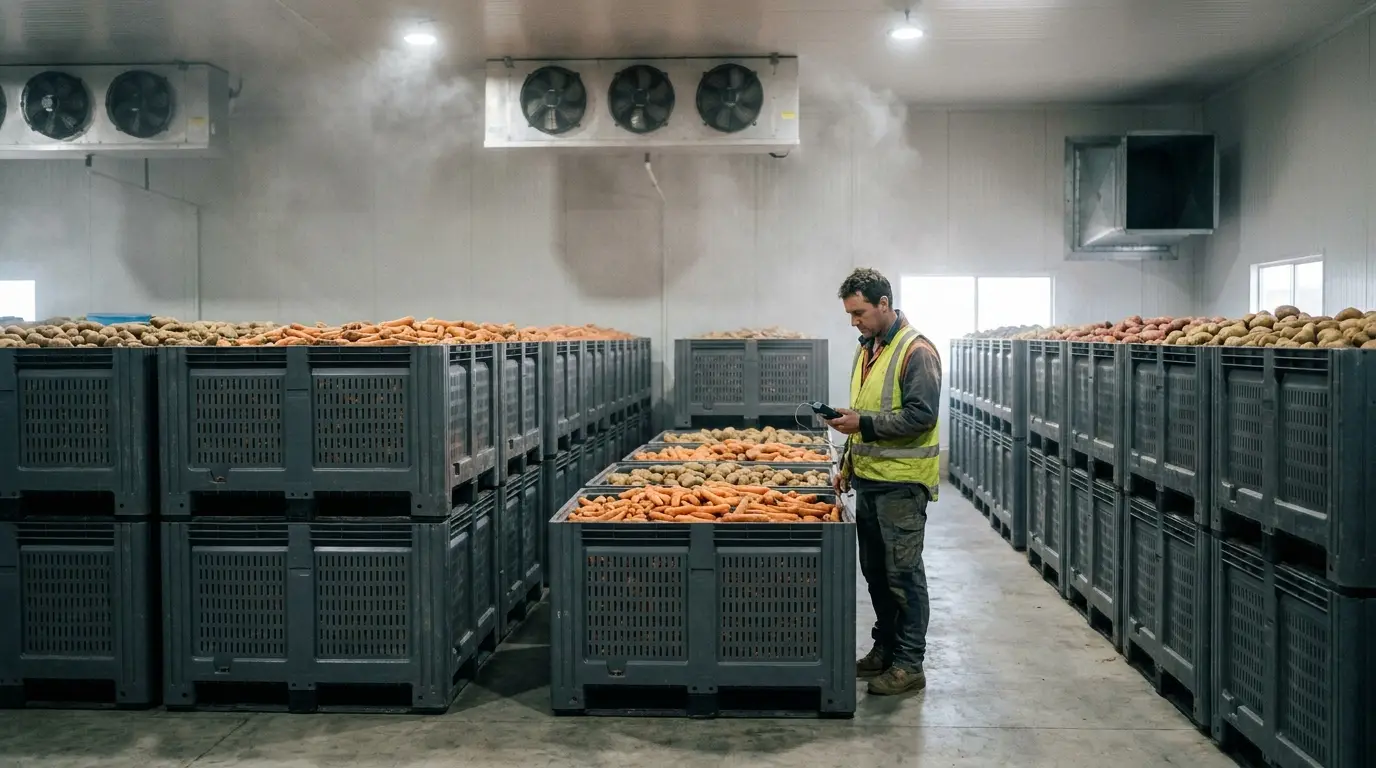
"Vented bins store longer" is one of the few claims in this trade that is both true and almost always explained wrongly. A vented wall does something specific and measurable, and it does nothing at all about a second problem that costs growers just as much crop. This article separates the two — with published respiration and ethylene numbers, and the arithmetic worked on real bins — so you know which storage problems you can buy your way out of and which ones you have to ventilate your way out of.
What does a vented bin wall actually do?
A vented wall is not a treatment. It is a coupling. Opening the wall lets the bin's internal atmosphere and temperature equalise with the room's, quickly and continuously, instead of sitting as a slowly-changing pocket inside a sealed box. Everything venting is good at, and everything it is useless at, follows from that one sentence.
Where the room is better than the bin's interior, coupling is exactly what you want. A stack of freshly-harvested potatoes is warmer and wetter inside than the cool room around it, so opening the wall lets the heat and the moisture leave. That is the whole mechanism behind the storage-life claim, and it is real.
But coupling has no preferred direction. Where the room is worse than the bin's interior, the same open wall hands the problem straight to the crop. Ethylene is the case that matters: a gas at parts-per-million concentrations, produced by some crops and damaging to others, whose level is set entirely by what else is in the room and how much air the room exchanges. A vented bin does not filter it, scrub it or slow it. If anything it speeds up the crop's exposure to it. A vented bin doesn't give the crop a good atmosphere; it gives the crop whatever atmosphere the room has. Which means the bin decision and the store decision are one decision, and most operations make them separately.
How much heat does a bin of produce give off?
Living plant tissue keeps respiring after harvest — burning sugars, giving off carbon dioxide, water vapour and heat — for the entire time it is in store. The rate is published per crop and per temperature, and the UC Davis Postharvest Technology Center produce-facts sheets give both the rate and the conversion to a heat load: multiply mL CO₂/kg·hr by 122 to get kcal per metric tonne per day (carrot, potato and broccoli sheets, postharvest.ucdavis.edu).
The table below runs that conversion on three crops, and then puts it on a real bin. The bin is a 1,400 L giant vented pallet box at a stated planning assumption of 600 kg/m³, giving 0.84 t of crop per bin — a round figure for sizing the decision, not a measured density for any particular crop. Rates are published ranges, quoted as ranges.
| Crop | Produce temp | Respiration (mL CO₂/kg·hr) | Heat (kcal/tonne·day) | Heat per 1,400 L bin (kcal/day) |
|---|---|---|---|---|
| Carrot (topped) | 0 °C | 5–10 | 610–1,220 | 512–1,025 |
| Carrot (topped) | 10 °C | 10–21 | 1,220–2,562 | 1,025–2,152 |
| Carrot (topped) | 20 °C | 23–48 | 2,806–5,856 | 2,357–4,919 |
| Potato | 5 °C | 6–8 | 732–976 | 615–820 |
| Potato | 10 °C | 7–11 | 854–1,342 | 717–1,127 |
| Potato | 20 °C | 9–23 | 1,098–2,806 | 922–2,357 |
| Broccoli | 0 °C | 10–11 | 1,220–1,342 | 1,025–1,127 |
| Broccoli | 10 °C | 38–43 | 4,636–5,246 | 3,894–4,407 |
| Broccoli | 20 °C | 140–160 | 17,080–19,520 | 14,347–16,397 |
Two things fall straight out of it. First, this is a genuine, continuous heat load that the vented wall exists to release — a warm bin of broccoli is shedding on the order of fifteen thousand kilocalories a day, and if the wall is sealed that heat has to leave through the crop itself, which is the mechanism behind hot centres, condensation and rot in the middle of a stack. Second, and more usefully, the load is enormously temperature-dependent, which is the subject of the next section.
Why venting matters most before the crop is cold
Run the ratios down the table and the pattern is sharp. Between 0 °C and 20 °C, carrot respiration rises 4.6× to 4.8×. Broccoli rises about 14×. Potato, measured from 5 °C to 20 °C, rises only 1.5× to 2.9×.
Which means the vented wall does the overwhelming majority of its work in the pull-down window — the hours between the paddock and a stable store temperature, when the crop is still warm and generating heat several times faster than it ever will again. Once the crop is cold, the heat it produces is a small fraction of what it produced warm, and the venting benefit, while still real, is a fraction of what it was. The practical consequence is that a vented bin used badly in the first twelve hours cannot be rescued by a good cool room afterwards: field heat you failed to pull is already spent as storage life.
That is also the honest answer to a question this site gets from its core audience. Potatoes have by far the flattest curve of the three, so if you are buying vented bins for potatoes purely on a heat argument, the heat argument is the weakest one available. The real potato case for venting is moisture — drying the surface, avoiding condensation, and managing sprouting conditions — not shedding a large heat load. Onion curing is the extreme version of exactly that, and is covered separately in curing and storing onions.
Broccoli is the opposite pole and makes the general point: the crop, not the bin, decides how much a vented wall is worth. At 14× and a raw load approaching sixteen thousand kilocalories per bin per day at 20 °C, a warm broccoli stack is a serious refrigeration problem, and the wall genuinely is the difference between the fans reaching the middle and not. How that stack is arranged so the air can actually get through it is a separate question, worked through in cool-room bin stacking.
How fast does ethylene build up in a store?
Now the half the bin cannot help with. Ethylene is a plant hormone, produced by ripening and by wounded tissue, and it acts at concentrations low enough that they are easy to dismiss until you do the arithmetic. UC Davis publishes apple ethylene production at 13 to 20 µL/kg·hr at 20 °C (postharvest.ucdavis.edu). Carrots, for contrast, produce more than 0.1 µL/kg·hr — call it two orders of magnitude less — and the same source records that "exposure to as little as 0.5 ppm exogenous ethylene will result in perceptible bitter flavor, within 2 weeks, at normal storage conditions", adding that carrots should not be mixed with ethylene-producing commodities.
Take a single bin of apples: the same 1,400 L box, at the same stated 600 kg/m³, so 840 kg. At the published rate that bin releases 10.9 to 16.8 mL of ethylene per hour. Put it in a stated 1,000 m³ room — say 20 m × 10 m × 5 m — with no air exchange, and the concentration climbs like this:
| Threshold | What happens at it | Time from one 1,400 L bin of apples |
|---|---|---|
| 0.5 ppm | Perceptible bitter flavour in carrots within two weeks (isocoumarin formation) | about 1.2 to 1.9 days |
| 2 ppm | Broccoli shelf life reduced by 50% at 10 °C | about 5.0 to 7.6 days |
One bin. Not a room full of apples — one bin, in a room the size of a modest shed, takes a mixed store past the concentration that turns a carrot crop bitter inside two days. Two honest caveats, because they matter: the apple production rate is published at 20 °C, so a properly cold room is considerably slower than this; and no real room is perfectly sealed. Both caveats point at the same place — this is the pull-down, staging-area and mixed-dock case, exactly the warm, crowded, briefly-shared spaces where growers put crops together because the cool room is full. Which is precisely where the previous section said the heat problem lives too.
What each crop does at those concentrations
The reason this catches people out is that the "produces ethylene" axis and the "is damaged by ethylene" axis are completely independent of the vented-versus-solid axis. Apples and carrots both want a vented bin. Putting them in the same air is the mistake, and the vented bin makes it happen faster.
| Crop | Ethylene produced (at 20 °C) | Response to ethylene exposure |
|---|---|---|
| Apple | 13–20 µL/kg·hr | The producer in the room — the source almost every mixed-store problem traces back to |
| Carrot | >0.1 µL/kg·hr | As little as 0.5 ppm gives perceptible bitter flavour within two weeks, via isocoumarin formation; should not be mixed with ethylene-producing commodities |
| Broccoli | <0.1–1.0 µL/kg·hr | Extremely sensitive; accelerated floret yellowing. Exposure to 2 ppm at 10 °C reduces shelf life by 50% |
| Potato | Very low (much higher if bruised, cut or damaged) | Not very sensitive, but responds in both directions — low levels may retard sprouting after 2–3 months above 5 °C without sprout inhibitor, while high concentrations may induce sprouting; low levels also elevate respiration, causing weight loss and mild shrivelling |
The potato row is the one worth pausing on, because it is genuinely counter-intuitive and it belongs to this site's core audience. Ethylene is not simply "bad" for potatoes: the published response runs in opposite directions depending on concentration, and the same gas that retards sprouting at low levels may induce it at high ones. That is not a lever to reach for casually — it is a reason to know your store's ethylene situation rather than assume it is irrelevant because the crop is a tuber.
Note also what raises potato ethylene production in the first place: bruised, cut or otherwise damaged tubers have greatly increased ethylene production rates. Handling damage is therefore not only a quality loss in the damaged tubers, it is an atmosphere problem for the rest of the store — which is a direct, physical link between how gently you fill a bin and how long the crop beside it lasts. The mechanics of drop height and fill technique are worked through in apple and pear bins: bin depth, drop height and bruising.
The fix is air exchange, not a bin wall
Here is the part that makes the whole problem tractable. Hold the same store and the same bin of apples, and ask how much fresh air you need to keep the concentration below 0.5 ppm at steady state. The answer is about 22 to 34 m³ per hour — which on a 1,000 m³ room is roughly 0.02 to 0.03 air changes per hour.
That is a very small amount of air. The contrast is the point: the concentration that ruins a carrot crop builds in under two days with no ventilation, and is held off indefinitely by an air exchange so modest it barely registers against the room's refrigeration load. The problem is cheap to solve and impossible to solve with a bin. No wall pattern, vent area, lid or material changes the number above, because the number is about the room.
So the priority order for a mixed store is:
- Segregate first. Keep heavy ethylene producers out of rooms holding sensitive crops. This is free and it is the single biggest lever. UC Davis states directly that carrots should not be mixed with ethylene-producing commodities.
- Ventilate second. A deliberate fresh-air exchange, sized against what is actually in the room, not left to door openings and luck.
- Then cool. Low temperature suppresses both halves of the problem at once — it cuts respiration heat several-fold and, per the broccoli data, is described as the most effective way to minimise ethylene effects.
- Then choose the bin. Vented for respiring crops, so the store you have built actually reaches the middle of the stack. That product choice, including the finding that vented and solid twins carry identical load ratings, is in vented vs solid bulk bins.
Note the order. The bin is last, not because it does not matter, but because a vented bin is how you deliver a good store atmosphere to the crop — it is not a substitute for having one. Buying vented bins into an unventilated mixed room buys you faster delivery of the wrong air.
How to spec the bins and the store together
Brief a supplier with five facts and the specification falls out of them: the crop, the temperature you can actually hold, what else shares the room, how long the crop sits, and whether the bins go back empty.
On the crop and temperature: if it is a high-respiration crop like broccoli, or anything going into store warm, prioritise open wall area and a stack layout the fans can push through — the vented wall is doing real work there. If it is potato or onion, the wall is buying you moisture management more than heat removal, and capacity, drainage and cleanability move up the list. Capacity by crop is tabulated in how much produce fits in a bulk bin.
On what shares the room: if the answer includes apples, pears or any other significant ethylene producer alongside carrots, broccoli or leafy crops, fix that before you order anything. On dwell time: the longer the crop sits, the more the small, continuous processes — respiration weight loss, low-level ethylene exposure, sprouting — dominate over the acute ones. And on the return leg, a folding vented bin like the one above collapses for backhaul, which is the freight side of the same decision and is worked through in collapsible vs fixed bulk bins.
Browse vented units in IBCs & bulk containers, crates in plastic crates, or the full catalogue; the produce range is collected at fresh produce, with crop-specific pages for potato bins and onion bins. When you know your crop, hold temperature and store volume, send them with your freight postcode for a spec-backed quote.
Common questions
Do vented bins stop ethylene damage?
No, and it is worth being blunt about it because the assumption is common. Ethylene damages produce at concentrations around 0.5–2 ppm, which is a property of the store atmosphere. A vented wall is a diffusion path: it lets the bin's internal atmosphere equalise with the room. If the room's ethylene is high, a vented bin brings the crop to that concentration faster than a solid one would. Venting solves the heat and moisture half of storage life; the ethylene half is solved by segregating ethylene producers from ethylene-sensitive crops and by exchanging air with outside.
Vented or solid bins for potatoes and onions?
Vented, for both — they are respiring crops that must shed field heat and moisture in store, and a sealed wall traps both. That product decision is covered in full in vented vs solid bulk bins, including the finding that vented and solid twins of the same model carry identical load ratings. What this page adds is the part that comes after the bin choice: potatoes have the flattest respiration curve of the crops below, so the heat argument for venting a potato bin is weaker than growers assume — its real payoff for potato is moisture and sprouting control, not heat removal. Curing airflow specifically is in curing and storing onions.
Can I store apples and carrots in the same cool room?
Not without controlling the air between them. Apples are a heavy ethylene producer — UC Davis Postharvest publishes 13 to 20 µL/kg·hr at 20 °C — while carrots produce more than 0.1 µL/kg·hr, roughly two orders of magnitude less, and are damaged by as little as 0.5 ppm exogenous ethylene, which produces perceptible bitter flavour within two weeks through isocoumarin formation. UC Davis states directly that carrots should not be mixed with ethylene-producing commodities. If the room is shared, it needs genuine fresh-air exchange (see the arithmetic on this page) and, ideally, physical separation.
How were the heat and ethylene figures on this page calculated?
The respiration rates and ethylene rates are published values from the UC Davis Postharvest Technology Center produce-facts sheets, quoted as ranges exactly as published. Heat is converted using the conversion given on those same sheets: multiply mL CO₂/kg·hr by 122 to get kcal per metric tonne per day. Bin mass is the bin's published volume at a stated planning assumption of 600 kg/m³ — a round figure for planning, not a measured density for any particular crop, and the ratios in the article are unaffected by it. The ethylene accumulation figures assume a stated 1,000 m³ room with no air exchange and the published apple production rate at 20 °C; a cold room is much slower, which is why the article frames this as the pull-down and mixed-load case. All figures are planning estimates for sizing a decision, not measurements of your store.
Is there an Australian standard for ethylene levels in a produce store?
No Australian Standard sets a maximum ethylene concentration for a produce cool room, and you should be sceptical of anyone who claims otherwise — the working thresholds in this article are published crop-response figures from postharvest research, not regulatory limits. What Australian rules do cover is the bin itself: under the Food Standards Code, Standard 3.2.2 places food-safety practice duties on businesses handling food, which is why bin surfaces have to be cleanable and food-contact suitable. The material side of that is in food-grade plastic: HDPE, PP & HACCP and the wash method in the hot-wash and sanitation SOP.
Sources: respiration rates, the mL CO₂/kg·hr × 122 = kcal/tonne·day heat conversion, ethylene production rates and ethylene responses for carrot, potato and broccoli, University of California, Davis, Postharvest Technology Center produce-facts sheets (postharvest.ucdavis.edu), including the published carrot finding that "exposure to as little as 0.5 ppm exogenous ethylene will result in perceptible bitter flavor, within 2 weeks, at normal storage conditions" through isocoumarin formation, and the published broccoli finding that exposure to 2 ppm ethylene at 10 °C reduces shelf life by 50%; apple ethylene production of 13–20 µL/kg·hr at 20 °C from the same source; food-safety practice duties for businesses handling food, Australia New Zealand Food Standards Code, Standard 3.2.2 (FSANZ). Heat-per-bin and ethylene-accumulation figures are worked from those published rates using clearly stated assumptions — bin mass from published bin volume at a stated 600 kg/m³ planning density, and a stated sealed 1,000 m³ room — and are planning estimates for sizing a decision, not measurements of any store; the apple production rate is published at 20 °C, so a cold room accumulates more slowly. No Australian Standard sets a maximum ethylene concentration for a produce store, and none is implied here; the thresholds quoted are published crop-response findings, not regulatory limits. Bin load figures are manufacturer-tested ratings for the specific models shown and vary with load distribution and beam span. Not a quote.