
Pallet weight and manual handling: which plastic pallet can a person actually lift?

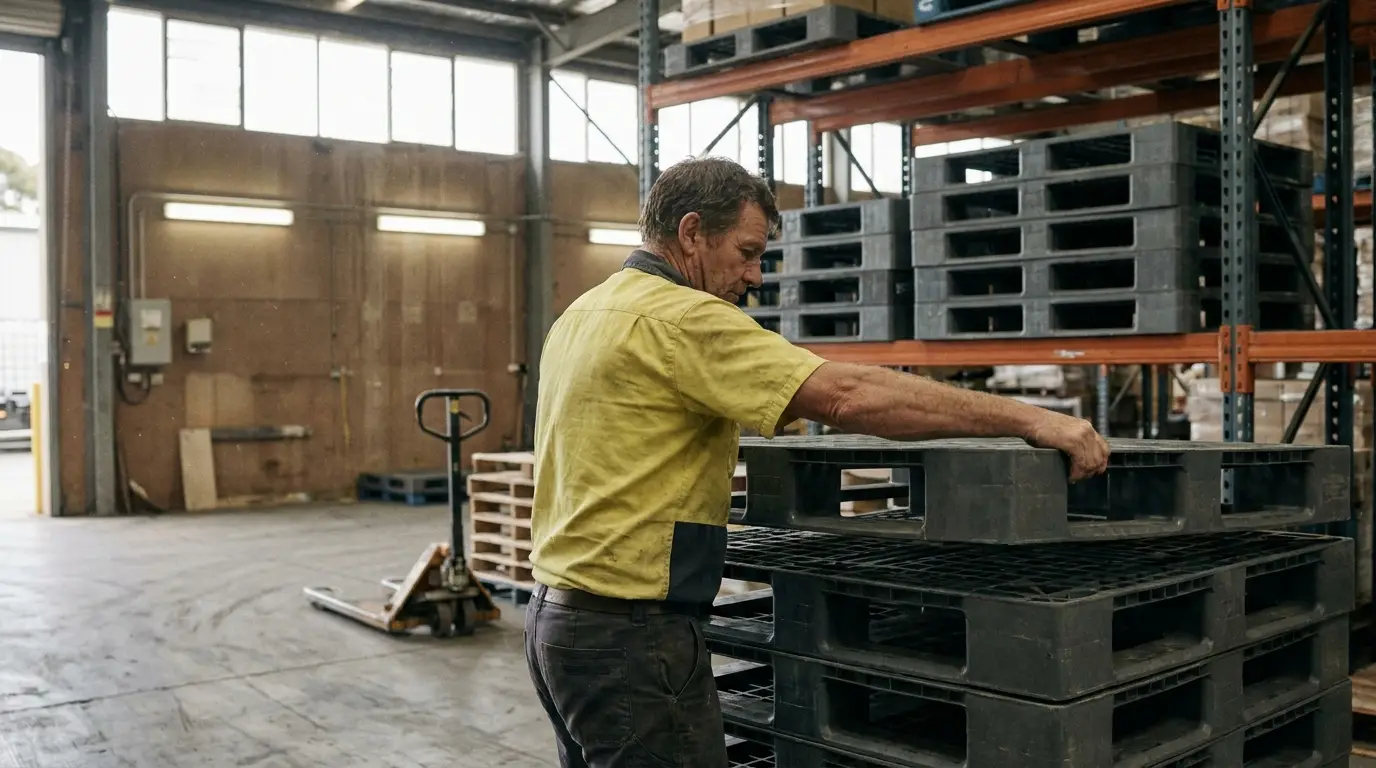
Most pallet specs are written for the load. Almost none are written for the person who picks the pallet up when it is empty - and that happens far more often than a spec sheet suggests. This is a look at what plastic pallets actually weigh, using the published figures for every deck in one Australian range, and at the finding that surprises most buyers: across a single footprint, deck mass and published load rating are barely related. You can very often take 14 kg out of the lift without losing a kilogram of rack capacity.
How heavy is a plastic pallet, and which can one person handle?
A plastic pallet weighs anywhere from about 4.4 kg to 29 kg, and the honest answer to "which one can a person handle" is: the lightest deck that still carries your load the way you actually move it. That sounds obvious. It is not what usually happens. The common failure is specifying one heavy-duty deck for the whole site because some of the site racks, and then handing every worker who touches an empty a 24 kg lift for the rest of the fleet's life.
The reason this matters more for plastic than for timber is that plastic gives you the choice. A timber pallet's mass is a consequence of the timber; a moulded deck's mass is a design decision, and different models at the same footprint make that decision very differently. The rest of this article puts our own catalogue numbers on the table so you can see the size of the choice you are actually making.
Why pallet weight is a work-health question, not a freight one
Pallet weight is normally sold as a freight story - lighter tare, more payload. That is real, and we work it through for bins in how many produce bins fit a semi-trailer. But the bigger exposure sits with the people handling empties, and the national injury data is unambiguous about where Australian workers get hurt.
In Key Work Health and Safety Statistics Australia 2025, Safe Work Australia reported 146,700 serious workers' compensation claims - claims involving at least one week of lost working time - for 2023-24. Body stressing accounted for 50,600 of them, or 34.5%: the single largest mechanism of injury, ahead of falls, slips and trips, and ahead of being hit by moving objects (safeworkaustralia.gov.au). Body stressing is the category that covers lifting, carrying, pushing and repetitive movement. It is, in other words, the category that empty-pallet handling sits in.
There is a second thing worth being clear about, because it is widely misunderstood: Australia has no legal maximum lifting weight. The Model Code of Practice: Hazardous manual tasks does not work that way. It treats a task as hazardous based on the combination of force, awkward or sustained posture, repetition, duration and vibration, and requires the risk to be eliminated or minimised so far as is reasonably practicable. So "it is under the limit" is not an answer - there is no limit. What there is, is a duty to make the task easier, and pallet mass is one of the few levers you can pull at purchase time.
How much do plastic pallets actually vary? (range audit)
Across the 132 SKUs in our catalogue, the plastic pallets that publish a weight run from 4.4 kg (a nestable light-weight Euro export deck) to 29 kg (a used heavy-duty hygienic ISO deck with a solid flat top). That is a 6.6× spread inside one product category, which is why "a plastic pallet weighs about X" is not a useful sentence.
Narrowing to a single footprint does not narrow it much. Here is every 1200 × 1000 mm deck in the range that publishes a weight, in ascending order, with its real published figures.
| Deck (1200 × 1000 mm) | Weight | Static (kg) | Dynamic (kg) | Racking (kg) |
|---|---|---|---|---|
| BPB-107 light weight | 4.9 kg | 1,500 | 750 | — |
| BPB-110 light weight | 5.4 kg | 1,600 | 800 | — |
| BPB-115 light weight | 5.9 kg | 1,200 | 600 | — |
| BPB-E1210 light weight | 6.4 kg | 2,000 | 600 | — |
| BPB-1210 light weight | 7.15 kg | 2,500 | 1,000 | — |
| BPB-E1210SL light weight | 7.5 kg | 3,000 | 1,000 | — |
| BPB-120 light weight | 7.5 kg | 3,200 | 900 | — |
| BPB-310 light weight | 9.0 kg | 3,200 | 800 | — |
| BPB-1210-3 medium duty ISO export | 9.3 kg | 2,500 | 1,200 | — |
| BPB-140 medium duty | 10.1 kg | 3,200 | 2,000 | 1,000 |
| BPB-320 medium duty | 12.5 kg | 6,400 | 1,600 | — |
| BPB-1210SU medium duty (used) | 15.0 kg | 4,000 | 1,000 | — |
| BPB-950 medium duty ISO | 15.5 kg | 5,000 | 1,250 | 500 |
| BPB-955 heavy duty ISO | 17.15 kg | 4,000 | 2,000 | 1,000 |
| BPB-750 medium duty ISO | 18.5 kg | 5,000 | 1,250 | 1,100 |
| BPB-720 heavy duty ISO | 24.5 kg | 8,000 | 2,000 | 1,000 |
| BPB-W1210USHD heavy duty hygienic (used) | 29.0 kg | 6,000 | 1,300 | 1,000 |
Seventeen decks, one footprint, 4.9 kg to 29 kg - a 5.9× spread. Two of these are second-hand stock, which we have flagged; the pattern holds without them. If your site handles empties by hand, the difference between the top and the bottom of this table is the difference between a routine task and one that belongs in a risk assessment.
Does a heavier pallet carry more? (the 1,000 kg table)
This is where the audit gets genuinely useful, and it is the finding we would want a buyer to take away. Look at the racking column above. Four decks publish exactly 1,000 kg racking - at 10.1 kg, 17.15 kg, 24.5 kg and 29 kg. The extra 18.9 kg between the lightest and the heaviest of those four buys you no additional published rack capacity at all.
What it does buy is static capacity: 3,200 kg on the 10.1 kg deck against 8,000 kg on the 24.5 kg one. Static is what the deck holds sitting on the floor or at the base of a block stack, where the whole underside is supported. That is a real and often decisive difference - if you block-stack heavy product, you want the mass. But if the pallet's job is to bridge two beams in a rack, the extra kilograms are not doing the work you think they are.
And the relationship is not even monotonic. The 15.5 kg BPB-950 publishes 500 kg racking. The 10.1 kg BPB-140 publishes 1,000 kg - double the rack figure for 5.4 kg less deck. The strongest rack figure at this footprint belongs to the 18.5 kg BPB-750 at 1,100 kg, not to either of the 24.5 kg or 29 kg decks. The same pattern shows up at 1200 × 800: an 18 kg deck in the range publishes 850 kg racking while a 20 kg deck publishes 650 kg.
"People buy weight because it feels like strength. It isn't. Rack rating comes from where the ribs and the beam-line supports are, not from how much polymer is in your hands. I have watched a site put 25 kg decks under a rack that a 10 kg deck was rated for, and then spend three years explaining the sore backs. Ask for the three numbers and the drawing, and let the lightest deck that clears them win."
- John Meir, Sales Leader, 20+ years in plastic materials handling
None of this means mass is worthless. A heavier deck is usually a thicker deck, and thickness is what survives forklift tine strikes, dropped loads and years of abuse - the argument we make in forklift abuse and pallet durability. It also matters that a closed, washable deck is heavier by construction, which we work through in hygienic pallets: open deck, closed deck and washability. The point is narrower and more practical: do not use mass as a shortcut for load rating, because at this footprint it simply is not one. The three published figures and what they mean are covered in plastic pallet load ratings: static vs dynamic vs racking.
The same published ratings for 6.7 kg less
The effect is not limited to the ISO footprint. Two Australian-standard decks in our range publish identical load figures - 10,000 kg static, 2,000 kg dynamic, 2,000 kg racking - and differ by 6.7 kg:
- BPB-E1165LS, 1165 × 1165 × 150 mm, 24.3 kg, full-perimeter base, anti-slip top, recycled HDPE.
- BPB-E1160V, 1160 × 1160 × 160 mm, 17.6 kg, three skids, recycled HDPE.
That is 27.6% less deck for the same three published numbers. The honest trade-off is in the base: a full-perimeter base spreads load continuously around the pallet edge, which is what you want on beam rails, on pallet-support bars and on soft or uneven ground, and it is the more forgiving choice when loads are point-loaded or the rack layout is not perfectly matched. Three skids is a lighter, well-proven construction, but the support is discontinuous, so the alignment between skid and beam matters more. Both are 4-way entry.
So this is a real decision rather than a free lunch - but it is a decision most buyers never get shown, because they compare "heavy duty" against "medium duty" as labels instead of comparing the published figures. If the ratings clear your load and the base suits your rack, the lighter deck removes 6.7 kg from every manual handling event for the life of the fleet, and takes a meaningful tonnage of dead weight out of a large installation. We follow that second effect through at facility scale in core shed storage and racking layout.
Why a pallet is a worse load than its mass suggests
A 24 kg pallet is harder on a body than 24 kg of boxed product, and the reason is geometry rather than mass. Four things stack up at once:
- Distance from the body. A 1200 mm deck cannot be held close in. Holding a load away from the trunk multiplies the compressive force on the lower back well beyond the load's own weight.
- No handles. The grip is a pinch on a deck edge or a hand hooked into a fork opening, so the forearm and shoulder work harder than the mass alone would require, and a wet or dusty deck makes it worse.
- Floor-level start. The bottom pallet of a stack is lifted from the deck of the floor, which is the highest-risk starting posture there is.
- Twist under load. Pallets are almost never lifted straight up. They are lifted, rotated, and placed on a stack beside the worker - and asymmetric loading under twist is exactly the combination the Code of Practice singles out.
The Model Code of Practice: Hazardous manual tasks identifies these as risk factors in their own right, independent of how much the load weighs, which is precisely why there is no weight threshold to hide behind. The practical consequence is that a 10 kg deck is not "40% better" than a 24 kg deck for the person doing the lifting - the improvement is larger than the arithmetic, because reducing mass also reduces how far the load pulls a worker off balance during the twist.
The other half of the answer is not to lift at all. Where empties are handled in volume, mechanical handling - a pallet jack, an inverter, a dispenser at the de-stack point - eliminates the task rather than making it lighter, which is the higher-order control the Code asks you to consider first. Deck mass is what you specify for the lifts that survive that process.
How do I spec for the lift without giving up the load?
Work in this order, and the answer usually falls out in one pass:
- Separate the racked fleet from the rest. Most sites rack a minority of their pallets. Specifying the whole fleet to the racked case is what puts unnecessary kilograms in everyone's hands. If the deck never goes on a beam, a light-weight deck in the 5-8 kg band is a different job entirely.
- Then spec to the racking figure, not the label. If it does rack, ask for the published racking rating at your beam span and take the lightest deck that clears it with margin. As the table above shows, that is often not the heaviest deck on the list.
- Check the static figure against how you stack. This is where mass genuinely earns its place. Block-stacking heavy product on the floor is a static load case, and there the heavier decks pull ahead properly.
- Count the manual touches. De-stacking empties, restacking returns, loading small deliveries, clearing a jam. Multiply by the deck mass and by the number of people doing it, and the difference between a 10 kg and a 25 kg deck stops looking like a detail.
- Standardise. One deck across a site means predictable stacks, predictable lifts, one forklift tine setting and no surprise 29 kg pallet in the middle of a column of 10 kg ones.
When you brief a supplier, give them the load mass, whether it racks and at what beam span, how you stack it, and how often a person touches an empty. Those four facts are enough to pick the deck. Compare the published weights and ratings across the full plastic pallet range or the whole catalogue, see how the same trade-offs play out on remote sites in our mining range and in packing and cold-chain work in fresh produce, or send your load, quantity and freight postcode for a spec-backed quote.
Common questions
How much does a plastic pallet weigh?
There is no single answer, and that is the point. Across our range a plastic pallet weighs anywhere from about 4.4 kg for a nestable light-weight export deck to 29 kg for a heavy-duty hygienic deck. Even at one footprint, 1200 × 1000 mm, the range runs from 4.9 kg to 29 kg. Ask for the weight of the specific model, not the category, because the category tells you almost nothing about the mass.
Is there a legal maximum weight for lifting a pallet in Australia?
No. Australian work health and safety law does not set a maximum lifting weight. The Model Code of Practice: Hazardous manual tasks treats a manual task as hazardous based on the combination of force, posture, repetition, duration and vibration - weight is one input, not a threshold. Your duty is to assess the actual task and eliminate or reduce the risk so far as is reasonably practicable, which for pallets usually means mechanical handling, a lighter deck, or both.
Does a heavier plastic pallet carry more weight?
Not reliably. In our own 1200 × 1000 range, four decks publish exactly the same 1,000 kg racking rating at 10.1 kg, 17.15 kg, 24.5 kg and 29 kg. One 15.5 kg deck publishes only 500 kg racking - half the figure of a deck 5.4 kg lighter. Extra mass generally buys static capacity (what the deck holds on the floor or at the base of a stack), and it buys durability, but it does not predict the racking figure. Read the static, dynamic and racking numbers for the specific model.
Which plastic pallet is best for manual handling?
The lightest deck that still carries your load the way you actually handle it. If the pallet never goes in a rack, a light-weight deck in the 5-8 kg band will usually do the job and is a fundamentally different lift to a 25 kg deck. If it does go in a rack, you do not have to jump to the heaviest option: a 10.1 kg medium-duty deck in our range publishes a 1,000 kg racking rating, the same figure as decks more than twice its mass.
Why is lifting a pallet harder than lifting the same weight in a box?
Geometry. A 1200 mm pallet has to be held away from the body, which multiplies the load on the lower back compared with the same mass held close in. It has no handles, so the grip is a pinch on a deck edge. It is usually lifted from floor level, and it is almost always twisted onto a stack rather than lifted straight up. The Model Code of Practice lists exactly those factors - awkward posture, sustained or repeated force, and poor grip - alongside weight, which is why mass alone understates the risk of a pallet lift.
How do I reduce manual handling risk in a pallet fleet?
Start by counting where pallets are handled by hand at all: de-stacking empties, restacking returns, clearing a jam, loading a light delivery. Then eliminate the lift where you can (pallet jack, inverter, dispenser), and where you cannot, reduce the mass by specifying to the load you actually carry rather than to the heaviest thing in the catalogue. Standardising on one deck also helps, because mixed stacks of different heights are where the awkward, unplanned lifts happen.
Sources: serious workers' compensation claim and mechanism-of-injury figures, Key Work Health and Safety Statistics Australia 2025, Safe Work Australia, October 2025 (146,700 serious claims in 2023-24; body stressing 50,600 claims, 34.5%); risk factors for hazardous manual tasks and the absence of any prescribed maximum lifting weight, Model Code of Practice: Hazardous manual tasks, Safe Work Australia; pallet test methods, ISO 8611 (Pallets for materials handling — Flat pallets); pallet racking design and loading, AS 4084:2023 Steel storage racking (Standards Australia). All pallet weights and load figures in the tables are the published manufacturer figures for the specific models named in our catalogue and were current at the time of writing; ratings are established under uniformly distributed test loads and vary with load distribution, beam span and temperature. BPB-1210SU and BPB-W1210USHD are second-hand stock. Nothing here is a substitute for your own risk assessment of the actual task. Not a quote.