
Nine feet, three skids or a perimeter base: the part of a pallet nobody specs

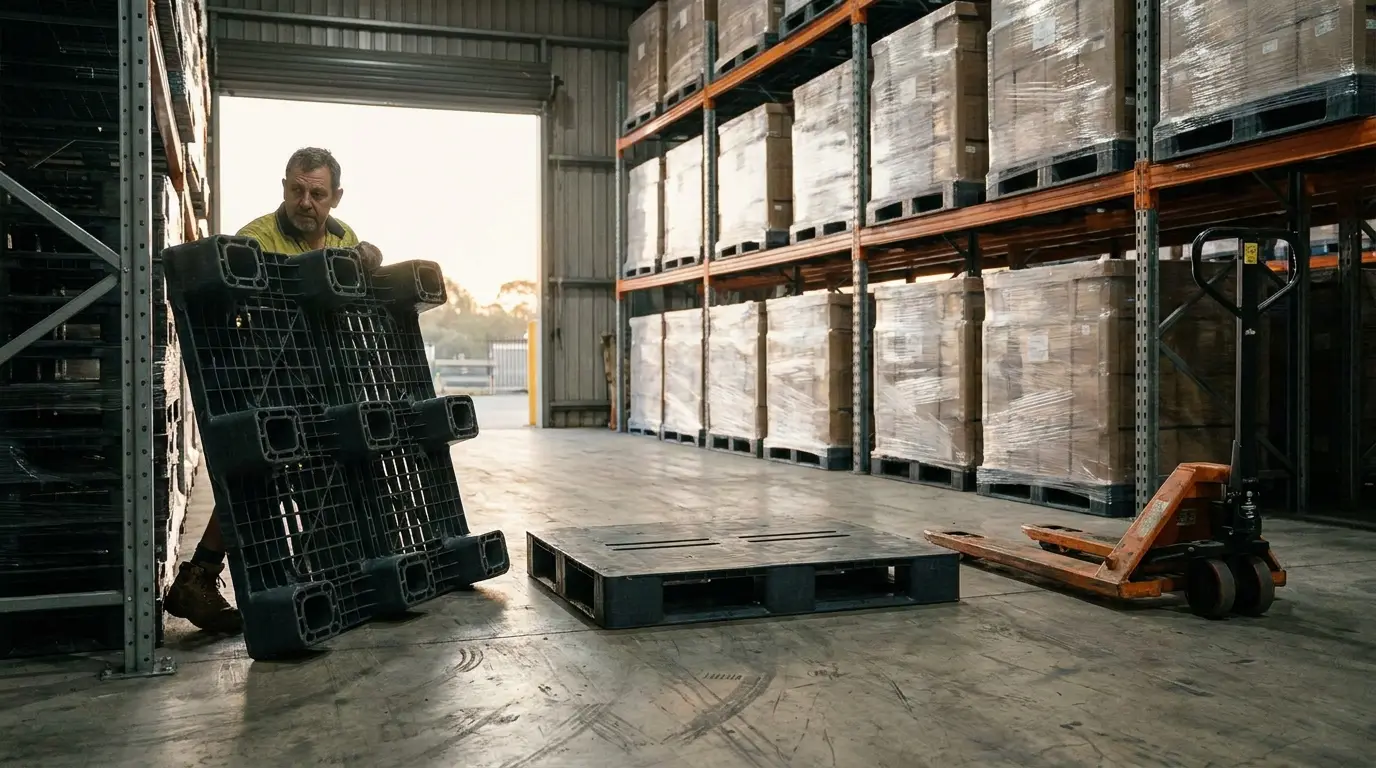
Almost every plastic pallet enquiry we receive names two things: a footprint and a load. Both are reasonable, and neither describes the half of the pallet that causes the problems. The deck faces your load; the base faces the beams, the pallet-jack wheels, the floor and the truck bed — and it is the attribute buyers most often inherit rather than choose. This is an audit of the four base architectures in our own published range: what each one does and does not do, and the one number in our catalogue that should change how you write the next order.
Which plastic pallet base type should I buy?
Start from the interface that is hardest to change later. If the pallet lives in racking, buy a deck that publishes a racking figure — in our range that means a skid, perimeter or cruciform base, and never a nine-foot one. If it lives on the floor and is moved by a hand pallet jack, the base has to give the jack’s load wheels somewhere to drop, which is a different opening from the one the forklift tines use. If it lives on a truck and is one-way freight, the lightest base wins and very little else matters.
What makes the base worth an article is that it is the least reversible of the three decisions. You can re-plan a load and you can re-rate a bay, but a rack built for one pallet type and then filled with another is a physical mismatch you discover by watching something fail. That framing is not ours — it belongs to the racking regulator, and we quote it below.
What base architectures does the range actually publish?
We audited all 50 plastic pallets in our published catalogue in September 2026. Thirty-seven state a specific base architecture, and they fall into exactly four groups. Twelve state “Any” — a category with its own trap, which we come back to — and one states nothing at all.
| Base architecture | SKUs | Published weight range | Mean weight | Publishes a racking figure |
|---|---|---|---|---|
| 3 skids | 15 | 5.9 – 29.0 kg | 13.7 kg | 8 of 15 |
| 9 feet | 12 | 4.4 – 10.0 kg | 7.2 kg | 0 of 12 |
| Full perimeter base | 6 | 6.8 – 24.5 kg | 17.0 kg | 3 of 6 |
| Cruciform full perimeter base | 4 | 7.5 – 10.5 kg | 8.9 kg | 1 of 4 |
| “Any” (used and custom lines) | 12 | not published | — | 0 of 12 |
Two things stand out before you read another word. The nine-foot group is the lightest class in the range by a clear margin, and it is also the only group in which no model publishes a racking rating. And the cruciform group is the quiet outlier: it averages 8.9 kg, barely above the nine-foot group, while being a continuous base rather than a set of discrete feet.
Why do nine-foot pallets publish no racking figure?
A racking rating describes one specific, unforgiving situation: the pallet spanning two beams with nothing underneath the middle, holding your load up on its own structure. That is why it is almost always the lowest of the three published numbers, and why it is the only one that describes what a rack bay actually does to a deck.
Nine discrete feet with open bays between them give a pair of beams very little continuous material to bear on. Three long runners, a perimeter rail or a cruciform give the beams something underneath along the whole span. That is the mechanism, stated as reasoning — and the published data lines up with it exactly: every one of the 12 decks in our range that publishes a racking figure has a skid, perimeter or cruciform base (eight three-skid, three full-perimeter, one cruciform), and none of the 12 nine-foot pallets publishes one.
Here is the honest caveat, because most product pages would leave it out. In our range, base type and duty class travel together: the nine-foot group is also the lightest group, averaging 7.2 kg against 13.7 kg for skids and 17.0 kg for perimeter bases. From published catalogue data alone we cannot cleanly separate “nine feet do not rack” from “light pallets do not rack”. Both readings point a buyer the same way, which is what makes the finding usable: if it is going in a rack, buy a deck that publishes a racking number, and confirm that number at your beam span.
Now the second half of the finding, which cuts against the tidy version of the story. Base architecture predicts whether a racking figure exists; it does not predict how big it is. Divide each racking rating by the pallet’s own weight and structural efficiency across those 12 decks runs from 29.2 up to 113.6 kilograms of rated racking per kilogram of pallet — a 3.9× spread — with the top two performers being a three-skid (BPB-E1160V, 113.6) and a cruciform (BPB-140, 99.0), while three of the four worst are also three-skids. The architecture opens the door. It does not tell you what is behind it.
What the racking regulator says about changing your pallet
This is not an area where we need to build an argument, because a state work-health-and-safety regulator has already made it in plain language. SafeWork NSW’s Pallet racking fact sheet opens on the principle that “Any racking used in the workplace should be designed specifically for the size, shape and weight of the products being stored”, and then defines the thing being designed for: “Unit load is an individual stored item – eg a pallet having material that can be placed or retrieved in one operation.” The pallet is not an accessory to the unit load. It is part of it.
Then it names the failure modes, and one of them names a base architecture outright. Under “Selection of pallets and goods on pallets”, the fact sheet says an assessment of any change to the pallet design should be done by a competent person, giving these examples: “changing from timber pallets to post pallets will apply concentrated loads on racking beams and the pallets may not key into the beams”; “using pallets larger than in racking design can overlap pallets behind or push them off their supports”; “using pallets smaller than allowed for, in the racking, can make them drop through”; and “using skid pallets in racking without timber decks can allow them to drop through” (safework.nsw.gov.au, Pallet racking fact sheet). Read that last example next to our audit: 15 of our 50 pallets are three-skid units, and whether a bay has decking under them is a question about the rack — decided, in practice, by whoever bought the pallet.
The phrase worth keeping is “key into the beams”. That is precisely what a base does, and precisely what nobody writes on a purchase order.
“Buyers ask me for a footprint and a load rating, and I can answer both in a sentence. The question that decides whether the fleet works is the one nobody asks: what is underneath it? A base is not a styling detail — it is the interface between your pallet and every other piece of steel in the building.”
John Meir, Sales Leader — BulkPlasticBins
How large is the category those failure modes sit inside? Safe Work Australia’s Key Work Health and Safety Statistics Australia records 146,700 serious workers’ compensation claims for the 2023-24p reference period, with a median of 7.4 weeks of working time lost and median compensation paid of $16,300. Of those, body stressing accounted for 50,600 serious claims (34.5%) — the largest single mechanism, and the most common one across every major occupation group — and being hit by moving objects for 23,400 (16.0%) (data.safeworkaustralia.gov.au). To be explicit, because it would be easy to imply otherwise: these are national, all-industry figures, and not one of them is attributed to pallet bases or to any product. They are here to size the two categories the base decision sits inside — moving a load by hand because the jack would not fit, and something leaving a rack — not to claim a cause.
The 1200 × 1000 pair: same racking figure, 2.43× the pallet
The cleanest way to see what a base buys you is a like-for-like pair on one footprint. Two pallets in our range share the standard 1200 × 1000 mm ISO footprint, both publish 4-way entry, and both are rackable and stackable. One has a cruciform full perimeter base; the other has a plain full perimeter base.
| Published figure (1200 × 1000 mm) | BPB-140 — cruciform full perimeter | BPB-720 — full perimeter | Difference |
|---|---|---|---|
| Racking rating | 1,000 kg | 1,000 kg | identical |
| Dynamic rating | 2,000 kg | 2,000 kg | identical |
| Static rating | 3,200 kg | 8,000 kg | 2.50× higher |
| Pallet weight | 10.1 kg | 24.5 kg | 2.43× heavier |
| Overall height | 150 mm | 164 mm | 14 mm taller |
| Racking per kg of pallet | 99.0 | 40.8 | 2.43× more efficient |
On the two numbers that govern a rack bay and a forklift — racking and dynamic — they are the same pallet. The extra 14.4 kg of moulding buys static capacity: 2.5× more of what a pallet holds sitting on the floor or at the bottom of a block stack. That is a completely legitimate thing to buy, and if you block-stack heavy product it is the right call. If the pallet’s working life is a forklift and a rack bay, you are carrying 14.4 kg of extra tare on every trip for a number you may never reach.
This is the same trap seen from the other direction when we looked at what a fleet’s tare does to invoiced net weight in tare drift: what a reusable bin does to net weight, and the same reason the flattering headline misleads: across those 12 racking decks the static-to-racking ratio runs from 3.2× to 18.3×. A static figure overstates what a deck will carry in a rack by somewhere between three and eighteen times, depending entirely on which pallet you are holding. BPB-140’s 3.2× is the tightest in the range; the widest belongs to a 1200 × 800 three-skid at 18.3×.
Will a hand pallet jack fit under it?
This is the question that generates the most avoidable phone calls, and it goes wrong because of a genuine confusion between two different openings. 4-way entry describes where forklift tines go in — an opening above the base, through the deck structure. A hand pallet jack enters the same way, then does something a forklift never does: at the end of the stroke its two low load wheels drop to the floor to lift the pallet, and they need a clear path down through the base to get there.
Entry style, meanwhile, tells you almost nothing about our range, because it barely varies. Of the 38 pallets that publish an entry style, 37 are 4-way and exactly one is 2-way (a display pallet). If you are using entry style as a proxy for anything, it is a proxy for “this is a normal pallet”.
Reasoning purely from geometry: nine discrete feet leave floor-level gaps on both axes; three continuous runners leave floor-level channels only parallel to the runners, so the cross axis is closed at floor level even though tines enter it; and a continuous perimeter rail closes the floor line all the way round unless the design specifically provides for the wheels. That is reasoning, not specification — our catalogue publishes no pallet-jack compatibility field, the same kind of gap we have hit before on vent area and label pockets. If a hand jack is part of the job, say so in the enquiry and have it confirmed for the exact model rather than inferred from a base name.
The used and custom trap: “Any” is not a base
Twelve of the 50 pallets in the range publish their base support as “Any” and their forklift entry as “Any”. They are not a random twelve: they are all nine used lines and all three custom lines, not one of them publishes a weight, and four publish no dimensions at all.
That is not a data gap to apologise for — it is an accurate description of what those products are. A used-stock line is graded by duty class and footprint, and the base you get is whatever the incoming units have. A custom line is defined by your brief, so the base is an output of the conversation rather than an input to the catalogue. But it carries a hard consequence worth stating plainly: when you buy used or custom, you are not specifying a base — you are accepting the one that arrives.
If those units are destined for a floor, a truck or a block stack, that is usually fine and the price advantage is real; the whole trade is set out in second-hand vs new bulk bins. If they are destined for racking, it is not fine, and it is exactly the situation the SafeWork NSW fact sheet describes — a mixed inbound fleet is a change of pallet design arriving one delivery at a time. Buy new to a published base spec for racked positions, and let the used fleet do the floor work.
How do I put the base in the brief?
Four lines, and they take less time to write than one wrong delivery takes to fix. One: does it go in a rack, and at what beam span — if yes, the deck must publish a racking figure and you size to that figure, not the static headline. Two: is it moved by a hand pallet jack, and on which axis. Three: is the load uniform or concentrated, because every published rating assumes a uniform load and a concentrated one changes the answer. Four: is there a receiving gate, a bay clear height or a maximum stored height it has to live inside, given that published pallet height across our range runs 120–165 mm and both extremes are perimeter-base pallets.
Where the racking itself is concerned, the design duty is not yours alone: Australian pallet racking is governed by AS 4084, and both the design of the rack and any change to what goes into it belong with your rack supplier and a competent person. Our job is to make sure the pallet you are handed matches the brief you wrote. For the three load numbers and how they relate, see plastic pallet load ratings: static vs dynamic vs racking; for what a worn base looks like when it is time to pull a deck out of service, pallet inspection and retirement criteria; and for the footprint half of the decision, CHEP vs Euro vs Australian pallet sizes.
Browse the full plastic pallet range or the whole catalogue, see how this plays out on site in mining and fresh produce, or send your load, rack details, handling equipment and freight postcode for a spec-backed quote.
Common questions
What are the different plastic pallet base types?
Four architectures cover almost everything. Nine feet: nine discrete moulded feet with open floor between them. Three skids: three continuous runners under the deck, all pointing the same way. Full perimeter base: a continuous rail around the whole footprint. Cruciform full perimeter base: a perimeter rail plus a cross through the middle. In our own range of 50 plastic pallets, 37 publish one of these four — 15 three-skid, 12 nine-foot, 6 full-perimeter and 4 cruciform — while 12 publish “Any” (all of them used or custom lines) and one publishes none.
Can you rack a nine-foot plastic pallet?
Not on our published data, and that is the most useful thing on this page. Of the 12 nine-foot pallets in our range, zero publish a racking figure; every one of the 12 decks that does publish a racking rating uses a skid, perimeter or cruciform base. A racking rating describes a pallet bridging two beams with nothing under the middle, and discrete feet with open bays between them give the beams very little continuous material to bear on. One honest confound: in our range the nine-foot group is also the lightest group (4.4–10.0 kg, against group means of 13.7 and 17.0 kg for skids and perimeter bases), so base type and duty class move together and published data alone cannot fully separate them. Both readings point a buyer the same way — if it is going in a rack, spec a deck that publishes a racking figure, and confirm that figure at your beam span.
Will a hand pallet jack fit under a plastic pallet?
Ask, and specifically do not read it off the 4-way entry line. 4-way describes where forklift tines enter, which is an opening above the base; a hand pallet jack also needs its two low load wheels to descend through the base to the floor at the end of the stroke, which is a different opening in a different place. Geometrically, nine feet leave floor-level gaps on both axes, three skids leave floor-level channels only parallel to the runners, and a continuous perimeter rail closes the floor line unless the design specifically provides for the wheels. Our catalogue publishes no pallet-jack compatibility field, so treat that as reasoning about geometry rather than a specification, and have it confirmed for the exact model on your quote.
Is a timber pallet base simpler to deal with?
It is different, not simpler, and the racking regulator treats the switch as a live risk in both directions. SafeWork NSW’s pallet racking fact sheet warns that “using skid pallets in racking without timber decks can allow them to drop through” and that changing pallet design can mean “the pallets may not key into the beams” (safework.nsw.gov.au). A timber stringer pallet also carries a base geometry you did not choose, plus the biosecurity, splinter and fastener issues covered in plastic vs timber pallets for mining. The advantage of a moulded plastic base is dimensional consistency unit to unit: once you have specified it, you keep getting it.
How are the racking-per-kilogram figures on this page calculated?
They are a plain ratio, computed in September 2026 across the 12 pallets in our published catalogue that state both a racking rating and a unit weight: the published racking figure in kilograms divided by the pallet’s own published weight in kilograms. It is a comparison of structural efficiency between decks — not a load permission and not a safety margin. Every published racking rating assumes a uniform load; concentrated or point loads stress a deck far harder. Australian pallet racking is governed by AS 4084, so size to the racking figure at your actual beam span and refer rack design to your rack supplier and a competent person.
Does the base change the pallet height, and does that matter?
It contributes to it, and it matters wherever a receiving gate or a bay opening is specified in millimetres. Across our range published overall pallet heights run 120 mm to 165 mm — and, usefully honest, both extremes are perimeter-base pallets, so height does not sort neatly by architecture either. The practical point is that pallet height eats into a bay’s clear opening and into any customer’s maximum stored height, so it belongs in the brief next to the footprint. See plastic pallet load ratings and CHEP vs Euro vs Australian pallet sizes for the rest of that conversation.
Sources: pallet racking design, rated capacity, the unit-load definition and the consequences of changing pallet design, SafeWork NSW Pallet racking fact sheet (safework.nsw.gov.au), which states it adapts information from WorkSafe Victoria’s guidance note on pallet racking operation and maintenance; national serious-claim counts, mechanism breakdown, median time lost and median compensation paid, Safe Work Australia, Key Work Health and Safety Statistics Australia, latest release, reference period 2023-24p (data.safeworkaustralia.gov.au) — these are all-industry national figures and are not attributed to pallet bases or to any product; Australian pallet racking design and loading, AS 4084 (Standards Australia); pallet test methods, ISO 8611. Base-architecture counts, weight ranges and means, racking-per-kilogram ratios and static-to-racking ratios were computed in September 2026 across the 50 plastic pallets in our own published catalogue using each model’s manufacturer-published figures; those ratios are structural comparisons between decks, not load permissions. Published load ratings assume a uniform load and vary with load distribution, beam span and temperature. Our catalogue publishes no pallet-jack compatibility field, so statements about jack access are reasoning from published base geometry and must be confirmed per model. Not a quote.