
Plastic pallet inspection & retirement: when to pull a deck out of the fleet

Almost every fleet has a written rule for buying pallets and no written rule for retiring them. Decks stay in service until one visibly breaks, which means the decision gets made by the failure rather than by the inspection. This is a repeatable method for making it earlier: classify the deck by what it was ever rated to do, inspect the surface that actually carries the load case you use, and map each defect to the rating it kills. The uncomfortable part, and the reason this article exists, is that the rating that fails first is the one no routine yard check ever tests.
When should you retire a plastic pallet?
Retire it the moment a defect has attacked the specific load case you use it for, not when it looks tired, and not at a fixed age. A plastic pallet has three published ratings: static (sitting on the floor), dynamic (moving on forklift tines) and racking (bridging two beams with nothing underneath). Damage does not degrade those three equally. A scuffed, discoloured top deck barely touches any of them. A hairline split in a bottom board barely touches static, barely touches dynamic, and can be decisive for racking.
So the retirement question is never "is this pallet damaged?" It is "is this pallet still good for the duty I am about to give it?" A deck retired from racking is often perfectly serviceable for floor storage or one-way freight for years afterwards. Downgrading rather than binning is usually the right call, provided you mark it, because an unmarked downgraded pallet finds its way back into a rack within a fortnight.
Why the number that fails first is the one nobody inspects
Here is the finding that should reorganise how you inspect. We audited every plastic pallet in our own published range that carries a racking figure, 12 of 50, and divided each model's published static rating by its published racking rating. The spread runs from 3.20× to 18.29×, with a median of 7.00×. In other words, the typical deck in this range holds roughly seven times more weight on the ground than it holds across a beam gap, and at the extreme the difference is more than eighteenfold.
The practical consequence is blunt. Every informal check a yard performs, loading a deck on the floor, driving it around on tines, eyeballing the top, exercises the generous numbers. The racking figure, the one that governs whether a suspended load stays where you put it, is never tested by anything anyone does casually. A deck that has lost a chunk of its bridging stiffness will still sit under a heavy load on concrete all day without a hint that anything is wrong.
| Pallet (published ratings, new, uniform load) | Static (kg) | Dynamic (kg) | Racking (kg) | Static ÷ racking | Dynamic ÷ racking |
|---|---|---|---|---|---|
| BPB-840 Medium Duty Euro (1200×800) | 6,400 | 1,600 | 350 | 18.29× | 4.57× |
| BPB-880 Heavy Duty Euro (1200×800) | 10,000 | 3,500 | 650 | 15.38× | 5.38× |
| BPB-888 Heavy Duty Euro (1200×800) | 10,000 | 3,500 | 850 | 11.76× | 4.12× |
| BPB-720 Heavy Duty ISO (1200×1000) | 8,000 | 2,000 | 1,000 | 8.00× | 2.00× |
| BPB-E1165LS Heavy Duty AU std (1165×1165) | 10,000 | 2,000 | 2,000 | 5.00× | 1.00× |
| BPB-140 Medium Duty ISO (1200×1000) | 3,200 | 2,000 | 1,000 | 3.20× | 2.00× |
Basis: manufacturer-published ratings for new pallets under a uniform load, read from our live catalogue in August 2026; the ratios are simple division of those published figures. Six representative models are shown, but the 3.20×–18.29× range and the 7.00× median are computed across all 12 rated models in the range. Real margin moves with load distribution, beam span, temperature and service history, always downward.
Two things fall out of the last column. First, BPB-E1165LS is the honest outlier: its dynamic and racking figures are identical at 2,000 kg, so a forklift move genuinely does exercise the rack case. Second, BPB-880 is the trap: a 3,500 kg dynamic rating on a deck that racks at 650 kg. It will feel indestructible on tines and is nothing of the kind across a beam. If you want the mechanics behind the three numbers, our companion piece on static vs dynamic vs racking load ratings works them through properly.
Step 1: what was this deck ever rated to do?
Before you look for damage, establish the ceiling. Only 12 of the 50 plastic pallets in our range publish a racking figure at all. The other 38, made up of 18 light-weight decks, 8 medium-duty models and 12 configurable lines, do not, and that is not an omission to chase up. A deck with no published racking rating is a floor and transport deck by design, and no condition, however pristine, promotes it into a rack. Inspection cannot upgrade a pallet; it can only confirm or revoke what the manufacturer rated.
This is where a lot of fleets quietly go wrong. Sixteen decks in the range carry a "rackable" attribute, but only twelve publish a number. The four that carry the attribute without a figure are one configurable line and, tellingly, our three used heavy-duty decks: BPB-110UH, BPB-120UH and BPB-810UH publish no static, no dynamic and no racking rating. That is deliberate and it is the right answer. A second-hand pallet's remaining capability is set by a history the listing does not know: how hot it ran, how long it sat loaded, how many times a tine caught a runner.
"A deck doesn't announce that it's finished. It sits in the yard looking exactly like the one next to it, carries a load on concrete all day, and then lets go the one time it's bridging two beams with somebody underneath. That's why the inspection is an underside inspection, and why you run it on a schedule instead of after an incident."
John Meir, Sales Leader, BulkPlasticBins
So step one of the SOP is administrative, not physical: identify the model, retrieve its published ratings, and write the duty on the pallet. For unrated or used stock, assign the duty yourself and mark it, with a paint stripe, a moulded-in tag or a colour convention, anything a forklift operator can read from the seat. Fourteen of the 132 products in our catalogue are used stock, and every one of them should enter a fleet through an incoming inspection rather than straight onto a rack. Browse the used pallet range or the full plastic pallet range to see which models publish what.
Step 2: turn it over, the damage that matters is underneath
The racking case is a bridging case. With the pallet supported only at its two ends, the top deck goes into compression and the bottom boards, runners and skids go into tension across the unsupported middle. Those bottom members are the structural chord doing the work, and they are also the ones a tine strikes, a chock scrapes and a rough concrete edge gouges. They are the members you cannot see while the pallet is doing its job.
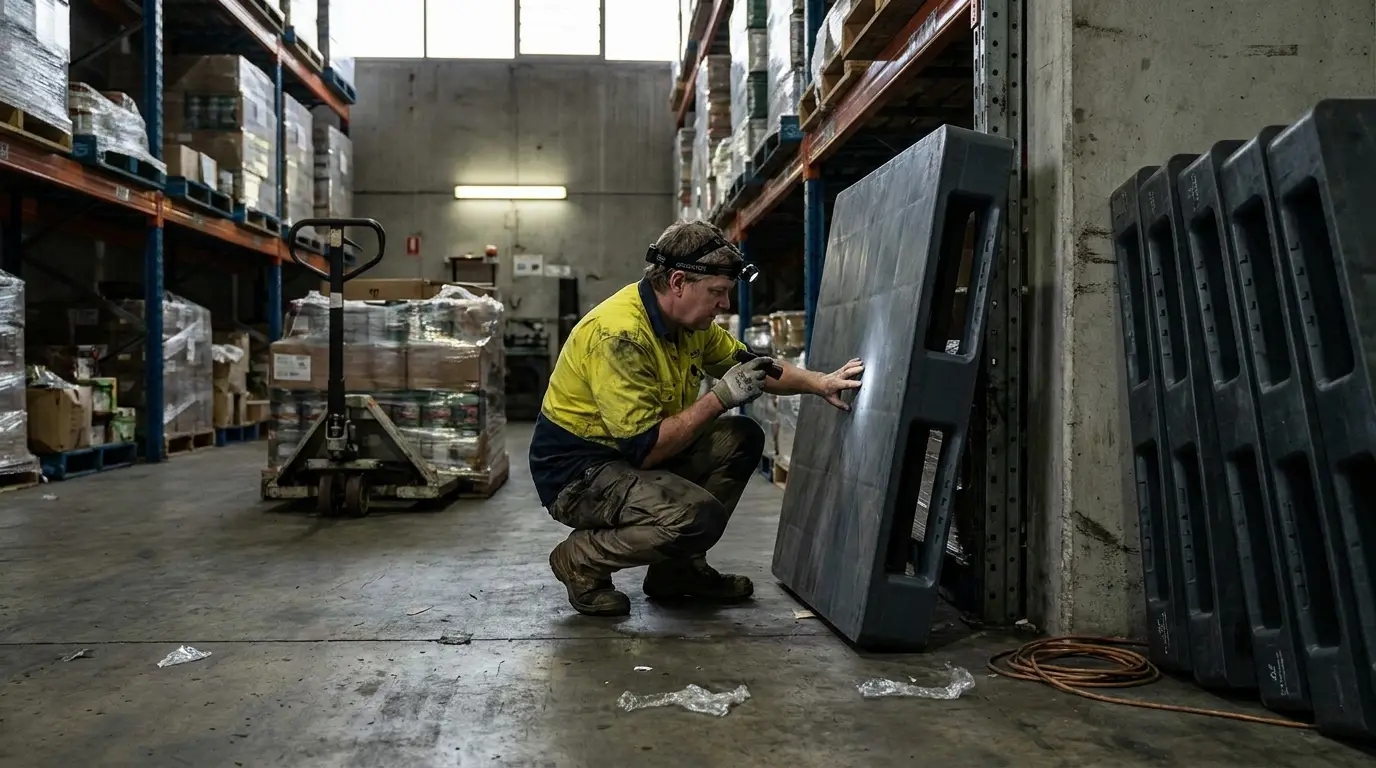
That single mechanical fact reorganises the whole inspection. A top-deck inspection is a cosmetic inspection. An underside inspection is a capability inspection. Tip the deck up on its edge against a rack upright, run a torch along the bottom boards and the junctions where they meet the feet, and look specifically at the middle third, the zone that sees peak tension in the bridging case and sees almost nothing when the pallet is on the floor.
Two failure signatures matter more than a visible crack, because both precede one. Stress whitening, a pale chalky band where HDPE or PP has been strained past its elastic limit, marks material that has already yielded. Permanent set, a sag that does not come back when the load comes off, is creep that has become structural. Neither breaks the pallet on the day you find it. Both mean the bridging chord is no longer the one the rating was tested on.
The go/no-go screening checklist (defect vs the load case it kills)
Screen every defect by asking which of the three ratings it attacks. The table below is the working version, a routing tool rather than a certification. "Retire from racking" means the deck can usually continue in a floor or transport role once it is marked; "retire from service" means take it out entirely.
| What you find | Where to look | Rating it attacks first | Screening call |
|---|---|---|---|
| Crack or split in a bottom board or runner | Underside, middle third | Racking | Retire from racking immediately; assess for floor duty |
| Stress-whitening band across a bottom member | Underside, over the beam line | Racking | Retire from racking; the material has already yielded |
| Permanent sag that does not recover unloaded | Whole deck, unloaded on flat ground | Racking, then static | Retire from racking; re-screen for stacking duty |
| Broken, crushed or missing foot or skid | Corners and centre foot | Static and dynamic | Retire from service, it cannot seat or stack squarely |
| Tine gouge deep enough to catch a fingernail | Entry openings, leading edge | Dynamic | Monitor; retire if it has reached a structural member |
| Deck-board crack on the top surface only | Top deck | Static, locally | Monitor; a real problem for bagged or small-footprint loads |
| Surface chalking, brittleness, colour fade | Sun-exposed faces | All three, invisibly | Flex-test a corner; UV embrittlement precedes brittle fracture |
| Deep scoring, embedded grit, un-cleanable surface | Anywhere product touches | None, this is hygiene | Retire from food or pharma duty regardless of load capability |
| Any repair, weld or added fastener | Anywhere | Racking | Retire from racking; a repaired deck is not the tested article |
The last row is the one that surprises people. A repair does not restore a rating. Published ratings are established against a defined test regime under ISO 8611, the international pallet test-method family, on the pallet as manufactured. A welded, bolted or plated deck is a different article from the one that was tested, so its published racking figure no longer describes it. Timber fleets repair as a matter of routine; plastic fleets should not carry that habit across. The abuse mechanisms behind most of these defects are covered in detail in which pallets survive forklift abuse on a mine site.
How do I screen for permanent deflection without a test rig?
You are looking for set, deflection that stays after the load is gone, and you can screen for it with a straight-edge and a consistent method. Unload the pallet, leave it unloaded on flat ground for a shift so any elastic recovery happens, then lay a straight-edge across the deck and measure the gap at the centre. Do it the same way on a known-good pallet of the same model and compare. You are not measuring against a published limit; you are measuring this deck against its own cohort, and a clear outlier is your finding.
Two cautions keep this honest. First, this is a screening method we use, not a standard. There is no published Australian condemnation limit for deflection in a plastic pallet, and if a specific deck's fitness for a specific rack is genuinely in question, that is a conversation for the manufacturer and your rack supplier, not a straight-edge. Second, creep is a heat story: sustained load at elevated temperature produces set far faster than the same load in a cool warehouse, which is why decks returning from outdoor yards, uninsulated sheds and remote sites deserve this screen even when they look fine. We work that mechanism through in UV, heat and creep on remote sites. Australian racking itself is governed by AS 4084:2023 (Steel storage racking), and Safe Work Australia publishes duty-holder guidance on storage racking, but note carefully that both govern the rack. Neither is a field-inspection scheme for the pallet sitting on it.
The retirement trigger that has nothing to do with load
A deck can be structurally perfect and still be finished. In a food, beverage or pharmaceutical chain the governing question is whether the surface can still be cleaned, and a deck that has been scored, gouged or embrittled by repeated hot washing holds soil and biofilm in crevices no wash cycle reaches. Worse, a cracked or chalking plastic surface is itself a foreign-matter source, shedding fragments into product.
That is not a hypothetical risk category. Foreign matter was the cause of 60 food recalls coordinated by FSANZ over 2021–2025 (foodstandards.gov.au), placing it third among recall causes in Australia behind undeclared allergens and microbial contamination. A pallet or bin that sheds is a candidate contributor to that column, and it earns retirement from food duty on the day the surface goes, whatever its racking figure still says.
The clean way to run this is a two-track retirement rule: a hygiene track and a structural track, either of which can retire a deck from a given duty independently. A deck failing hygiene but passing structure moves to non-food work; a deck failing structure is out of racks no matter how well it washes. Deck architecture is what makes the hygiene track winnable in the first place, and which crevices exist to hold soil is covered in hygienic pallets: open deck, closed deck and washability. The same two-track logic applies to bins and to the records that follow them, which we work through in bin and crate traceability.
What happens to a retired plastic pallet?
A retired plastic deck is feedstock, not waste, and that is the single largest practical difference from retiring timber. A condemned HDPE or PP pallet is a clean, single-polymer, high-volume stream, exactly what a reprocessor wants, where a condemned timber pallet is a mixed stream of wood, nails and staples that mostly goes to landfill or fuel. Keeping retired decks segregated and clean preserves that value; letting them accumulate mixed with general waste destroys it.
Two habits make the difference. Batch them: a pallet of condemned decks is a recycling proposition, a single deck behind the shed is rubbish. Mark on retirement, not on collection: the moment a deck fails inspection it needs a visible, unambiguous mark, or it will be back in a rack before the paperwork is filed. We cover the end-of-life pathway properly in are plastic pallets recyclable?, and the whole-of-life comparison against renting a pool fleet sits in pooling vs buying.
If you are building an inspection SOP from scratch and want it matched to the decks you actually run, tell us the models, the duty and the environment. We can point you at which of them publish a racking figure, which are floor-and-transport decks by design, and which of your current fleet is a candidate to be downgraded rather than replaced. Start from the full catalogue, the mining range or the fresh produce range, or send your fleet list through the quote form.
Common questions
When should you retire a plastic pallet?
Retire it when a defect has attacked the load case you actually use it for, or when it can no longer be cleaned to the standard your product needs. In practice that means three triggers: any crack, split or permanent deformation on the underside of a pallet you rack; foot, skid or corner damage that stops it seating squarely; and surface damage that sheds material in a food or pharmaceutical chain. Condition alone is not the test, a scuffed deck used only on the floor may have years left, while a lightly cracked bottom board on a racked deck is finished today.
Is there an Australian Standard for condemning a plastic pallet?
Not in the way buyers expect. ISO 8611 is the international test-method family behind published pallet ratings, and it tests pallets against a design specification, it is not a field-inspection scheme for in-service decks. AS 4084:2023 (Steel storage racking) governs the rack, not the pallet on it. So the binding reference for a used deck is the manufacturer's published rating for that model, and the judgement about whether a damaged unit still meets it is yours to make, with your rack supplier and, where rack design is in question, a structural engineer. Treat any checklist, including ours, as a screening tool that routes decks to a decision, not as a certification.
How is the static-to-racking spread on this page calculated?
It is a straight audit of our own published catalogue, not an industry estimate. We took every plastic pallet in the BulkPlasticBins range that publishes a racking figure, 12 of 50, and divided each model's published static rating by its published racking rating. The results run from 3.20× (BPB-140: 3,200 kg static, 1,000 kg racking) to 18.29× (BPB-840: 6,400 kg static, 350 kg racking), with a median of 7.00×. Every figure is a manufacturer-published rating for a new pallet under a uniform load; your load profile, beam span and temperature all move the real margin, always downward.
Do second-hand plastic pallets need a different inspection?
They need the same inspection, done before they enter the fleet rather than after. A used deck arrives with an unknown history of load, heat, UV and forklift contact, and that history is exactly what sets its remaining capability. It is why the used heavy-duty decks in our own range publish no static, dynamic or racking figure, a listing cannot honestly assign one. Inspect incoming used stock the way you inspect fleet stock, decide the duty it is fit for, and mark it for that duty. Our guide to second-hand vs new covers the buying side of the same decision.
Is a damaged plastic pallet safer or less safe than a damaged timber one?
They fail differently, and the plastic failure is the quieter one. A timber pallet advertises its condition: boards split visibly, nails lift, and a bad one usually looks bad. A plastic deck can carry an internal crack, stress whitening at a beam line or accumulated creep deflection while still presenting a clean, unbroken top surface. That is an argument for a scheduled underside inspection on plastic, not an argument for timber, which brings its own splinter, fastener and biosecurity problems, covered in plastic vs timber pallets for mining.
How often should a pallet fleet be inspected?
Tie the interval to the duty, not the calendar alone. Decks that go into racking, carry point loads, or sit in a food or pharma chain earn the shortest interval and a documented result; floor-and-transport decks can run longer. The two events worth inspecting around rather than on a schedule are a forklift strike and a return from an outdoor or high-heat posting, because both attack capability without necessarily leaving obvious damage, see UV, heat and creep on remote sites.
Sources: Australian food recall statistics, including foreign matter as a recall cause 2021–2025, Food Standards Australia New Zealand (foodstandards.gov.au/food-recalls/recallstats); storage racking duty-holder guidance, Safe Work Australia (safeworkaustralia.gov.au); pallet racking design and loading, AS 4084:2023 Steel storage racking (Standards Australia); pallet test methods, ISO 8611 (Pallets for materials handling, Flat pallets). Load figures are manufacturer-published ratings for the specific new models named, tested under a uniform load, and were read from our live catalogue in August 2026; the 3.20×–18.29× static-to-racking range and the 7.00× median are computed across all 12 rated plastic pallets in that range by dividing each model's published static figure by its published racking figure. Real ratings vary with load distribution, beam span, temperature and service history. The inspection checklist and the straight-edge deflection screen are screening methods used to route a deck to a decision, not a published condemnation standard: neither ISO 8611 nor AS 4084 sets field retirement criteria for in-service plastic pallets. Confirm any specific deck against the manufacturer's rating, your rack supplier and, where rack design is in question, a structural engineer. Not a quote.