
Bin & crate traceability: lot codes, labelling and being recall-ready

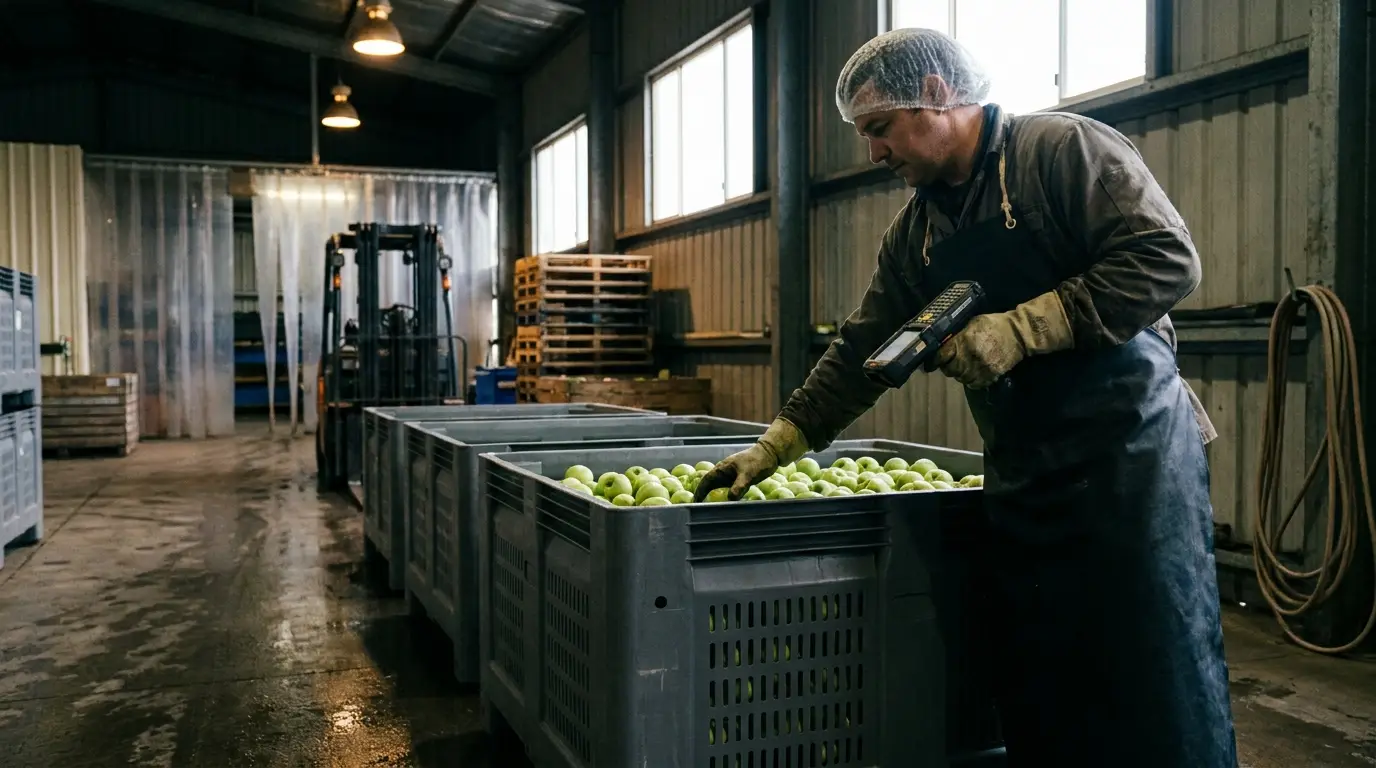
Traceability is usually sold as a paperwork problem, so it gets solved with paperwork. In a bulk-bin operation it is a physical problem first: fruit loses its identity the moment it goes into a bin, and from that point the bin is the lot. Which means the capacity you bought, the wall you are trying to label, and the wash cycle that removes that label are all traceability decisions that were made months before anyone thought about records. This is how those decisions actually work, with the arithmetic run across real bins.
What is the traceable unit in a bulk-bin operation?
It is the bin, and almost nobody writes that down. Once picked produce is tipped in, the smallest parcel you can hold, test, isolate or withdraw is one bin's contents. Everything upstream of that, block, row, picker, hour, is only traceable if your record binds it to identified bins; everything downstream is only traceable if the bin identity survives to the grader.
The consequence is that your effective lot size is set by whichever is coarser: your bin, or your record. A grower running 605 L bins but recording only "Tuesday, Block 4" has a Tuesday-sized lot, not a 605 L one, and has paid for granularity they are not banking. Conversely, meticulous records against 1,400 L bins cannot produce a lot smaller than 1,400 L, because the physical parcel does not divide. Fixing the record is cheap. Fixing the bin is a purchase decision, which is why it deserves the attention here.
What Australia’s recall record actually asks of you
FSANZ coordinated 92 food recalls in 2025, above the 10-year average of 87, with 866 recalls over the decade 2016–2025 (foodstandards.gov.au). It is worth reading the causes honestly rather than the headline. Across 2021–2025, undeclared allergens accounted for 197 recalls, far and away the largest cause, but that is overwhelmingly a packaged-food labelling problem and it is not the fresh-produce grower's exposure.
The two causes that do sit squarely on a bulk-bin operation are microbial contamination, 91 recalls, and foreign matter, 60 recalls, over the same five years. Within the microbial group FSANZ reports Listeria monocytogenes as the dominant organism at 40% (36 recalls), ahead of Salmonella at 20% (18) and E. coli at 14% (13). Both of those causes generate the identical operational question at two in the morning: which lots, in which bins, went where, and what else touched them?
One more figure from the same dataset is worth carrying around. For the allergen recalls, FSANZ reports that the leading detection method was customer complaints, 91 of 197 cases. Detection often comes from outside your fence, on someone else's timeline, which means the clock starts when you are least prepared. FSANZ's own summary of the 2025 statistics puts the emphasis where it belongs:
"The data highlights the proactive work of food businesses and regulators in quickly removing potentially unsafe food from the market, reflecting the effectiveness of routine safety checks and the ongoing importance of clear and accurate labelling, strong supplier controls and recall readiness."
Food Standards Australia New Zealand, 2025 food recall statistics
"Recall readiness" is the operative phrase, and readiness is built in the shed months earlier. The underlying food-safety practice duties sit under the Food Standards Code, principally Standard 3.2.2 Food Safety Practices and General Requirements; what follows is the physical method that makes those duties satisfiable, not a compliance opinion on any particular scheme.
How bin size sets your recall exposure (worked table)
Here is the arithmetic nobody runs before buying bins. Fix a notional day's intake at 12,000 L, then bin it eight different ways using real vented bins from our range. The column that matters is the last-but-one: what share of that day a single positive result condemns.
| Vented bin | Volume (L) | Tare (kg) | Bins for a 12,000 L day | Crop exposed per bin | Total tare (kg) |
|---|---|---|---|---|---|
| BPB-D1208V44 (1200×800×440) | 240 | 21.5 | 50 | 2.00% | 1,075 |
| BPB-D1210V54 (1200×1000×540) | 395 | 33 | 31 | 3.29% | 1,023 |
| BPB-K1165HV (1162×1162×560, folding) | 470 | 44 | 26 | 3.92% | 1,144 |
| BPB-D1210V74 (1200×1000×740) | 605 | 37.5 | 20 | 5.04% | 750 |
| BPB-D1120V78 (1120×1120×780) | 700 | 39.5 | 18 | 5.83% | 711 |
| BPB-E1165FV (1162×1162×785, folding) | 750 | 53 | 16 | 6.25% | 848 |
| BPB-C1212V97 (1200×1200×978, folding) | 1,080 | 59.5 | 12 | 9.00% | 714 |
| BPB-1311V (1300×1150×1250) | 1,400 | 68.5 | 9 | 11.67% | 617 |
Basis: published volumes and empty weights for these eight vented models, read from our live catalogue in August 2026, against a stated 12,000 L day, bins rounded up to whole units. "Crop exposed per bin" is one bin's volume as a share of the day. Change the 12,000 L and the absolute counts move; every ratio stays identical. Real fill is never level to the rim, so treat these as planning figures.
The headline is a 5.83× spread in exposure per positive result, from 2.00% of the day to 11.67%, for the same crop, the same shed and the same records. That is the single largest lever a grower has over recall size, and it is exercised entirely at purchase time. It is also worth saying plainly what it is not: smaller bins do not make contamination less likely. They only make the consequence of finding it smaller. The prevention side is a cleaning question, worked through in our hot-wash and sanitation SOP, and a material question covered in food-grade plastic: HDPE, PP and HACCP.
What finer lots really cost, and it is not freight
The reflex objection to smaller bins is freight: more units means more tare, more trucks, more cost. Run it and the objection largely collapses. Going from the 1,400 L bin to the 240 L bin multiplies the unit count by 5.56× (9 bins to 50) but multiplies the tare by only 1.74× (617 kg to 1,075 kg), because small bins are dramatically lighter per unit. The freight penalty of a 5.8× finer lot is a 74% tare increase, not a 456% one.
And the tare column is not even monotonic, which is where the useful answer hides. The 605 L BPB-D1210V74 totals 750 kg of tare for the day, comfortably beating the larger 750 L folding bin at 848 kg and the smaller 470 L folding bin at 1,144 kg. Compared with the 1,400 L giant, it delivers a 2.3× finer lot for about 22% more tare. That is the standout row in the table: most of the traceability benefit, almost none of the freight cost.
So what actually constrains lot granularity? Two things, and neither is weight. Label events: 50 bins is 50 chances to write, attach or scan an identifier, against 9. FSANZ's own analysis of the largest recall category names errors during packaging as a leading root cause, and every additional handling step is another opportunity for exactly that class of error. Forklift moves: 50 units is 5.56× the tips, lifts and placements, which is real labour and a real damage rate. Fine lots are bought with discipline and handling time. Decide whether you have those before you buy the bins.
One deliberate omission: this table is not a bin-selection guide. Carrying efficiency per kilogram of bin, folding versus one-piece, and which body suits paddock versus shed are settled in field harvest bins vs packhouse bins and how much produce fits in a bulk bin. The only question here is what a bin's volume does to a recall.
Why a label that survives the wash is the problem
Ask a grower what they want from a bin label and the answer is almost always "something that doesn't come off". That is precisely backwards, and it is the most common traceability failure we see.
A carton is filled once and shipped; a durable label is correct for a carton. A bin is a re-used asset that carries a different lot every cycle. If the lot code is the durable thing on the wall, then any bin that skips or survives a wash arrives at the next block still legibly declaring last week's lot. That is worse than an unlabelled bin: an unlabelled bin makes someone stop and check, while a confidently wrong one gets tipped. The failure mode of a durable lot label is silent misattribution.
The correct arrangement is two identifiers with opposite lifespans:
- Asset ID, permanent. Says only which bin this is. Never changes for the life of the unit. Survives hot wash, sun and forklifts. Nothing about the crop.
- Lot identifier, deliberately temporary. Says which lot is in the bin right now. Must be trivial to remove or overwrite. If it is still there after the wash, the system has failed.
The physical wall makes this harder or easier than most buyers expect. Of the 36 bins in our range that publish a volume, 15 are vented and 21 solid, and that split matters for adhesives: a vented wall is a grid of apertures with no continuous flat area, so a stuck-on label bridges holes, lifts at the edges and shreds in the wash. A solid wall gives an adhesive somewhere to live. Since venting is usually non-negotiable for produce, for good reasons set out in vented vs solid bulk bins, the practical answer for vented bodies is a mechanically retained tag in a corner post or under the rim rather than an adhesive on the wall.
A bin-ID system that survives a packhouse
The design constraint is not the technology, it is the wash line and the forklift. Anything that has to be read at the moment of tipping must be readable wet, at speed, from the seat, on a bin that may be facing any direction. That rules out most elegant solutions immediately.
Four rules make the difference in practice.
- Put the asset ID where nothing touches it. Under the top rim or inside a corner post, not on the broad face a tine, a chock or a wash-line brush will find. The most common cause of an unreadable bin ID is abrasion, not weather.
- Duplicate it on adjacent faces. A single tag means a bin turned the wrong way is unidentifiable, and unidentifiable bins get processed anyway because the line does not stop.
- Bind, don't write. The record binds asset ID → lot → date → destination. Nothing about the crop is written on the bin except the temporary lot mark. This is what lets a bin be re-used the same afternoon without contaminating the record.
- Capture the wash. A wash record against the asset ID is what converts "these bins are clean" into evidence, and it is what makes a bin's next lot genuinely separate from its last. The wash SOP and the traceability record should share the same identifier.
There is a hardware corollary worth stating. A bin that has been scored, gouged or embrittled to the point where it cannot be verified clean, or where a permanent tag will no longer hold, has failed its traceability duty even if it still carries a full load. That is the same two-track retirement logic we apply to decks in plastic pallet inspection and retirement criteria: hygiene and structure retire a unit independently, and either one is sufficient.
How do I spec bins for traceability?
Four questions, in this order, and the first is the one that gets skipped.
- What lot size can you live with? Decide the share of a day you are willing to lose to one positive result, then choose volume to match. That is the whole exercise; everything else is detail.
- Can you carry the handling? Finer lots cost label events and forklift moves in direct proportion to unit count, and only about a third of that proportion in tare. If the shed cannot absorb 5× the moves, buy the middle of the range, not the bottom.
- Where does the permanent tag live? On a vented body, plan a mechanically retained tag under the rim or in a corner post before you buy, not afterwards.
- Can every bin be verified clean between lots? Segregation is only real if the previous lot is genuinely gone. Smooth, non-porous, washable bodies are what make the record true rather than aspirational.
If you want this run against your own numbers, send your daily intake volume, your crop and the lot size you are trying to hit, and we will map it to the bins in the range that land closest on both exposure and tare. Start from the fresh produce range, browse IBCs and bulk containers or the full catalogue, or send the details through the quote form. Bin choice also moves the loss you never see in a recall at all, which we cover in how bin choice cuts post-harvest loss.
Common questions
What is the traceable unit for produce in bulk bins?
The bin, in almost every case. Once picked fruit or vegetables go into a bulk bin they lose individual identity, so the smallest parcel you can isolate, hold, test or withdraw is one bin's contents. That makes bin capacity a traceability decision: with a 1,400 L bin, one positive result condemns 1,400 L; with a 605 L bin it condemns 605 L. If your records only bind a lot to a day or a block rather than to identified bins, then your real traceable unit is the whole day or the whole block, which is usually far larger than anyone intends.
How do you calculate the recall-exposure figures on this page?
Straight arithmetic on our own published catalogue, with the assumptions stated. We fix a notional day's intake at 12,000 L, divide it by each bin's published volume and round up to whole bins, then express one bin as a percentage of the day. The 240 L BPB-D1208V44 needs 50 bins, so one bin is 2.00% of the day; the 1,400 L BPB-1311V needs 9, so one bin is 11.67%. Tare totals are bins × published empty weight. Change the 12,000 L and every absolute number moves, but every ratio in the table stays exactly the same, which is the point. These are planning figures, not a published standard and not a price.
Do plastic bins trace better than timber bins?
Yes, for two reasons that have nothing to do with marketing. First, a moulded plastic bin has dimensional consistency and a smooth wall, so a permanently attached asset tag sits in the same place on every unit and can be read the same way every time; timber bins vary, splinter and lose fixings. Second, and more decisively, a plastic bin can be washed and verified clean between lots, so segregation actually means something. A porous timber bin carries residue from the previous lot into the next one, which quietly undermines the record you just wrote. The freight and cost side of that comparison is in what a timber bin really costs a potato grower.
What does Australian food law require for produce traceability?
The core duty is that a food business must be able to identify what it received and where its product went, so that unsafe food can be withdrawn quickly. In Australia those food-safety practice duties sit under the Food Standards Code, principally Standard 3.2.2 Food Safety Practices and General Requirements, and FSANZ coordinates the recall system itself. This page is a practical method for making bins traceable, not a compliance opinion, and it is deliberately not a guide to what any particular retailer scheme audits. Confirm your obligations against the current Code and your own scheme documentation, and treat your buyer's requirements as additional to the law, not a substitute for it.
Should the lot code go on the bin permanently?
No, and this is the mistake that causes the most trouble. A bin is a re-used asset that carries a different lot every cycle, unlike a carton that is filled once. So the bin needs two identifiers with opposite lifespans: a permanent, never-changing asset ID that says which bin this is, and a lot identifier that must be easy to remove or overwrite at every wash. If the lot code is the durable one, then a bin that skips a wash cycle arrives at the next block still declaring last week's lot, and the record is now actively wrong rather than merely missing.
Can second-hand bins be brought into a traceable fleet?
Yes, provided they enter through an inspection and get an asset ID on day one, before their first lot. Two checks matter more than age: whether the surface can still be cleaned and verified between lots, and whether the wall has a sound, unbroken area to carry a permanent tag. A bin that fails the first check should not carry food regardless of what it can still lift, and a bin that fails the second will keep losing its identity in the wash. The buying-side comparison is in second-hand vs new bulk bins, and the condition-screening method is in inspection and retirement criteria.
Sources: Australian food recall statistics, including annual recall counts, the 2016–2025 decade total and the 2021–2025 breakdown by cause and by microbial organism, Food Standards Australia New Zealand (foodstandards.gov.au/food-recalls/recallstats); 2025 food recall statistics summary, FSANZ (foodstandards.gov.au); food safety practice duties, Standard 3.2.2 Food Safety Practices and General Requirements, Australia New Zealand Food Standards Code. Bin volumes, internal dimensions and empty weights are manufacturer-published figures for the specific models named and were read from our live catalogue in August 2026. The lot-granularity table is a planning calculation against a stated 12,000 L notional day with bins rounded up to whole units; published volumes assume level fill, so real exposure and tare will differ. This page is a practical method for making bins traceable and is not a compliance opinion, a certification, or guidance on what any particular retailer or third-party scheme audits, confirm your own obligations against the current Food Standards Code and your scheme documentation. Not a quote.