
Produce bin liners: when a liner helps and when it undoes the bin

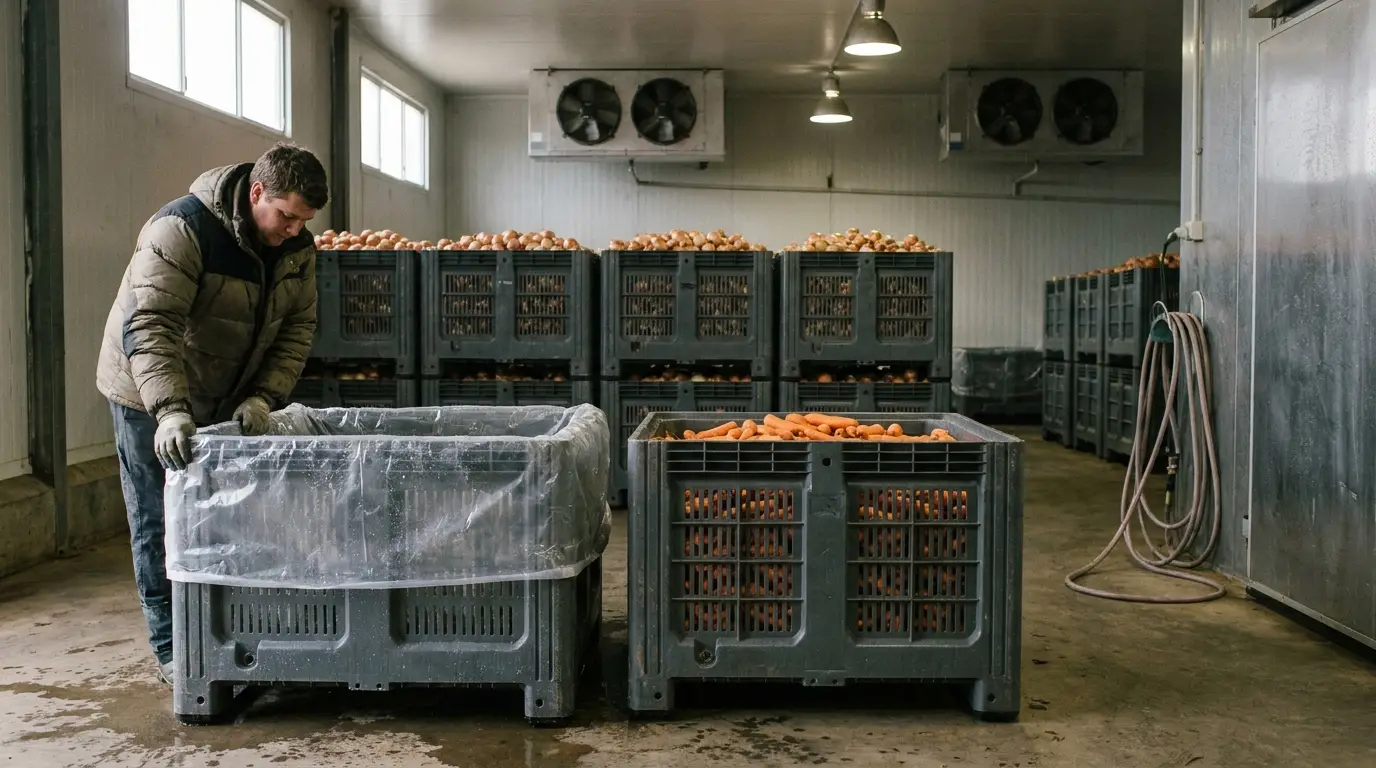
Liners go into produce bins constantly, and almost never as a decision. They go in because the last load was messy, because a customer asked once, because the bin is going somewhere dusty, or because someone wants the crop to hold its moisture. Each of those is a different job, and only some of them are jobs a liner does well. The one thing a liner reliably does - and the thing nobody says out loud - is convert a vented bin into a solid one at the crop's surface. Sometimes that is exactly right. Sometimes it quietly undoes the wall you specified and paid for.
When should you use a produce bin liner?
Use a liner when the job is containment: holding liquids, slurries, fines, husk or soil that would otherwise seep through a vented lattice or settle onto the load below; keeping an unlike load off the bin surface; or meeting a written customer or scheme requirement. Do not use a liner as a storage device unless the crop's published conditions actually want higher humidity and less air exchange at its surface - and be aware that for several crops an Australian packhouse handles every week, they want precisely the opposite.
The honest framing is that a liner is not neutral. It is an intervention in the crop's microclimate, applied by hand, one bin at a time, that is invisible on any spec sheet and gets no engineering scrutiny at all. A bin wall gets specified, quoted, argued over and signed off. A roll of film gets bought by the pallet and fitted by whoever is on the line. That asymmetry is the real subject of this page.
What a liner actually does to the bin
Physically, a liner does three things at once, and it is worth separating them because they do not all point the same way. It blocks air exchange through the wall apertures, so the bin stops equalising with the room. It raises relative humidity at the crop surface, because the crop keeps transpiring into an enclosure that no longer vents. And it introduces a cool impermeable surface inside the load, which is where vapour will condense first whenever the temperature moves.
Notice that only the second of those is usually the intention. The first is a side effect that reverses your bin choice, and the third is a new failure mode that the bare bin did not have. Whether the trade is worth making depends entirely on the crop, which is what the next section quantifies. What a liner does not do is change the store: the ethylene, heat and air-change questions belong to the room, and we work those through separately in ventilation and ethylene: what a bin wall can't fix.
The crop decides: optimum humidity from 65% to 100%
If a liner's main effect is to raise humidity at the crop surface, then the question "should I use a liner?" reduces to "does this crop want more humidity than the store is giving it?" - and the published answers are much further apart than most people expect. The table below is taken directly from the UC Davis Postharvest Technology Center produce-facts sheets, one row per crop, quoted as published storage recommendations rather than as limits of any kind.
| Crop | Published optimum storage RH | What that means for a liner |
|---|---|---|
| Carrot (topped) | 98-100% | Wants humidity as high as it can get; the same sheet warns that free moisture and unevaporated condensation promote decay. High RH yes, free water no. |
| Broccoli | >95% | High-humidity crop, but also a very high respiration rate, so the heat and air-exchange cost of sealing it is real. |
| Cabbage | >95% | High-humidity crop with moderately low respiration; the most tolerant of the group. |
| Apple | 90-95% | Comfortably below saturation. A liner adds little and adds a condensing surface. |
| Onion, dry (storage) | 65-70%, with adequate air circulation | A liner works directly against the published conditions on both counts. |
| Onion, dry (curing) | 75-80% | Different stage, different target - still well below the level a sealed enclosure drifts to. |
The span is the finding: 65-70% at one end and 98-100% at the other, roughly a 30-point gap, across crops that routinely share a shed, a forklift fleet and a bin pool. There is no such thing as a liner policy for a packhouse; there is only a liner decision per crop, and for at least one major Australian crop the answer is clearly no.
Onions are worth stating in full because the sheet is unusually explicit. UC Davis gives dry-onion storage as 65 to 70% relative humidity "with adequate air circulation (1m3/min/m3 of onion)" (postharvest.ucdavis.edu). A liner opposes both halves of that specification simultaneously - it raises humidity and it obstructs circulation through the wall. That is not a marginal call. Curing has its own separate target of 75-80% for scale colour development, and the stage-by-stage handling belongs with curing and storing onions.
The failure mode: condensation and free moisture
The specific risk a liner introduces is not humidity, it is liquid water - and the distinction matters, because the crop that most wants high humidity is also the one the source warns about. On the carrot sheet, UC Davis states that high relative humidity is essential to prevent desiccation and loss of crispness, and then immediately adds: "Free moisture from the washing process or unevaporated condensation, common with plastic bin-liners (and due to fluctuating temperatures) will promote decay." (postharvest.ucdavis.edu). Both halves of that sentence are the recommendation. Carrots want 98-100% RH and they want no free water, and a liner is the thing most likely to give you the second while you are chasing the first.
The mechanism is temperature swing, which is why the sheet names fluctuating temperatures explicitly. Air inside a lined bin sits near saturation. Move that bin - out of a cool store onto a warm dock, or load it warm from the field and start pulling it down - and the film becomes the surface where the moisture arrives at a lower temperature than the air carrying it. Vapour condenses on the inside of the liner, runs down, and pools in the bottom fold, where there is no ventilation to evaporate it. A bare vented bin in the same swing simply exchanges air with the room.
Two practical consequences follow, and both are about timing rather than the liner itself. The first is that a liner is most dangerous exactly when a bin is moving between temperatures and least dangerous once everything has equilibrated - so a liner fitted for a short, stable transport leg is a very different proposition from the same liner left on through a pull-down. The second is that a bin loaded straight off a wash line is the worst case of all, because the free moisture is already present before the film goes on; the drying step in carrot and root-veg handling is doing more work than it gets credit for.
"The part people miss is that a liner doesn't hold humidity, it holds water once the temperature moves," says John Meir, Sales Leader at BulkPlasticBins. "If a bin is going to sit at one temperature, a liner behaves itself. If it's going to travel through a temperature change, you've put a condensing surface inside the load and taken away the vents that would have dried it out. That's why the same liner looks brilliant on one job and causes a rot claim on the next one."
The audit: your vented bin already has a solid twin
If the reason for the liner is to stop air moving through the wall, there is a more direct answer, and our own published catalogue makes the case better than any argument could. Across the bulk-container range there are 10 exact vented/solid twin pairs: models sharing an identical external footprint, an identical external height and an identical rated volume, where the only published difference is the wall and a small amount of mass.
| Footprint & height (mm) | Volume | Solid | Vented | Mass difference |
|---|---|---|---|---|
| 1200 × 800 × 740 | 500 L | BPB-D1208S74, 32.0 kg | BPB-D1208V74, 31.5 kg | 0.5 kg (1.6%) |
| 1200 × 1000 × 978 | 905 L | BPB-C1210S97, 56.0 kg | BPB-C1210V97, 55.0 kg | 1.0 kg (1.8%) |
| 1200 × 800 × 978 | 695 L | BPB-C1208S97, 48.5 kg | BPB-C1208V97, 47.5 kg | 1.0 kg (2.1%) |
| 1200 × 800 × 805 | 565 L | BPB-C1208S80, 41.0 kg | BPB-C1208V80, 40.0 kg | 1.0 kg (2.4%) |
| 1120 × 1120 × 780 | 700 L | BPB-D1120S78, 40.5 kg | BPB-D1120V78, 39.5 kg | 1.0 kg (2.5%) |
| 1200 × 1200 × 978 | 1,080 L | BPB-C1212S97, 61.0 kg | BPB-C1212V97, 59.5 kg | 1.5 kg (2.5%) |
| 1200 × 1000 × 740 | 605 L | BPB-D1210S74, 38.5 kg | BPB-D1210V74, 37.5 kg | 1.0 kg (2.6%) |
| 1200 × 1200 × 805 | 880 L | BPB-C1212S80, 52.0 kg | BPB-C1212V80, 50.5 kg | 1.5 kg (2.9%) |
| 1300 × 1150 × 1250 | 1,400 L | BPB-1311S, 71.0 kg | BPB-1311V, 68.5 kg | 2.5 kg (3.5%) |
| 1162 × 1162 × 780 | 750 L | BPB-K1165S, 48.0 kg | BPB-K1165V, 45.0 kg | 3.0 kg (6.2%) |
Read the right-hand column, because it is the whole argument. The entire physical difference between "vented" and "solid" in these ten pairs is 0.5 kg to 3.0 kg of moulded wall - between 1.6% and 6.2% of the bin's own tare. It is a small amount of material, and it is a permanent, engineered, washable, non-consumable version of what a liner does badly. In eight of the ten pairs the published static rating is identical as well, so the choice costs nothing in load capacity. (Masses are published as-manufactured tare figures for each model on the date of writing; percentages are the difference divided by the solid model's tare.)
The cleanest illustration is the ISO pair below: the same 1200 × 1000 footprint, the same 740 mm height, the same 605 L, the same 5,000 kg static and 1,000 kg dynamic rating, the same PP/HDPE build and the same 4-way base. One kilogram of wall separates them.
None of this says a vented bin was the wrong buy. It says that if you find yourself lining vented bins routinely, for the same crop, on the same run, the fleet is telling you something about the original wall specification - and the fix is a purchasing decision made once, not a consumable fitted several thousand times. If the wall choice itself is still open, that is the subject of vented vs solid bulk bins.
The four jobs a liner genuinely does well
Against all of that, there are jobs where a liner is the correct engineering answer and no bin wall substitutes for it. There are four, and they have one thing in common: the liner is containing something, not conditioning something.
1. Liquids, slurries and fines. This is the liner's real home. A moulded bin has seams, drain positions and a vented or ribbed floor; it is not a vessel. Where the load is liquid, semi-liquid, or fine enough to escape and settle onto the load below, a film liner is the containment. This use is engineered enough that the range includes a purpose-built version of it - a bag-in-box container designed around the liner rather than lined as an afterthought.
2. A barrier between unlike loads. Where a bin carries something other than the crop between runs, or where a batch must not touch a surface shared with another batch, a disposable barrier does a job that washing does differently and more slowly. That is a legitimate use, and it pairs with rather than replaces a cleaning regime - the two-track logic in our hot-wash and sanitation SOP applies.
3. A written customer or scheme requirement. If a buyer's specification calls for a liner, it is a commercial requirement to satisfy, and the useful question is only which document it comes from and what it is trying to achieve, in case a better-specified bin satisfies the same intent. It is worth asking, because a requirement written for a timber or second-hand bin fleet sometimes survives long after the reason for it has gone.
4. Protecting the bin, not the crop. Staining, sap, residue and anything that turns a routine wash into a scrub - a liner here is a maintenance decision, and it is fine, provided everyone understands it is being fitted for the asset's benefit and not the crop's. This one is worth naming precisely because it is often the true reason while a crop-quality reason is the one given.
Notice what is missing from that list: "to keep the crop moist" appears nowhere as a standalone justification. It can be valid - for a wilting-prone crop on a short leg, in a store that genuinely cannot hold humidity - but it is the use that most often turns into the condensation problem above, and it is the one with a permanent alternative sitting in the same catalogue.
How to decide, and what to tell a supplier
Work it in this order, because the first question settles most cases on its own.
First, name the job. Containment, barrier, contract requirement, or asset protection - a liner is defensible for all four. If the honest answer is "to hold moisture in", go to the second question. If the honest answer is "because the bin has holes in it and this load shouldn't", you have a bin specification issue, not a liner question.
Second, check the crop's published conditions. If the crop's optimum sits at or above 95% RH, a liner is at least arguable and the risk to manage is free water and temperature swing. If it sits below about 90%, and certainly at the 65-70% of dry onions in storage, a liner is working against the published conditions and should have a specific reason that outweighs them.
Third, check the temperature history, not the temperature. A stable, fully cooled load is a mild case. A load that is warm, wet from a wash line, or about to cross a temperature boundary is where the condensation mechanism does its damage - so the same liner decision can be right for the transport leg and wrong for the store.
Fourth, count the cycles. If the answer is "every bin, every run, every season", price the permanent solution against the consumable, including the labour of fitting and removing film by hand and the waste stream at the other end. That is the point at which the twin-pair table above stops being a technical curiosity and becomes a purchasing decision.
When you brief a supplier, four facts do the work: the crop and its storage stage, the temperature path the bin will take, whether the load is free-flowing or liquid, and whether any customer specification is in play. Those decide vented against solid, and they decide liner against no liner, which are genuinely two separate decisions that get collapsed into one far too often. Browse the fresh produce range, compare wall styles and capacities across IBCs & bulk containers or the full catalogue, or send your crop, stage, volumes and postcode for a spec-backed quote. If capacity rather than wall style is the open question, how much produce fits in a bulk bin is the better starting point, and for stacking and airflow inside the store see cool-room bin stacking.
Common questions
When should you use a liner in a produce bin?
Use a liner when the job is containment rather than storage: liquids, slurries, fines and small debris that would fall through or seep out; a barrier between unlike loads where the bin carries something else between crops; or a documented customer or certification-scheme requirement. Avoid a liner where the crop needs air exchange and moderate humidity - dry onions being the clearest Australian case, with a published optimum of 65-70% relative humidity and an airflow requirement a liner directly obstructs (UC Davis). The deciding question is what the crop needs at its own surface, not how clean the bin looks.
Is a lined vented bin the same as a solid bin?
At the crop's surface, close to it - which is the point. A liner covers the apertures, so air exchange through the wall largely stops and humidity at the surface rises. But it is a worse solid bin than a solid bin: the film is a consumable fitted by hand every cycle, it can tear or slump, and it traps condensate against the crop instead of shedding it. Our range publishes 10 pairs where the vented and solid versions are otherwise identical - same footprint, same height, same litres, same static rating - so if you want a solid wall the honest move is to buy it. See vented vs solid bulk bins for choosing the wall itself.
Do liners cause condensation in produce bins?
A liner does not create water, but it is very good at keeping water where you do not want it. UC Davis states plainly that free moisture from the washing process or unevaporated condensation, "common with plastic bin-liners (and due to fluctuating temperatures)", will promote decay (postharvest.ucdavis.edu). The mechanism is temperature swing: while a warm crop is pulling down, the film is the cooler surface the moist air reaches first, so vapour condenses on it and runs back onto the crop with nowhere to evaporate. The risk is highest on bins loaded warm and moved between temperatures, and lowest on a stable, fully cooled store.
Should you line a bin of onions or potatoes?
For dry onions in storage, no - it works against the published conditions. UC Davis gives storage at 65-70% relative humidity "with adequate air circulation (1m3/min/m3 of onion)", and a liner opposes both halves of that. Potatoes are less clear-cut and depend on the stage: a liner can reduce weight loss on a short transport leg, but for a store the airflow and moisture questions we cover in potato storage bins and why potatoes and onions need vented bins matter more. Curing is a separate stage again with its own conditions - see curing and storing onions.
How were the twin-pair and humidity figures on this page calculated?
The twin pairs are a direct count of our own published catalogue on the date of writing: bulk containers that share an identical external footprint, external height and rated volume while differing only in wall style. There are 10 such pairs. The mass difference is the published tare of the solid minus the published tare of the vented, divided by the solid's tare - it ranges from 0.5 kg to 3.0 kg, or 1.6% to 6.2%. The humidity and airflow figures are quoted directly from the UC Davis Postharvest produce-facts sheets for each crop and are stated as published storage recommendations, not as regulatory limits. No price or cost figure is given anywhere on this page.
Are bin liners a food-safety requirement in Australia?
No general Australian rule requires a liner in a produce bin. The duties that attach to the container itself - that it be fit for purpose, cleanable and not a source of contamination - sit under the Food Standards Code, and they can be met by a properly washed bare bin. Where a liner appears as a requirement it is normally a customer or certification-scheme specification rather than a legislative one, so ask which document it comes from and treat it as a commercial spec to satisfy. We are a container supplier and not a food-safety authority; for the cleaning side of the same question see our hot-wash and sanitation SOP.
Sources: optimum storage relative humidity, respiration data and the handling guidance quoted for each crop, University of California, Davis, Postharvest Technology Center produce-facts sheets (postharvest.ucdavis.edu) — carrot (optimum RH 98-100%, and the quoted sentence on free moisture and unevaporated condensation common with plastic bin-liners), onions/dry (curing 75-80%; storage 65-70% with adequate air circulation, 1m³/min/m³ of onion), broccoli (>95%), cabbage (>95%) and apple (90-95%), each retrieved and quoted directly from the published sheet on the date of writing. Those figures are published storage recommendations for crop quality, not regulatory limits, and no Australian standard sets a humidity limit for a produce store. General duties attaching to a food-contact container sit under the Australia New Zealand Food Standards Code; this page is a practical handling guide and is not food-safety advice or guidance on what any customer or certification scheme audits — direct those questions to the scheme owner or the relevant authority. Footprints, external heights, rated volumes, tare masses, materials and load ratings are the published figures for each model in our own catalogue on the date of writing and change as the range changes; the count of 10 exact vented/solid twin pairs is a direct count of that catalogue, defined as models sharing an identical external footprint, external height and rated volume while differing in wall style. Mass differences are the published solid tare minus the published vented tare, expressed as a percentage of the solid model's tare; published tare is a nominal as-manufactured figure, not a measurement of any individual unit. Load figures are manufacturer-tested ratings for the specific models shown and vary with load distribution, beam span and temperature. No liner material, thickness, permeability or performance figure is quoted because none was verified for this page. Not a quote.