
Plastic pallets in the freezer: what cold really does to a deck

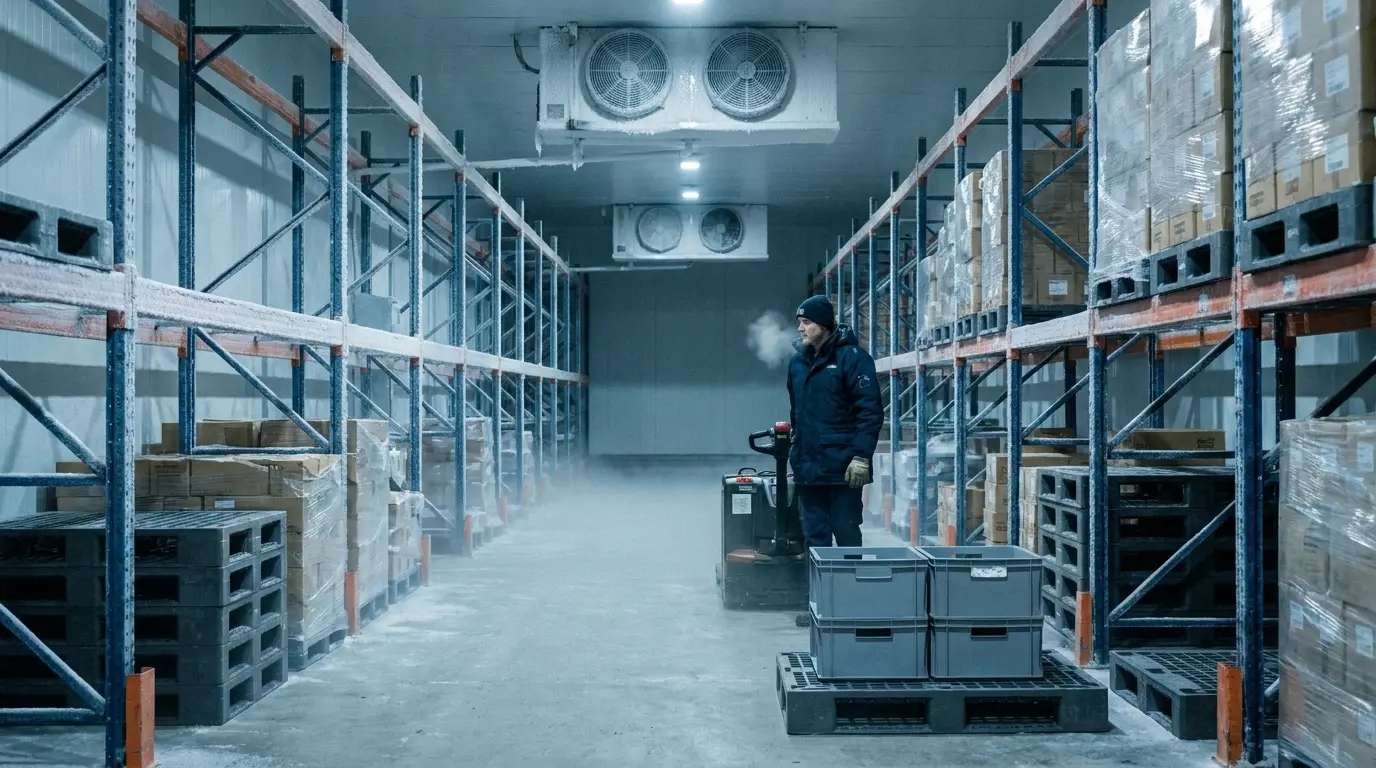
We have written at length about what heat does to a plastic pallet — UV embrittlement, thermal creep, decks slowly sagging under sustained rack load on a Pilbara site. Cold storage is not that story running backwards. It is a different failure mode with a different mechanism, it lands on a different item in the fleet, and the honest answer is more reassuring about the pallet and less reassuring about everything stacked on it than most buyers expect.
Do plastic pallets work in a freezer?
Yes — polyethylene decks are working well inside their comfortable range at Australian frozen-storage temperatures, and the measured evidence for that is unambiguous. The useful question is not whether plastic survives a freezer but which polymer, in which grade, in which item of your fleet, because the cold-tolerance gradient across a materials-handling range runs in the opposite direction to the load gradient. The heaviest-loaded item, the pallet, is almost always made of the most cold-tolerant polymer. The item nobody specs for temperature — the crate sitting on top of it — is usually made of the one with the higher transition.
There are three things worth getting right, and they are the spine of this article. First, the actual temperature band, because it is narrower and better defined in Australia than people assume. Second, the mechanism, because cold and heat attack different load cases and confusing them leads to the wrong precaution. Third, the honest limit of what a datasheet tells you: a two-letter polymer name is not a low-temperature specification, and we can show by how much.
How cold is an Australian freezer, actually?
Australian cold-chain practice is well documented, so this is a question with a real answer rather than a rule of thumb. The Australian Food Cold Chain Logistics Guidelines 2017 recommend two working temperatures: chilled foods never warmer than +5 °C (and kept above 0 °C so they do not freeze and suffer ice-crystal damage), and frozen foods, including ice cream, never warmer than −18 °C (fpsc-anz.com). The same document notes that ice cream and ice confection respond faster than other frozen foods and should preferably be stored between −22 °C and −30 °C.
Why −18 °C and not some rounder number? The Guidelines give the reason plainly, and it is a genuinely interesting one for anyone who assumes "frozen" is a single state: "enzymatic activity, which can develop off-flavours in some foods, only ceases at about −18 °C, and so a food might be spoiled even though it has been kept 'frozen' (ie below 0 °C) throughout its journey." The threshold is a biochemistry number, not a convenience.
The other half of the picture is the part that matters most for handling equipment: the fleet does not sit at one temperature. The Guidelines set maximum "out of refrigeration" time limits — 20 minutes for ice cream, and up to 90 minutes for other frozen foods where the ante-room is held at a chilled 0 °C to +5 °C. Those windows exist to protect the product, but they describe the pallet's working life too: a cold-store deck is not a deck sitting quietly at −25 °C, it is a deck being cycled between −25 °C and a dock several times a day, and being struck by forklift tines at the coldest point of that cycle.
What does cold do to the polymer?
Every polymer has a temperature below which it stops absorbing an impact by deforming and starts absorbing it by breaking. That is the ductile-to-brittle transition, and it is the single property that decides whether a deck shrugs off a tine strike or splits. It is measured, not guessed: ASTM D746 and ISO 974 both define a brittleness-temperature test by impact, and instrumented Charpy testing is used to locate the transition across a temperature sweep.
For polyethylene, the measured answer is a comfortable one. An open-access study of six bimodal high-density polyethylene grades found the ductile-to-brittle transition below −70 °C for every sample, and reported that HDPE Izod impact strength "remains virtually unchanged (80–95 J/m) within the range from −20 to −60 °C" (Salakhov, Shaidullin, Chalykh, Matsko, Shapagin, Batyrshin, Shandryuk & Nifant'ev, Polymers 13(11):1821, 2021). Line that up against the Australian bands above and the margin is wide: a −18 °C chamber sits more than 50 °C above the transition those samples showed, and even a −30 °C ice-cream store is inside the plateau where impact strength was flat.
Polypropylene is the polyolefin that sits higher up the scale — it is well established that PP's toughness falls off at lower temperatures earlier than polyethylene's, which is exactly why so much industrial effort goes into rubber-toughened and copolymer PP grades for cold service. What we will not do is put a single number on "PP" and pretend it applies to a moulded crate, because the number is a property of the compound, not the family. The next two sections show why that distinction is the practical heart of the whole question.
Where the cold risk actually sits in a range
Here is the finding that redirects this article. We counted the published material field across every product in our own live catalogue, and the polymer split by category is not subtle:
| Category | Units publishing a material | Contain PP | No PP at all |
|---|---|---|---|
| Plastic pallets | 49 | 5 (10.2%) | 44 (89.8%) |
| IBCs & bulk containers | 42 | 18 (42.9%) | 24 (57.1%) |
| Plastic crates | 37 | 31 (83.8%) | 6 (16.2%) |
Read down that middle column and the gradient is the reverse of the load gradient. The pallet — the item carrying a tonne, taking every tine strike and holding the whole load off the floor — is almost never polypropylene. Only five pallets in the range contain PP at all, and four of those five are second-hand stock. Narrow it further to the twelve decks that publish a racking figure, the ones that actually go into a freezer rack, and eleven of the twelve contain no polypropylene. Meanwhile 28 of 37 crates are pure PP, and the crate is the item that gets dropped, kicked, thrown onto a conveyor and stacked by hand — in a chamber where it is coldest.
The second half of that finding sharpens it. Across the range, 43 units publish both a material and a folding feature, and 26 of them contain PP — including all 18 folding crates, every one of which is polypropylene. A folding wall is not a plain moulded panel; it is a designed hinge line, and a hinge line is a deliberate stress concentration. Cold, an impact, and a stress concentration are the three ingredients of a brittle fracture, and a folding PP crate in a blast freezer is the one item in a typical fleet that assembles all three. It is also, almost universally, the item nobody writes a temperature spec for.
This is the shape of unit the audit is pointing at, and it is a good crate — light, high fold ratio, a genuine freight saver on the return leg. The point is not that it is a bad product; it is that a 1.75 kg polypropylene crate with hinged walls is a fundamentally different low-temperature proposition from the 24.5 kg polyethylene deck underneath it, and buyers routinely spec the second one carefully and the first one not at all. If your operation is blast-freezing or handling below −25 °C, this is the item to raise with a supplier, not the pallet.
Which of the three load ratings changes, and which way?
A plastic pallet publishes three numbers — static, dynamic and racking — and cold does not move them all in the same direction. Getting this right is the difference between a sensible cold-store precaution and a pointless one.
| Rating | What it is | Dominant mechanism | Direction as temperature falls |
|---|---|---|---|
| Static | Load supported on the floor or at the base of a stack | Sustained compression; long-term creep | Eases — creep rate falls with temperature |
| Racking | Load bridging two beams with nothing under the middle | Sustained bending; creep deflection over months | Eases — this is the case heat attacks, not cold |
| Dynamic | Load moving on forklift tines | Short-duration loading, shock and tine entry | Harder — impact toughness is the property that falls |
So cold is the mirror of the heat article, not a repeat of it. The failure our Pilbara guide warns about — a deck slowly deflecting in a rack over a hot summer under constant load — is a creep failure, and creep essentially stops as you go down through zero. The failure a freezer produces is the opposite kind: sudden, local, and delivered by a forklift in a fraction of a second.
An important limit on all of the above: this is the direction of each mechanism, not a permission to adjust a number. No manufacturer publishes a cold derating (or up-rating) table for plastic pallets, no Australian Standard sets one, and inventing one from polymer literature would be exactly the kind of confident-sounding fabrication this trade does not need. Work to the published racking figure at your real beam span, under AS 4084:2023 for the rack itself, keep loads uniform, and treat the cold as a reason to be careful with handling rather than a licence to load differently.
Why “HDPE” is not a low-temperature spec
This is the part that should change how you brief a supplier. In the same Polymers study, all six samples were bimodal high-density polyethylene — the same material name, correctly applied — and their measured low-temperature behaviour was not remotely the same. At −40 °C, Izod impact strength ran from 380 J/m down to 58 J/m across those grades, a spread of roughly 6.6×, driven by molecular weight. Relative elongation at break at −45 °C told the same story: 250% for the highest-molecular-weight grade against 46% for the lowest, a 5.4× spread.
Two decks can both be honestly described as "HDPE" and be six times apart on the property that decides whether a cold tine strike splits one of them. Nothing on a normal pallet datasheet distinguishes them.
How hard is this to predict from the outside? A 2024 study built a machine-learning model to estimate ductile-brittle transition temperatures for polyolefins, and to do it the authors used 7,587 instrumented puncture tests across 181 recycled PE and PP compounds — 14 PE materials, 72 PP materials and 95 PE/PP blends — over test temperatures from −60 °C to 51 °C, achieving a mean absolute error of about 7.25 °C (Kiehas, Reiter, Torres, Jerabek & Major, Frontiers in Materials 10:1275640, 2024). If a purpose-built model over thousands of experiments still lands within about seven degrees, no buyer is going to infer a transition temperature from a two-letter name on a spec sheet.
The practical conclusion, and it is a short one: if you are running below about −25 °C, or blast-freezing, ask for the grade's brittleness temperature to ASTM D746 or ISO 974, or its low-temperature impact data, for the specific product. That is a real, answerable question. "Is it food grade?" and "is it HDPE?" are not the questions that decide this, and we cover what the first of those actually means in food-grade plastic: HDPE, PP & HACCP.
How to spec a deck for a freezer or blast freezer
Six things, in the order they matter for a cold-chain fleet:
- State your real minimum, not your nominal one. "Frozen" covers −18 °C to −30 °C under the Australian guidelines, and a blast tunnel goes lower again. The gap between those numbers is where the material question lives.
- Spec the crate as carefully as the pallet. On the audit above, the crate is where the polypropylene is and the pallet is where it isn't. If any item in your load gets a low-temperature question, it should be that one — and folding crates first.
- Schedule the rough handling for the warm end of the cycle. The Guidelines' 20-minute and 90-minute out-of-refrigeration windows already push you toward fast, direct moves; use them to put the hardest tine work at the ante-room end rather than deep in the chamber.
- Ask for measured data, not a material name. ASTM D746 / ISO 974 brittleness temperature, or low-temperature impact figures, for the specific grade.
- Don't re-derate the rack for cold. Creep is the racking enemy and it slows as it gets colder. Work to the published figure at your beam span under AS 4084:2023, and keep the load uniform.
- Inspect the underside, not the top. Cold damage shows as cracks and stress whitening at the load path, and on a racked deck that is the bottom boards in tension — the method is in pallet inspection and retirement criteria.
Two neighbouring pieces round this out. If the load is chilled produce rather than frozen goods, the geometry of the stack and the airflow through it matter more than the polymer does — that is cool-room bin stacking. If the chamber is also a wash-down and food-contact environment, deck architecture drives whether you can actually get it clean, which is hygienic pallets: open deck, closed deck and washability. Browse decks across the plastic pallet range, crates in plastic crates, or the full catalogue; for cold-store produce specifically, start at fresh produce. When you are ready, send your minimum operating temperature, load mass, whether it racks and your freight postcode for a spec-backed quote.
Common questions
Do plastic pallets crack in a freezer?
Polyethylene decks are not operating anywhere near their limit at Australian frozen-storage temperatures. In a peer-reviewed study of six bimodal HDPE grades, the ductile-to-brittle transition sat below −70 °C for all of them, and Izod impact strength held virtually unchanged at 80–95 J/m from −20 to −60 °C (Salakhov et al., Polymers 13(11):1821, 2021). That is a comfortable margin against a −18 to −30 °C store. What does change is that impact behaviour is grade-dependent, and a hard tine strike on a very cold deck is a worse event than the same strike at 25 °C. Cracking in cold stores is usually a handling problem meeting a marginal grade, not an inherent property of plastic.
Are plastic pallets better than timber in cold storage?
For most cold-chain work, yes, and the reason is water rather than strength. Timber is porous: it absorbs wash water, condensation and defrost drip, then freezes it inside the pallet, which adds unrecorded mass, sheds ice onto product below and drives splitting as the water expands. A moulded plastic deck absorbs nothing, so nothing freezes inside it, and it can be washed and returned to the chamber. Plastic is also exempt from ISPM-15 heat treatment for export, which matters for frozen export lanes — we cover that in plastic vs timber export pallets. Timber still wins on lowest up-front price for genuinely one-way freight.
What temperature must frozen food be stored at in Australia?
The Australian Food Cold Chain Logistics Guidelines 2017 recommend that frozen foods, including ice cream, be transported, stored and handled at temperatures never warmer than −18 °C, and that chilled foods be kept never warmer than +5 °C while staying above 0 °C. Ice cream and ice confection are noted as more heat-sensitive again and are preferably stored between −22 °C and −30 °C (fpsc-anz.com). Those figures describe the food, not the pallet, but they are what sets the temperature band your handling equipment lives in.
Does cold reduce a plastic pallet’s racking rating?
Not in the direction people expect. The racking figure is a sustained-load, bridging case, and the mechanism that erodes it over time is creep — slow deflection under constant load — which is driven by heat and slows as temperature falls. Cold is the enemy of the impact case, not the creep case. That said, no manufacturer publishes a cold derating table for plastic pallets and we will not invent one, so the correct practice is unchanged: work to the published racking figure at your actual beam span, keep the load uniform, and confirm with the supplier if you are operating outside normal ambient. The three ratings are explained in plastic pallet load ratings.
How were the figures on this page calculated?
Nothing here is modelled. The temperature bands are quoted directly from the Australian Food Cold Chain Logistics Guidelines 2017. The polymer figures — the sub-−70 °C transition, the 80–95 J/m plateau, and the 380-to-58 J/m spread at −40 °C — are measured values reported in the open-access Polymers study cited above, and they describe polyethylene test specimens, not pallets; we quote them for direction and for the size of the grade-to-grade spread, not as pallet ratings. The material counts (44 of 49 pallets, 31 of 37 crates, 18 of 18 folding crates) are a straight count of the published material field across our own live catalogue on the date of writing. No pricing appears on this page at all.
Sources: temperature bands, out-of-refrigeration time limits and the −18 °C enzymatic-activity rationale, Australian Food Cold Chain Logistics Guidelines 2017 (fpsc-anz.com); low-temperature polyethylene mechanical data (ductile-to-brittle transition below −70 °C; Izod 80–95 J/m from −20 to −60 °C; 380–58 J/m at −40 °C; elongation at break 250–46% at −45 °C), Salakhov, Shaidullin, Chalykh, Matsko, Shapagin, Batyrshin, Shandryuk & Nifant'ev, "Low-Temperature Mechanical Properties of High-Density and Low-Density Polyethylene and Their Blends", Polymers 13(11):1821, 2021, doi 10.3390/polym13111821 (open access); ductile-brittle transition prediction dataset (7,587 instrumented tests, 181 PE and PP compounds, −60 °C to 51 °C, MAE 7.25 °C), Kiehas, Reiter, Torres, Jerabek & Major, Frontiers in Materials 10:1275640, 2024, doi 10.3389/fmats.2023.1275640 (open access); brittleness-temperature test methods, ASTM D746 and ISO 974; pallet test methods, ISO 8611; steel storage racking design and loading, AS 4084:2023. The polymer studies report measurements on polyethylene test specimens, not on pallets or crates, and are cited for mechanism, direction and grade-to-grade spread only — not as ratings for any product. Material counts (49 pallets, 42 bulk containers and 37 crates publishing a material; 12 decks publishing a racking figure; 43 folding units, 18 folding crates) are a direct count of our own published catalogue on the date of writing and change as the range changes. No derating table for cold service is published by any manufacturer or standard referenced here, and none is implied. Load figures are manufacturer-tested ratings for the specific models shown and vary with load distribution and beam span. Not a quote.