
Laydown yard storage layout: why the ground, not the sun, retires a mine fleet

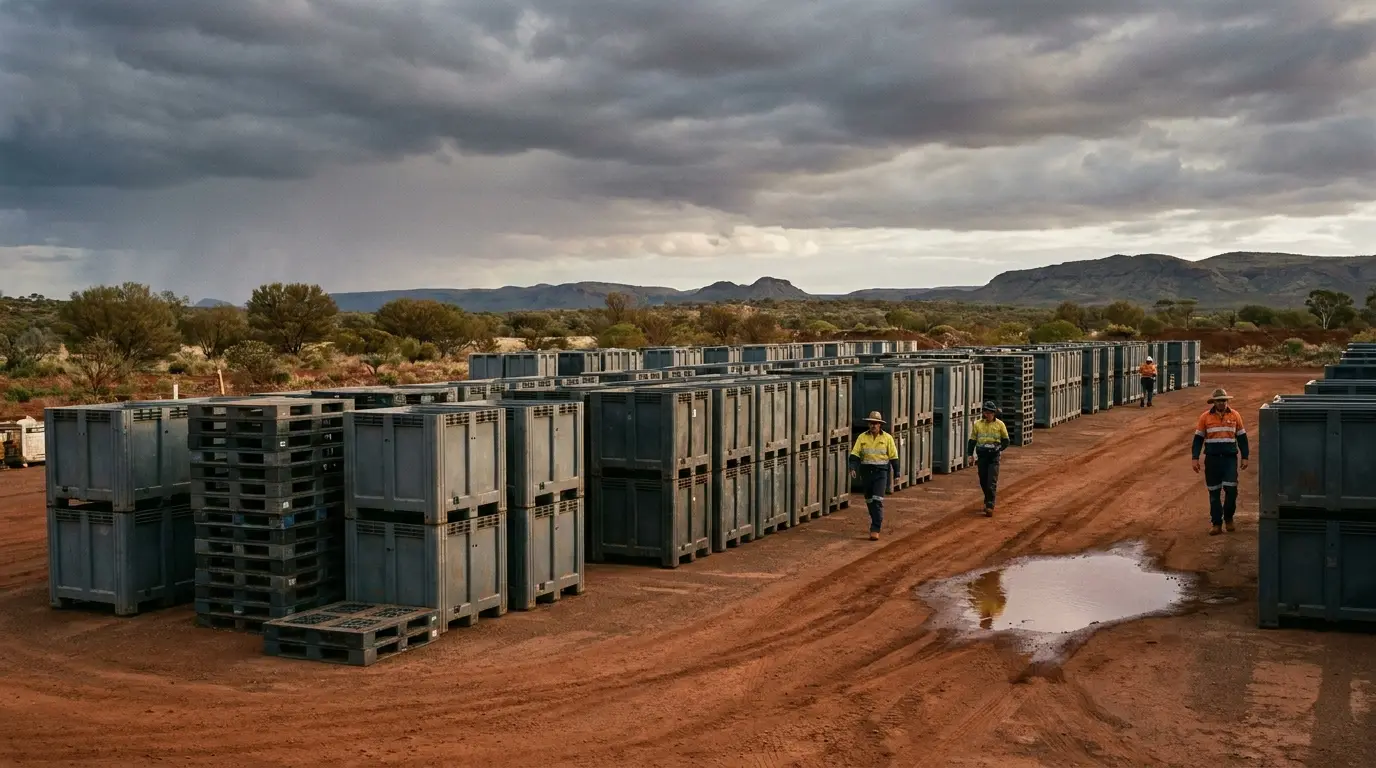
Almost every conversation about storing plastic outdoors on a mine site starts with the sun. It is the wrong place to start. A laydown yard is defined by three things a shed is not — it has no roof, it has no slab, and it is where stock sits for months with nobody looking at it. Those three facts, not the UV index, decide what condition your fleet is in when someone finally needs it. This is a layout method for a yard, built on published weather data and the real dimensions of bins we actually sell.
What actually retires stock in a laydown yard?
Water, ground movement and wind — in that order, and all three arrive in the same season. Water is the driver: it softens the surface, cuts ruts under forklift wheels, ponds where the crossfall is wrong, and turns dust into an abrasive slurry. Ground movement follows from it, as repeated point loading in the same spots settles unevenly on a surface that is now soft. Wind is the one that actually knocks things over, and it does so almost exclusively to empty stock, for reasons the arithmetic below makes obvious.
Sunlight belongs on the list, but further down and on a much longer clock. UV embrittlement and thermal creep are real, they are properties of the polymer rather than of the yard, and they are worked through in detail in our guide to plastic pallets in the Pilbara: UV, heat and creep. This page deliberately does not repeat that material. What follows is the part nobody writes down: how the ground and the weather calendar should shape the way a yard is laid out.
What a wet season delivers, and why August lies
Yards get designed by people standing in them, and on a Pilbara site people are usually standing in them in the dry. The Bureau of Meteorology’s long-run summary statistics for Port Hedland Airport (station 004032) show exactly how misleading that is. Mean annual rainfall is 313.0 mm over 83 years of record, and the mean number of days with rain of 1 mm or more is 20.2 per year (bom.gov.au). That works out at roughly 15.5 mm on each day it meaningfully rains, and it is why annual rainfall is the wrong design input for a yard.
The calendar concentrates it further. From the same table, January, February and March deliver 61.5 mm, 90.5 mm and 53.6 mm — 205.6 mm, or 65.7% of the entire year, inside three months. The same station records a mean of 218.9 clear days a year. So the yard spends most of its life bone dry and dusty, then takes two-thirds of its water in a quarter of the year, frequently in single large events.
There is one more layer, and it is specific to this part of the country. BoM’s tropical cyclone climatology puts the season from November to April, notes that about eleven cyclones form in the Australian region each season and that about half of them become severe, and then identifies where the risk concentrates in a single sentence worth reading twice:
“These maps show that an area north of Port Hedland has the maximum occurrence of cyclones.”
Bureau of Meteorology, Tropical cyclone climatology
Read those two datasets together and the design brief writes itself. The wet is short, intense and seasonal; the wind risk peaks in the same window; and it happens in the Pilbara, which is where a great deal of Australia’s iron-ore laydown sits. A yard laid out for the 218.9 clear days will fail on the 20.2 wet ones. Everything below is about designing for the twenty.
How much lean can a yard stack take? (worked table)
Here is a piece of arithmetic that never gets run before bins are bought. Take the six bulk containers in our range tagged for mining that publish a full set of dimensions, and ask the question their spec sheets do not answer: how far can a stack of these lean before it goes over?
The method is stated so you can check it. For a uniform column of height h on a base of width b, the centre of mass crosses the pivot edge at a tilt of arctan(b/h). We use each bin’s published external dimensions, the short footprint axis (a stack tips about its narrow face first), a three-high column at full published height, and an evenly distributed load. It is a geometric upper bound, not a stacking permission: a real stack shears or shifts at the interlock well before it rotates as one rigid block. Confirm the model’s own stacking rating before stacking anything.
| Bulk container | External (mm) | Volume | Static (kg) | 3-high column | Lean budget |
|---|---|---|---|---|---|
| BPB-1311S (giant pallet box) | 1300 × 1150 × 1250 | 1,400 L | 7,000 | 3,750 mm | 17.0° |
| BPB-C1210S97 (folding solid) | 1200 × 1000 × 978 | 905 L | 7,000 | 2,934 mm | 18.8° |
| BPB-C1212S97 (folding solid) | 1200 × 1200 × 978 | 1,080 L | 7,000 | 2,934 mm | 22.2° |
| BPB-C1210S80 (folding solid) | 1200 × 1000 × 805 | 720 L | 7,000 | 2,415 mm | 22.5° |
| BPB-A1211D86 (folding export IBC) | 1220 × 1145 × 865 | 820 L | 6,600 | 2,595 mm | 23.8° |
| BPB-C1212S80 (folding solid) | 1200 × 1200 × 805 | 880 L | 7,000 | 2,415 mm | 26.4° |
The result is the point of the exercise. Every one of these six publishes a static rating between 6,600 and 7,000 kg — a spread of about 6% — so on that number alone they are interchangeable. Their overturning geometry is not: 17.0° to 26.4°, a 1.55× spread. The rating you buy on does not describe the behaviour you get in a yard.
Two rows deserve calling out. First, the largest bin has the smallest budget: BPB-1311S holds 1,400 L, the most in the set, and is the least tolerant of a leaning surface, because at 1,250 mm it is also the tallest. Second, look at BPB-C1212S97 against BPB-C1212S80. Identical 1200 × 1200 footprint, identical 7,000 kg static rating, same family — and 22.2° versus 26.4°, entirely because one body is 173 mm taller than the other. Height is the variable doing the work, and it is the one nobody compares. The mechanics of the three published load numbers themselves are in pallet load ratings: static vs dynamic vs racking.
Why lean is not what topples a stack
Now the honest part, because the obvious conclusion from that table is wrong. Convert each lean budget into the differential settlement across the base that would be needed to use it up, and the numbers come out large: 341 mm for BPB-C1210S97, 353 mm for BPB-1311S, and up to 596 mm for BPB-C1212S80. A yard built with a normal drainage crossfall of 2–3% is leaning about 1.15° to 1.72°, which is a rounding error against a 17–26° budget.
So a three-high stack does not simply fall over because the ground is not flat, and anyone telling you otherwise is selling something. What ground lean actually does is subtler and worth understanding properly:
- It loads the bottom unit eccentrically. A published static rating is established with the unit level and evenly supported. Tilt the column and the down-slope skids or feet carry disproportionate load, so the real margin is smaller than the number on the page even though the stack is nowhere near tipping.
- It removes reserve against a dynamic event. The budget is consumed by lean plus whatever pushes: a wind gust, a forklift nudge, a load being placed on top, a tine catching a rim. Static lean eats the margin those events need.
- It compounds. Settlement under repeated point loading is not self-correcting. A soft patch gets softer, a rut gets deeper, and the same stack position gets worse every wet season.
The practical version: measure and fix lean because it steals margin, not because your stacks are about to topple. Then spend the attention you saved on the case that genuinely does fall over.
The empty stack is the exposure
A laydown yard is, for most of the year, a place where empty units wait. That is the whole risk profile, and it shows up cleanly if you divide the tare mass of a stack by the side area it presents to the wind.
| Bulk container | Tare (kg) | 3-high empty mass | Side area (long face) | Mass per m² of sail |
|---|---|---|---|---|
| BPB-1311S | 71.0 | 213 kg | 4.88 m² | 43.7 kg/m² |
| BPB-C1210S97 | 56.0 | 168 kg | 3.52 m² | 47.7 kg/m² |
| BPB-C1210S80 | 47.0 | 141 kg | 2.90 m² | 48.7 kg/m² |
| BPB-C1212S97 | 61.0 | 183 kg | 3.52 m² | 52.0 kg/m² |
| BPB-C1212S80 | 52.0 | 156 kg | 2.90 m² | 53.8 kg/m² |
| BPB-A1211D86 | 62.0 | 186 kg | 3.17 m² | 58.8 kg/m² |
Here is the finding, and it is the opposite of what a buyer expects. Across six bins whose volumes differ by 1.9× and whose lean budgets differ by 1.55×, the empty mass per square metre of sail collapses into a narrow 43.7 to 58.8 kg/m² band — a spread of only 1.34×. Bigger bins are heavier and bigger, and the two effects cancel almost exactly. You cannot buy your way out of the empty-stack problem. Every option in the range presents roughly the same wind problem per square metre.
Fill them and it changes completely. At a stated planning fill of 600 kg/m³, a three-high BPB-C1212S80 goes from 156 kg to about 1,740 kg — 11.2×, and BPB-1311S from 213 kg to about 2,733 kg — 12.8×, with the sail area unchanged. So a full stack is a non-problem and an empty stack is the entire problem — in the one place on site that is full of empties, during a wind season BoM puts from November to April.
Which points at the only lever the published data actually supports: fold the empties. Real numbers from the same six units — BPB-C1212S80 and BPB-C1210S80 fold from 805 mm to 293 mm (63.6% off), BPB-C1212S97 and BPB-C1210S97 from 978 mm to 465 mm (52.5% off), and BPB-A1211D86 from 865 mm to 330 mm (61.8% off). Removing 63.6% of the height removes the same share of the side area, so the mass holding down each remaining square metre rises about 2.7×, and the column drops from 2,415 mm to 879 mm. Note the honest exception: BPB-1311S publishes no folded height, because it does not fold. The largest bin in the set is the one you cannot shrink, and it has to be managed by stack height, orientation and restraint instead. The return-freight side of the same trade is worked through in collapsible vs fixed bulk bins.
Standing water, ruts and bridging
A yard surface fails in a specific pattern, and it is worth naming because the fix is different at each stage. Water ponds where crossfall is flat or reversed. Ponding softens the surface. Forklift wheels then cut ruts through the soft patch. The ruts hold the next lot of water, and the cycle accelerates. On a site that is dry for 218.9 days a year, all of that damage happens inside a short window and is invisible for the rest of it.
Two consequences matter for what you store and how. The first is about the unit itself: a solid body left open in a yard collects water and windblown fines, which then sit as a slurry against the floor of the bin and add mass nobody accounted for. A vented body drains, which is a genuine yard advantage even where the product being stored would otherwise prefer solid walls. If a solid bin has to live outdoors, it wants a lid, an inversion or a tilt — not hope.
The second is structural, and it is the same mechanism that governs a pallet in a rack. A unit sitting across a rut is bridged: supported at its ends with nothing under the middle. Every published static rating assumes full, even support from the surface below. Bridging turns that into a spanning load, puts the underside into tension, and produces exactly the kind of damage that is invisible while the unit is still doing its job. We work that failure mode through, along with what to look for when you turn a unit over, in pallet inspection and retirement criteria. In a yard, the practical translation is short: grade out the ruts before you re-stack, not after.
It is also worth being clear about what the yard is not doing to your stock. Plastic in a yard does not rust and does not rot, so water is a stability and contamination problem rather than a material one. The damage that does accumulate comes from handling, and those failure modes — tine strikes, dropped loads, corner impacts — are covered in forklift abuse and pallet durability on a mine site.
How do I lay out a laydown yard?
Design for the twenty wet days, not the 218.9 clear ones. In practice that means seven decisions, in this order:
- Set the crossfall first, and check it after every wet. A 2–3% fall costs almost nothing in lean budget (1.15–1.72°) and is the single control that stops the pond–soften–rut cycle ever starting.
- Separate long-dwell stock from working stock. Anything that moves weekly belongs on the best-drained, best-compacted ground near the access route. Long-dwell archive can take the worse ground, but only if it is stacked low.
- Zone the empties, and fold them. Give empties their own area, fold everything that folds before the wet season starts, and keep folded stock low and banded. This is the highest-value single action in the yard.
- Stack tall stock lower than short stock. Counter-intuitive but correct: the tallest bodies have the least lean budget, so the giant pallet box wants fewer units high than the 805 mm body does, not more.
- Orient stacks to the prevailing wind. A stack presents its largest sail on its long face. Turn the long face out of the wind and you have improved the ratio for nothing.
- Rotate stack positions between seasons. Point loading in the same footprint every year is what creates the soft patches in the first place; moving positions spreads the wear.
- Walk the yard in February, not August. Every problem on this page is visible in the wet and invisible in the dry.
One deliberate omission: nothing here tells you how much a stack may weigh. That question belongs to the model’s published ratings and to the stack-load arithmetic we work through for a covered, flat-floored environment in cool-room bin stacking, while the facility-scale version of laying out a covered store is in core shed layout. This page is about the surface underneath and the weather above, because in a yard those two bind first.
If you are specifying units for open storage, the four facts worth sending us are the dwell time, whether the stock sits empty or full, your surface (slab, compacted hardstand, gravel) and your stack height. Those decide whether you want a folding body, a vented body or simply a low one. Browse the bulk containers and IBC range, compare decks across the plastic pallet range or the full catalogue, see the whole mining range, or send those four facts through for a spec-backed quote.
Common questions
How high can I stack bulk bins outdoors on a mine site?
There is no single number, and anyone who gives you one without asking about your ground is guessing. Three limits apply and the lowest one governs: the model's published stacking or static rating, the overturning geometry of the column on the surface you actually have, and your site's own stacking rules. Outdoors the geometry matters far more than it does on a slab, because a hardstand has crossfall, ruts and differential settlement that a warehouse floor does not. Work out all three, take the smallest, and treat empty stacks as a separate and stricter case.
How is the lean budget in your table calculated?
It is pure geometry, not a rating. For a uniform column of height h standing on a base of width b, the centre of mass passes over the pivot edge when the tilt angle reaches arctan(b/h). We took the published external dimensions of each bin from our live catalogue, used the short footprint axis (a stack tips about its narrow face first), assumed a three-high column at full published height with an evenly distributed load, and reported the angle. It is an upper bound: a real stack shifts, shears or deforms at the interlock well before it rotates as one rigid block, and no dynamic load is included. Use it to compare shapes, not to license a stack height.
Is a laydown yard harder on plastic than on timber or steel?
Each material fails differently outdoors, so the honest answer depends on what your yard does to things. Timber in a yard absorbs water, swells, rots at ground contact and remains a pest pathway; steel in a wet, dusty yard corrodes, and coating damage from forklift work starts the process. Plastic does neither — it is non-porous, so standing water and slurry do not get into it, and it cannot rust or rot. What plastic is exposed to outdoors is UV over years and creep under sustained load in heat, which is a genuine trade and is the subject of a separate guide on this site. None of the three is immune; they simply present the yard with different bills.
Do I need a concrete slab for a laydown yard, or will compacted gravel do?
Compacted gravel is normal and workable for most laydown, and the arithmetic on this page shows why: the geometric reserve on a three-high stack is measured in hundreds of millimetres of differential settlement, not tens. What compacted gravel does not tolerate is uncontrolled water and repeated point loading in the same spots, which together produce ruts, soft patches and localised settlement. If you are stacking high, storing long-dwell stock, or putting racking outdoors, the ground becomes a structural question rather than a housekeeping one and belongs with a geotechnical or civil engineer — racking in particular is governed by AS 4084:2023, and its baseplate reactions are concentrated, not average.
What Australian standards cover outdoor storage and stacking?
No Australian Standard sets a stack height for bulk bins in an open yard, and it is worth saying that plainly rather than implying one exists. The rules that do apply come from elsewhere: general work-health-and-safety duties on stability and stored materials, AS 4084:2023 Steel storage racking where racking is involved, AS 1940 where flammable and combustible liquids are stored, and the manufacturer's published ratings for the specific unit. Everything on this page is a planning method for reasoning about your own yard, not a compliance position — confirm your obligations against your jurisdiction's WHS regulator and your site's own procedures.
Should empty bins be folded, or is it fine to leave them standing?
Fold them, and do it before the wet season rather than during it. The reason is in the numbers on this page: an empty three-high stack carries only about 44–59 kg for every square metre of side area it presents to the wind, roughly a twelfth of what the same stack holds when full. Folding a body from 805 mm down to 293 mm removes 63.6% of the height and the same share of the side area, so the mass holding each remaining square metre down rises by about 2.7× — and the shorter column is easier to restrain and easier to see over. Bodies that do not fold, like the largest pallet boxes, have to be handled by stack height, orientation and restraint instead.
Sources: mean annual rainfall (313.0 mm, 83 years of record), mean number of days of rain ≥ 1 mm (20.2), monthly mean rainfall for January–March (61.5 / 90.5 / 53.6 mm) and mean number of clear days (218.9), Climate statistics for Australian locations, Port Hedland Airport station 004032, Australian Bureau of Meteorology (bom.gov.au/climate/averages/tables/cw_004032.shtml); tropical cyclone season dates, the regional average of about eleven cyclones per season, the proportion becoming severe, and the quoted statement on maximum cyclone occurrence, Tropical cyclone climatology, Australian Bureau of Meteorology (bom.gov.au/cyclone/tropical-cyclone-knowledge-centre/history/climatology/); steel storage racking design and loading, AS 4084:2023 (Standards Australia); flammable and combustible liquids storage, AS 1940; pallet and container test methods, ISO 8611. External dimensions, folded heights, empty weights, volumes and published load ratings are manufacturer figures for the specific models named and were read from our live catalogue in August 2026. The lean-budget, differential-settlement and sail-loading figures are geometric planning calculations derived from those published dimensions under the assumptions stated on the page (three-high column, full published height, evenly distributed load, short footprint axis, and a stated 600 kg/m³ fill for the full-stack comparison); they are an upper bound for comparing shapes and are not a stacking rating, a wind-loading assessment or an engineering certification. No Australian Standard specifies a stack height for bulk containers in an open yard. Confirm stacking limits against the manufacturer’s rating for your model, your own site procedures and, where racking or ground bearing is in question, a qualified engineer. Not a quote.