
Dust ingress on a mine site: what a lid actually closes

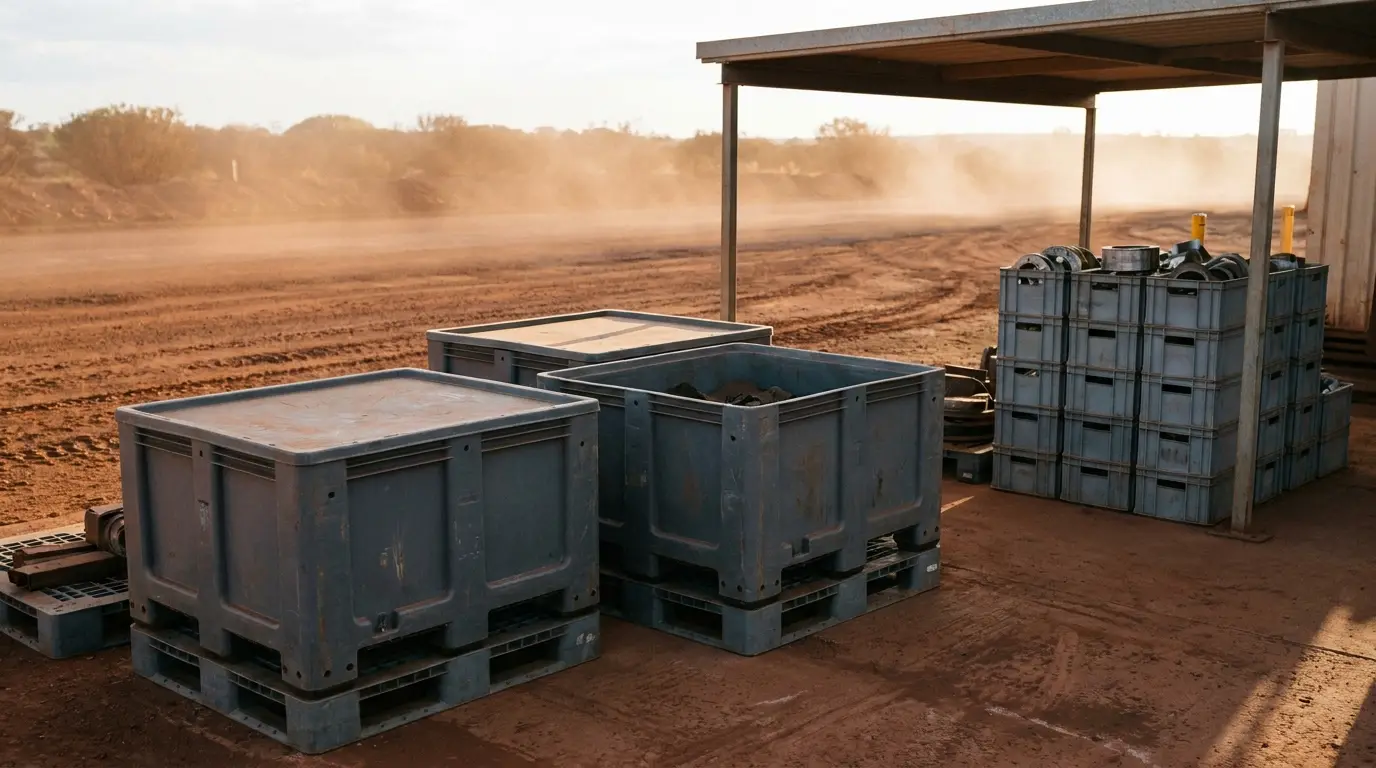
Dust is the one variable every Australian mine site has. It is also the variable that almost never appears on a purchase order, because it does not show up as a number on a container spec sheet the way a load rating or a footprint does. So the decision gets made backwards: a site buys the body it already runs, discovers the stores are gritty, and orders lids. This page argues that the lid is the last part of that decision, not the first — and it uses published deposition data and our own catalogue to show why.
Do you actually need a sealed container on a mine site?
For most of what a site stores in bulk containers — ore samples, rejects, consumables, waste streams, bulk hardware — no. For a minority of what a site stores in crates — machined spares, bearings, seals, hydraulic fittings, instrumentation, sample lots whose chain of custody matters — yes, and more thoroughly than a lid provides.
The reason is that dust does not damage things by weight. It damages things by where it lands. A kilogram of red fines in the bottom of a bin of crushed rock changes nothing. A tenth of a gram of the same material on a sealing face, in an open bearing box or migrating between two sample lots is a rework, a warranty argument or a re-assay. Every useful decision about dust follows from that asymmetry, so the question to ask is never how much dust. It is what can the dust reach.
That reframes the product question completely. A lid removes one path. The body removes or leaves open the others. An inner bag removes them all for one item. Those three controls are not substitutes and they do not cost the same, and the sections below put real numbers on each.
How much dust really lands in an open bin?
Start with the only deposition figures that are actually published and enforceable in Australia. The NSW EPA’s Approved Methods for the Modelling and Assessment of Air Pollutants in New South Wales (August 2022) sets, in Table 11, an impact assessment criterion for deposited dust on an annual averaging period: a maximum increase of 2 g/m²/month and a maximum total of 4 g/m²/month, with dust assessed as insoluble solids as defined by AS 3580.10.1–1991 (epa.nsw.gov.au). Those criteria are applied at and beyond the boundary of a facility.
Then take a measured number rather than a criterion. The NSW EPA commissioned a twelve-month dust deposition monitoring program across the Lower Hunter, an industrial region with coal handling, rail and heavy road traffic. Every one of the twelve dust deposition gauge sites came in below the criterion, with annual averages ranging from 0.5 to 1.1 g/m².month (Lower Hunter Dust Deposition Study).
Now put those rates on a real container, using published internal opening dimensions. The maths is one multiplication and you can repeat it for any bin in the range.
| Open container | Internal opening | Catch area | At 4 g/m²/month (criterion) | At 0.5–1.1 g/m².month (measured) |
|---|---|---|---|---|
| BPB-1311S giant pallet box | 1240 × 1060 mm | 1.314 m² | 5.3 g/month · 63 g/year | 0.7–1.4 g/month · 8–17 g/year |
| BPB-C1212S80 jumbo container | 1120 × 1120 mm | 1.254 m² | 5.0 g/month · 60 g/year | 0.6–1.4 g/month · 8–17 g/year |
| BPB-C1210S80 ISO container | 1120 × 920 mm | 1.030 m² | 4.1 g/month · 49 g/year | 0.5–1.1 g/month · 6–14 g/year |
| BPB-C5638S security crate | 492 × 320 mm | 0.157 m² | 0.6 g/month · 7.6 g/year | 0.08–0.17 g/month · 0.9–2.1 g/year |
Read the right-hand columns and the sales pitch dies on the spot. A jumbo container standing open for a whole year in air that meets the EPA criterion collects about 60 grams. In the measured Lower Hunter conditions it collects eight to seventeen grams. That is a coffee-scoop, not a hazard, and it is worth saying plainly before anyone sells you a lid on the strength of a photograph of a dusty yard.
Two honest limits on those numbers. First, the EPA criterion is a receptor criterion, applied at and beyond a boundary — a laydown yard fifty metres off a haul road is a source, and its deposition rate will be higher, possibly much higher. We could not verify a published figure for that case, so we have not invented one and no multiplier appears anywhere on this page. Second, deposition gauges measure what settles from the air. They do not capture the wind-driven and re-entrained dust that arrives sideways when a loaded truck passes, which is precisely the mechanism a wall stops and a lid does not.
What the dust is made of — and why that beats how much
The same study analysed what the deposited dust actually was, and this is the finding that should change a purchasing decision:
“Soil or rock (primarily aluminosilicate) as the primary source of deposited dust averaging 69% of all samples with a range of 40% to 90%.”
NSW EPA / AECOM, Lower Hunter Dust Deposition Study
The rest of the breakdown from the same summary: insect and plant debris averaged 10% (range 0–40%), coal 10% (0–25%), rubber dust 4% (0–20%) and soot 3% (0–20%), with the remainder largely halite (salt), fly ash, alumina, paint and miscellaneous fibres. Black particles — coal, soot and rubber together — made up about 17% of the total, an annual average deposition of roughly 0.09 to 0.19 g/m².month.
Two things follow. The dominant component is mineral: hard, angular aluminosilicate, which is exactly the material class that scores a sealing face, laps into a bearing race and holds moisture against a machined surface. And there is salt in the mix, which is a corrosion vector rather than an abrasion one and behaves differently again — it needs humidity, not impact, to do damage.
That is why grams matter and tonnes do not. Sixty grams of aluminosilicate spread through 880 litres of crushed rock is undetectable. Sixty grams of it distributed across the stacked, unwrapped faces of a crate of machined spares is a morning of cleaning and an argument about whether the parts are still to spec. The container's job is not to catch less dust. It is to decide what the dust can touch.
As our sales lead John Meir puts it:
“Every site that rings us about dust asks for a lid. Almost none of them ask what is under it. If the thing you are protecting has a machined surface, the lid is the cheapest third of the answer and the bag inside is the other two-thirds — and if the thing you are protecting is a tonne of rock, you did not need any of it.”
John Meir, Sales Lead
What a lid actually closes (worked table)
Here is the arithmetic nobody runs before ordering lids. A container presents two kinds of surface to the outside world: the open top, and the sides. On a solid body the sides are closed, so a lid closes essentially the whole remaining path. On a vented body the sides carry apertures, and the lid closes only the top.
So: across the sixteen vented bulk containers in our range that publish full external dimensions, what fraction of the top-plus-side envelope is the top? Method stated so you can check it — top area is L × W, side area is 2 × (L + W) × H, both from published external dimensions, and the figure is top ÷ (top + sides).
| Vented bulk container | External (mm) | Top area | Side area | Top as % of envelope |
|---|---|---|---|---|
| BPB-1311V | 1300 × 1150 × 1250 | 1.495 m² | 6.125 m² | 19.6% |
| BPB-C1208V97 | 1200 × 800 × 978 | 0.960 m² | 3.912 m² | 19.7% |
| BPB-C1212V97 | 1200 × 1200 × 978 | 1.440 m² | 4.694 m² | 23.5% |
| BPB-D1210V74 | 1200 × 1000 × 740 | 1.200 m² | 3.256 m² | 26.9% |
| BPB-E1165FV | 1162 × 1162 × 785 | 1.350 m² | 3.649 m² | 27.0% |
| BPB-C1212V80 | 1200 × 1200 × 805 | 1.440 m² | 3.864 m² | 27.1% |
| BPB-K1165HV | 1162 × 1162 × 560 | 1.350 m² | 2.603 m² | 34.2% |
| BPB-D1208V44 | 1200 × 800 × 440 | 0.960 m² | 1.760 m² | 35.3% |
Across all sixteen the range is 19.6% to 35.3%, median 26.7%. Put a lid on a vented body and you have closed roughly a quarter of the exposed envelope and left three-quarters of it open. Worse, the fraction runs the wrong way for the containers people most want to seal: the tall, high-volume bins have the smallest top share, because height adds side area faster than it adds anything else. The 1,400 L BPB-1311V is the worst case in the range at 19.6%, and it is also the bin a site is most likely to be storing something bulky and valuable in.
One limitation, stated because it is real: this compares the area of the faces, not open area. A vented wall is a grid of apertures in a solid panel, and our catalogue publishes no vent-area figure for any model, so we cannot tell you what percentage of that side area is actually open. The comparison is therefore an upper bound on what the sides can admit and a lower bound on how much a lid helps — but the direction is not in doubt, and the ranking between models holds.
The practical conclusion is unglamorous. If dust is the problem, the decision is the body, and the lid finishes it. Buying a lid for a vented bin because the stores are dusty is buying a quarter of a solution.
Which bodies even have a lid? A footprint audit
This is the part that catches people after the fleet is bought. Lids in our range are not per-model parts — they are footprint-level accessories, and the range does not cover every footprint we sell a body in.
Nine of the 132 SKUs in the catalogue are lids. Seven publish dimensions: five for bulk containers — BPB-C1208SL (1200 × 800, 40 mm, 7 kg), BPB-C1210SL (1200 × 1000, 40 mm, 8.5 kg), BPB-C1212SL (1200 × 1200, 40 mm, 10 kg), BPB-1311L (1300 × 1150, 9.45 kg) and BPB-K1165L (1162 × 1162, 45 kg) — and two for crates. The remaining two are custom entries with no published dimensions.
Match those five footprints against the bodies. Of the 39 bulk container bodies in the range, 37 publish a footprint, and 33 of those 37 share a footprint with a published lid. The four that do not are worth naming, because two of them are common choices:
- BPB-H1111FS — 1100 × 1100 mm folding solid container.
- BPB-D1120S78 and BPB-D1120V78 — the 1120 × 1120 mm solid and vented pair.
- BPB-A1211D86 — 1220 × 1145 mm folding solid export container.
None of that makes those bodies bad choices; it makes them bodies you should not standardise on if a lid is part of the plan. Ask the question at quote stage, before a hundred units land on site.
There is a second, quieter finding in the lid data. The lid is the only part of this system a person picks up by hand, every single time the container is opened. Published lid masses run 7 kg, 8.5 kg, 9.45 kg and 10 kg for the four flat lids — roughly 10% to 33% of the mass of the bodies they close — and then there is the 1162 × 1162 pallet-box lid at a published 45 kg, effectively the same mass as the box it sits on (those bodies run 44–53 kg). The C-series lids publish a 40 mm profile; that one publishes no height, so it is plainly a different item and you should confirm its construction and mass before specifying it. Either way, a lid that gets removed twenty times a shift is a manual-handling design decision, not an accessory line — the same argument we make about deck mass in pallet weight and manual handling.
The crate problem: where dust-sensitive gear actually lives
Here is the inversion that earned this page. On a mine site, the dust-sensitive items are almost never in the big bins. They are in crates — the bearings, the seal kits, the hydraulic fittings, the instrument spares, the shutdown kits, the bagged sample lots. So you would expect the crate half of the range to be the closed, lidded half.
It is the opposite. Of the 34 crate bodies, 30 declare a wall style and 21 of those are vented against 9 solid. Among bulk containers the split runs the other way: 22 solid to 17 vented. And the lid coverage inverts too — five lid SKUs serve the bulk containers, while the entire crate range is served by two published lids (BPB-AP4L-3 at 440 × 332 mm and 0.425 kg, and BPB-AP7L at 656 × 425 mm and 0.755 kg).
So the container class that most needs to exclude mineral dust is the one that is mostly open-walled and mostly has no lid. That is not a criticism of the crates — they are designed for produce, for wash-down, for nesting and for airflow, and they are very good at those jobs. It is a statement about what a crate is for. The honest conclusion for a mine store is this: for dust-critical parts, the crate is not the barrier. Put the barrier immediately around the part — a sealed bag, the manufacturer's box, a lidded sub-container — and let the crate do what a crate is good at, which is stacking, carrying and being findable.
Where a solid crate is the right unit is sample integrity, where the enemy is not dust from outside but fines migrating between lots inside a stack. That was the finding behind our pick in RC chip trays and sample storage, and it holds here.
How to spec for dust without over-buying
Six steps, in the order that actually saves money.
- Sort the fleet by contents, not by weather. This is the whole argument. The vented body that is right for a wet yard — drainage, no standing water, no trapped heat — is wrong for anything with a machined surface, and most sites are running one fleet for both. Draw the line at the goods, not at the roof.
- Choose the body first. Solid walls, if dust matters, before you spend a dollar on lids. A lid on a vented body closes 19.6–35.3% of the envelope; a solid body closes the rest.
- Then check the lid exists. Confirm a footprint-matched lid is available for that exact body, and confirm its mass, before the order goes in. Four of our bulk footprints have no lid in the range.
- Put the real barrier around the part. For bearings, seals, machined faces and instrumentation, use a sealed inner package. Nothing in this range is dust-tight, and specifying a lid as if it were a seal is the expensive mistake.
- Get it off the ground and out of the re-entrainment zone. Most yard dust arrives sideways at low level from vehicle movement, not vertically out of still air. Where the container sits does more than what it is made of — the layout argument is in laydown yard layout, and the exposure story for units left in the open is in UV, heat and creep on remote sites.
- Plan the clean, not just the cover. Mineral dust that gets in has to come out, and a moulded plastic body washes where a porous one does not — the method is in hot-wash and sanitation, and the reason plastic tolerates that treatment at all is in forklift abuse and durability.
Where to go next: the underlying vented-versus-solid trade in its own right is vented vs solid bulk bins, and if the units are shuttling between sites the fold economics are in collapsible vs fixed bulk bins. Browse the range in bulk containers and plastic crates, the mining pages at mining, or the full catalogue. When you are ready, send the footprint you run, whether the contents are dust-sensitive, and your site postcode for a spec-backed quote.
Common questions
Do plastic bulk containers keep dust out on a mine site?
A solid-walled container with a fitted lid keeps out most of what falls on it, and that is genuinely useful. But no plastic bulk container or crate in our range is dust-tight, and none carries an ingress protection (IP) rating — the IP code in AS 60529 covers enclosures for electrical equipment, and its dust digits are earned by tested seals under test conditions, not by a lid that drops onto a moulded rim. Treat a lid as a cover that removes the vertical path, not as a seal. For parts that genuinely cannot tolerate mineral dust — bearings, seals, machined faces, electronics — the barrier is a sealed inner bag or box, and the container is what carries and stacks it.
Should I buy vented or solid bins for a dusty mine site?
Solid, if the contents are dust-sensitive — and this is the opposite of the answer a wet yard gives you. Venting exists to let air, water and heat move through the load, which is why it wins for produce and for anything that has to drain (we cover that trade in vented vs solid bulk bins). On a mine site the same apertures are the dominant dust path: across our 16 vented bulk containers publishing full dimensions, the walls are 64.7% to 80.4% of the top-plus-side envelope, so a lid on a vented body leaves most of the exposed surface open. The practical answer is to split the fleet by what is inside, not by where it lives: vented for anything that drains or breathes, solid plus lid for anything with a machined or sealing surface.
Will a bulk container lid fit any bin?
No — lids in our range are sold by footprint, not by model, and the range does not cover every footprint. Five bulk lid SKUs publish dimensions: 1200 × 800 (BPB-C1208SL), 1200 × 1000 (BPB-C1210SL), 1200 × 1200 (BPB-C1212SL), 1300 × 1150 (BPB-1311L) and 1162 × 1162 (BPB-K1165L). Those five cover 33 of the 37 bulk container bodies that publish a footprint. The four that have no footprint-matched lid in the range are the 1100 × 1100 BPB-H1111FS, the 1120 × 1120 pair BPB-D1120S78 and BPB-D1120V78, and the 1220 × 1145 BPB-A1211D86. If a lid is part of the plan, confirm lid availability and fit for that exact body before you standardise a fleet on it.
How heavy is a bulk container lid?
Heavier than people expect, and it matters because the lid is the one part of the system a person handles by hand every time the container is opened. The four flat lids in our range publish 7 kg (1200 × 800), 8.5 kg (1200 × 1000), 9.45 kg (1300 × 1150) and 10 kg (1200 × 1200) — between about 10% and 33% of the mass of the bodies they close. The outlier is the 1162 × 1162 pallet-box lid BPB-K1165L, published at 45 kg, which is as much as the box itself (those bodies run 44–53 kg); the C-series lids publish a 40 mm profile and that one publishes no height, so it is a different item and you should confirm its construction and mass at quote. Anything in that upper range is a two-person lift or a lift with equipment — see pallet weight and manual handling.
What about worker exposure to mine dust?
That is a different question and this page does not answer it. Airborne dust exposure for workers is a work health and safety matter governed by workplace exposure standards and enforced by the relevant state WHS or mining regulator, and it turns on ventilation, suppression, monitoring and respiratory protection — not on container choice. Everything here is about what gets into a container and reaches the goods inside it. If you are dealing with a respirable dust question, take it to your regulator and your occupational hygienist.
How were the dust figures on this page calculated?
Two cited figures, then arithmetic you can repeat. The deposition rates are the NSW EPA impact assessment criterion for deposited dust (2 g/m²/month maximum increase, 4 g/m²/month maximum total, annual averaging period, assessed as insoluble solids per AS 3580.10.1–1991) and the measured annual averages of 0.5 to 1.1 g/m².month across twelve monitoring sites in the NSW EPA Lower Hunter Dust Deposition Study. We multiply those by each container's published internal opening area to get grams per month and per year. The envelope percentages are the published external dimensions: top area divided by top area plus side area. Two limits stated plainly: the EPA criterion applies at and beyond a facility boundary, so a working laydown yard beside a haul road is a source rather than a receptor and will be higher — we have no verified figure for that case and have not invented one; and the envelope comparison uses the area of the faces, not open area, because our catalogue publishes no vent-area figure. No pricing appears on this page.
Sources: deposited dust impact assessment criteria (2 g/m²/month maximum increase, 4 g/m²/month maximum total, annual averaging period, assessed as insoluble solids per AS 3580.10.1–1991), NSW Environment Protection Authority, Approved Methods for the Modelling and Assessment of Air Pollutants in New South Wales, August 2022, Table 11 (EPA 2022P3963); measured deposition rates (12 monitoring sites, annual averages 0.5–1.1 g/m².month) and dust composition (soil or rock, primarily aluminosilicate, averaging 69% of samples, range 40–90%; insect and plant debris 10%; coal 10%; rubber dust 4%; soot 3%; black particles ~17% total, 0.09–0.19 g/m².month), NSW EPA / AECOM, Lower Hunter Dust Deposition Study; degrees of protection provided by enclosures (IP Code), AS 60529. The EPA criterion is applied at and beyond the boundary of a facility, so it describes ambient air at a receptor, not conditions inside a working yard beside a haul road; no on-site deposition rate is quoted or estimated because none was verified. Envelope percentages compare the area of the top and side faces from published external dimensions, not open area — no vent-area figure is published for any model in our catalogue. Container counts (39 bulk container bodies, 37 publishing a footprint, 33 footprint-matched to a lid; 34 crate bodies, 21 vented and 9 solid of the 30 declaring; nine lid SKUs, seven publishing dimensions) are a direct count of our own published catalogue on the date of writing and change as the range changes. No product in this range carries an ingress protection rating and none is implied. Worker exposure to airborne dust is a work health and safety matter for your WHS or mining regulator and is outside the scope of this page. Load figures are manufacturer-tested ratings for the specific models shown and vary with load distribution and beam span. Not a quote.