
Storing empty produce bins off season: what storage life does to your yard

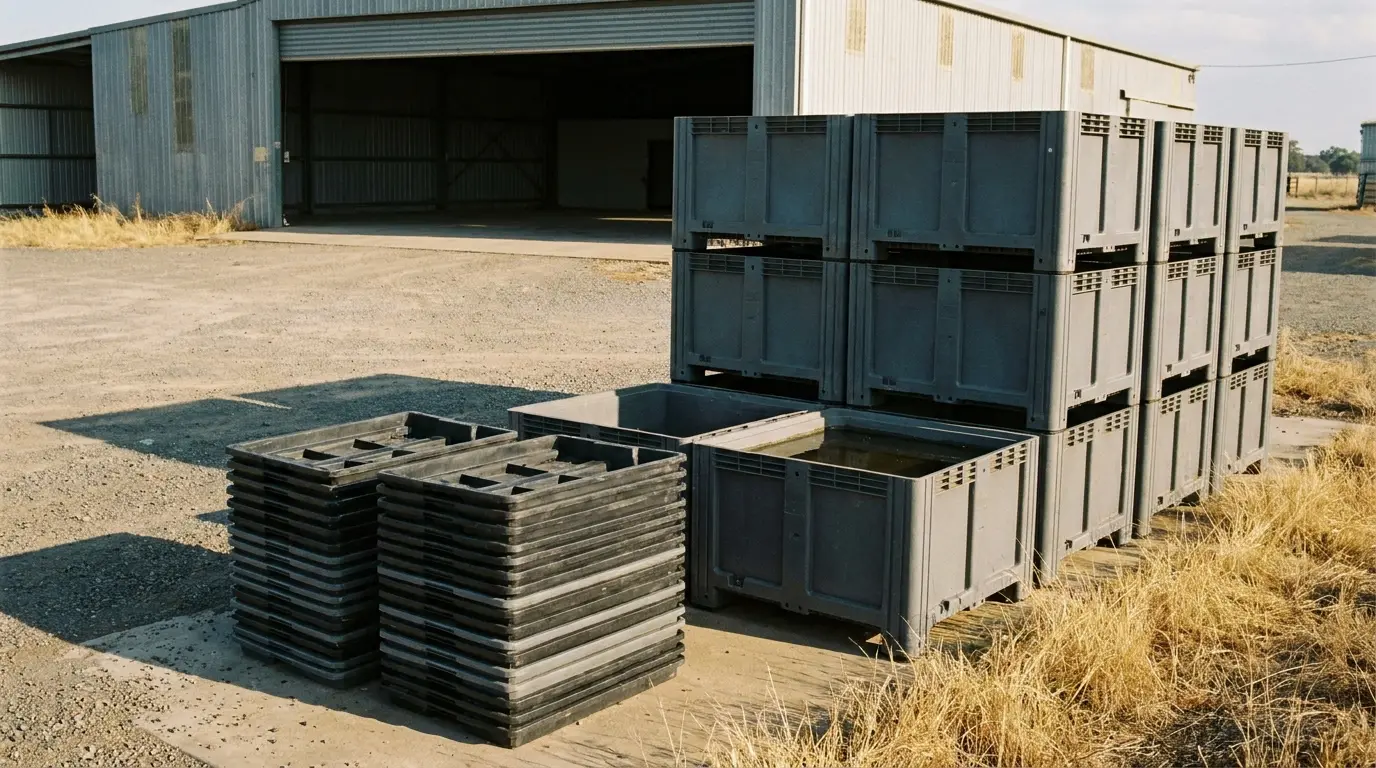
Australian produce is violently seasonal, so for a large part of the year the expensive thing you bought is doing nothing, in a yard, in the sun. We have written seventeen articles about which bin to buy for the loaded season and not one about the months of nothing — which is where units get lost, water gets in and the fleet quietly stops being the size you think it is. This is the off-season piece, and it starts somewhere unexpected: the harvest calendar does not decide when your bins are empty. Storage life does.
How much yard does an empty bin fleet actually need?
Far less than most operations give it, and the gap is almost entirely about folding. At a stated 2.4 m clear working height, a single footprint in your yard holds two empty bins standing upright for nearly every model we publish. Fold the ones that fold and the same footprint holds five to ten. If your bins do not fold, it holds two — or, for the two biggest bins in our range, exactly one.
That is the whole practical answer, and we will show the arithmetic below. But it is the second-order question that decides how much it matters to you: how many months of the year are your bins empty at all? Two growers with identical fleets and identical sheds can have wildly different off-seasons, and the variable is not the one on the calendar.
Your off-season is set by storage life, not the calendar
A bin is not idle because the harvest finished. It is idle because the crop left it. If the crop sits in the bin for eight months of controlled storage, the bin is working the whole time — it is a storage vessel, not just a transport one — and the off-season is the short gap at the end. If the crop ships within a fortnight, the same bin spends most of the year empty.
Published storage life is where that shows up, and the spreads are much wider than the crop names suggest. All of the figures below are from UC Davis Postharvest Technology Center produce-facts sheets, fetched and checked in September 2026.
| Crop and form | Published storage life | Conditions as published | Months of a year one fill commits the bin |
|---|---|---|---|
| Carrot — mature roots | 7–9 months | 0 °C | 7–9 |
| Carrot — mature roots | 3–5 months | 3–5 °C, “minimal decay” | 3–5 |
| Carrot — immature roots | 4–6 weeks | 0 °C | ~1–1.4 |
| Carrot — bunched (tops on) | 10–14 days | 0 °C | ~0.3–0.5 |
| Onion, dry — pungent cultivars | up to 6–9 months | 0 °C, cultivar dependent | 6–9 |
| Onion, dry — mild cultivars | 0.5–1 month | 0 °C | 0.5–1 |
| Potato — early crop, cured | up to 5 months | 4 °C, 95–98% RH, after curing 8 days at 15 °C / 95% RH | up to 5 |
| Potato — immature | 3–5 weeks | at optimum; <3 weeks recommended for visual and sensory quality | ~0.7–1.2 |
Read the final column as a planning frame, not a schedule: it is how long one fill commits a bin at the published optimum, on a stated assumption of a single fill. A real packhouse turns bins several times in a season, so your bins are busier than the column suggests — but the relative picture is exactly right, and it is the relative picture that sizes a yard. To be explicit about what these numbers are: they are published storage recommendations for crop quality under optimum conditions, not regulatory limits, and no Australian Standard sets a storage duration for a produce store.
The bin you store longest is the bin that is idle least
Look at the onion rows again, because they are the same crop. UC Davis records dry-onion storage as “Mild onions: Typically 0.5 to 1 month at 0 °C. Pungent Onions: Typically up to 6 to 9 months at 0 °C depending on the cultivar” (postharvest.ucdavis.edu, Onions (dry)). Depending which ends of the two published ranges you take, that is between 6 and 18 times the occupancy for the same crop, in the same shed, in the same bin. Carrot is wider still: mature roots at 7–9 months against bunched carrots at 10–14 days is roughly a 15- to 27-fold difference in how long one fill holds the bin.
Which produces the finding that we think earns this page, and it is one nobody sells you anything for. The crop that keeps your bins full is the crop that gives you no off-season problem at all. A grower moving from mild to pungent onions, or from bunched to mature carrot, does not need more bins and does not need a bigger yard — the bins they already own simply stop being empty. The yard problem and the fleet-size problem are the same problem, viewed from opposite ends of the year.
“Growers ask me how many bins they need and I ask what they grow, which sounds like small talk. It isn’t. Two operations packing the same tonnage can need fleets that differ by a factor of several, and the difference is not the tonnage — it’s how many months the crop sits in the bin before it leaves.”
John Meir, Sales Leader — BulkPlasticBins
For scale, horticulture is not a small thing to be planning by feel: the ABS puts the local value of Australian vegetables at $6.0 billion in 2024-25, up $317.3 million (5.6%), with potatoes alone at $1.2 billion, up $108.7 million (9.8%), inside a horticulture sector worth $19.5 billion (abs.gov.au, Australian Agriculture: Horticulture, 2024-25, released 30 June 2026; crop estimates reproduced courtesy of Hort Innovation). Note what that release does and does not give you: it publishes local value, not tonnes, so it sizes the industry and tells you nothing about how many bins are in it. We have not converted it into a fleet estimate and you should be suspicious of anyone who does.
What the range actually offers an empty fleet
Here is the part that costs us a sale to say out loud. We audited all 45 bulk containers in our published catalogue in September 2026 for every mechanism that makes an empty unit smaller. There is exactly one, and it is not universal.
- 25 of 45 publish a folded height. 20 do not. That includes both 1,400 L giants, the largest units we sell.
- 0 of 45 publish a nestable stacking mode. Nesting appears on 11 of our 37 crates and 18 of our 50 pallets — and on none of the bulk containers.
So for a bulk bin there is one published way to shrink an empty fleet, and it is unavailable on 44% of the range. If you already own non-folding bins, no article and no purchase changes your off-season footprint — the answer for you is yard discipline, covered below, not a product. We would rather say that than imply the fix is a new order.
The yard arithmetic: how many bins fit one footprint
Take a stated 2.4 m clear working height — our planning assumption, not a standard, and substitute your own — and divide it by each unit’s published height, rounded down. That gives units per footprint standing empty, and units per footprint folded. Across the 25 folding models the gain runs from 2.0× to 5.0×, and it does not track size.
| Model | Footprint | Rated volume | Height / folded | Upright per footprint | Folded per footprint | Gain |
|---|---|---|---|---|---|---|
| BPB-V121210-18 | 1200 × 1200 | 1,070 L | 1000 / 240 mm | 2 | 10 | 5.0× |
| BPB-C1212V80 | 1200 × 1200 | 880 L | 805 / 293 mm | 2 | 8 | 4.0× |
| BPB-A1211D86 | 1220 × 1145 | 820 L | 865 / 330 mm | 2 | 7 | 3.5× |
| BPB-K1165V | 1162 × 1162 | 750 L | 780 / 280 mm | 3 | 8 | 2.7× |
| BPB-C1212S97 | 1200 × 1200 | 1,080 L | 978 / 465 mm | 2 | 5 | 2.5× |
| BPB-K1165HV | 1162 × 1162 | 470 L | 560 / 280 mm | 4 | 8 | 2.0× |
| BPB-1311V | 1300 × 1150 | 1,400 L | 1250 / no fold | 1 | — | — |
The pair worth staring at is the top row against the fifth. BPB-V121210-18 and BPB-C1212S97 share the same 1200 × 1200 footprint and are within 1% of each other on rated volume — 1,070 L and 1,080 L. One folds to 240 mm, the other to 465 mm: 1.94× the folded height for the same capacity, which is 10 units per footprint against 5. Two bins that are interchangeable on the number a buyer normally compares are not interchangeable at all in a yard in July.
Normalise it as rated capacity parked per footprint and the range widens further: the folding jumbo parks 10 × 1,070 L = 10,700 L of capacity on one footprint, the C97 parks 5,400 L, and the 1,400 L non-folding giant parks 1,400 L. That is 7.6× the parked capacity per square metre between the best case and the biggest bin. Two honest limits on that number: it is column geometry from published heights, and our catalogue publishes no folded-stack limit, so nothing here is a stacking permission. No Australian Standard sets a stack height for bulk bins in a yard, and the wind and ground-bearing side of an empty stack is worked through in laydown yard layout.
The catch: the best folder is the lightest bin
Before anyone re-specs a fleet on the table above, the trade has to be stated, because it is significant and it runs against the conclusion. BPB-V121210-18 publishes a 1,400 kg static rating. BPB-C1212S97 publishes 7,000 kg — five times as much — along with 950 kg dynamic against 700 kg, and 61 kg of moulded HDPE against 32 kg of PP. The bin that folds twice as well is the light-duty bin, and it is light-duty because there is less of it.
So the off-season saving is bought with loaded-season capability, exactly as the tare-efficiency trade is in tare drift and net weight, where the same lightweight jumbo turns up as the best tare performer in the range and the weakest on static rating. The published sequence to work through is: what the loaded season needs first, what the empty season costs second. A bin that folds beautifully and cannot carry your crop stack is not a saving.
We are also deliberately not re-running the fold-versus-fixed purchase case here, or the return-freight economics of folding — that is collapsible vs fixed bulk bins, and it prices the fold per trip. This page prices it per month of yard, which is a different question with a different answer for a seasonal operation: a grower who folds twice a year and freights rarely gets almost nothing from the return-freight argument and almost everything from this one.
What an empty bin collects
A loaded bin is watched. An empty one is not, and the whole difference in the off-season is that it spends months as an open container in the weather. What it collects is water, wind-blown soil, and whatever finds the water useful.
There is one genuinely useful thing our catalogue can tell you here, and it points the opposite way to the loaded-season advice. Of our 45 bulk containers, 23 publish solid walls and 17 vented. A vented empty left standing outdoors drains. A solid empty left standing outdoors is a vessel: it holds rain, and then it holds whatever grows in the rain, and it holds the weight. That is the one place where the wall style you chose for the crop’s sake — the choice worked through in vented vs solid bulk bins and, at the crop’s surface, in when a liner undoes the bin — behaves in reverse when nothing is in it.
State it as what it is: a mechanism, not a measurement. We have run no trial and publish no figure for how much water a given empty bin holds or how quickly. The action it points to costs nothing, which is the best kind of finding: store empties folded, inverted, vented or under cover, and never solid-walled and upright in the open if you can avoid it. Sun, wind loading and ground bearing on an empty stack are separate exposures and belong to UV, heat and creep on remote sites and laydown yard layout; we are not re-deriving them here.
Re-entry: the season starts with a wash
The last off-season decision is made at the start of the off-season, and it is the one most often skipped: wash before storage, not after. Soil that has dried onto a bin for eight months through a summer is a materially harder job than soil washed off the week the season ends, and the bin has to be clean before it touches food regardless — so the work is not avoided by delaying it, only made worse. The method itself is out of scope here and covered properly in hot-wash and sanitation for produce bins.
Two consequences follow that are easy to miss. First, an off-season of accumulated soil is precisely the mass-drift mechanism that makes a published tare stop matching the fleet, and drift only ever runs heavier — the arithmetic and what it does to an invoice is in tare drift and net weight. Second, a fleet counted in April is not the fleet available in October: units get lent, cracked, buried under something and quietly lost, and the only cheap way to know is to count and grade them going into storage rather than discovering it under harvest pressure. The criteria for pulling a unit out of service are in inspection and retirement criteria, and if the count comes back short, second-hand vs new is the cheapest way to think about topping it up.
Browse the IBCs and bulk containers range or the whole catalogue, see the rest of the crop-side guidance in fresh produce, or send your crop, cultivar, storage duration and fleet size for a spec-backed quote.
Common questions
How should I store empty produce bins over the off-season?
In order of what actually saves you something: fold anything that folds, because at a stated 2.4 m clear working height folding turns 2 units per footprint into 5–10; store them so they cannot fill with water, which means folded, inverted, vented or under cover; wash them before storage rather than after, because eight months of dried-on soil is a different job from fresh soil; and record what condition they went away in, because that is what decides how many are usable on day one. If your bins do not fold — and 20 of the 45 bulk containers in our range do not — none of the first point is available to you, and the answer is yard discipline rather than a purchase.
How long can produce actually stay in the bin?
It depends far more on the cultivar and the maturity than on the crop name, which is exactly why the off-season is hard to plan. UC Davis publishes, at 0 °C: mature carrot roots 7–9 months but bunched carrots 10–14 days; dry onions 0.5–1 month for mild cultivars and up to 6–9 months for pungent ones. For potatoes, early-crop tubers cured 8 days at 15 °C and 95% RH allow “extended storage of up to 5 months at 4 °C”, while immature potatoes hold good quality for only 3–5 weeks (postharvest.ucdavis.edu). These are published storage recommendations for crop quality under optimum conditions — not regulatory limits, and not a promise about your shed.
Do plastic bulk bins nest when empty?
Not in our range, and this is worth knowing before you plan a yard around it. Across all 45 bulk containers we publish, none states a nestable stacking mode — nesting appears only on 11 of our crates and 18 of our pallets. For a bulk bin the only published space-saving mechanism is the fold, and 20 of the 45 do not publish a folded height either. If a supplier tells you a bulk bin nests, ask for the nested pitch in millimetres and check it against the model’s published dimensions before you plan storage around the number.
Is it better to just buy fewer, bigger bins?
For the off-season, that runs the wrong way, and the arithmetic is stark. The two 1,400 L bins in our range are 1,250 mm tall and publish no folded height, so at a stated 2.4 m clear height you get one per footprint. A 1,070 L folding bin at 240 mm folded gives you ten — parking about 7.6× the rated capacity on the same square metre. But the big bin exists for good reasons the small one cannot match: 7,000 kg published static against 1,400 kg, and a published racking figure the folding bin does not have. This is a genuine trade between the loaded season and the empty one, not a free upgrade. The loaded-season side of it is in produce bin sizing and collapsible vs fixed bulk bins.
How are the units-per-footprint figures on this page calculated?
Simple column arithmetic, computed in September 2026 from each model’s published external height and published folded height in our catalogue: a stated 2.4 m clear working height divided by the unit height, rounded down. The 2.4 m figure is a planning assumption we have chosen and stated, not a standard — substitute your own clear height and the ratios hold. Treat this as geometry only: our catalogue publishes no folded-stack limit, so nothing here is a stacking permission, and no Australian Standard sets a stack height for bulk bins in a yard. Confirm safe stack heights for your models, your ground and your conditions.
Should I store empty bins outside or under cover?
Under cover if you have it, and if you do not, at least store them so they cannot hold water — folded, inverted, or vented. Of our 45 bulk containers, 23 publish solid walls and 17 vented, and this is the one decision where the wall style you bought for the crop’s sake works in the opposite direction off-season: a vented empty left upright drains, while a solid empty left upright is a vessel. That is a mechanism, not a measured claim — we have not tested it and publish no figure for it. The related exposures of sun, wind and ground are covered in UV, heat and creep on remote sites and laydown yard layout.
Sources: crop storage life, curing conditions and storage temperatures, University of California, Davis, Postharvest Technology Center produce-facts sheets for Carrot, Onions (dry) and Potato (postharvest.ucdavis.edu), fetched and verified September 2026 — these are published storage recommendations for crop quality under optimum conditions, not regulatory limits, and no Australian Standard sets a storage duration or a yard stack height; industry scale, Australian Bureau of Statistics, Australian Agriculture: Horticulture, reference period 2024-25 financial year, released 30 June 2026 (abs.gov.au), horticultural crop estimates reproduced courtesy of Hort Innovation Australia — that release publishes local value, not tonnes, and has not been converted into any fleet or bin estimate here. Folded-height, external-height, wall-style, volume, weight, load-rating and stacking-mode counts were computed in September 2026 across the 45 bulk containers, 37 crates and 50 plastic pallets in our own published catalogue. Units-per-footprint figures are column arithmetic against a stated 2.4 m clear working height divided by published unit height and rounded down; they are geometry, not a stacking permission — our catalogue publishes no folded-stack limit, and safe stack heights depend on your models, ground and conditions. Statements about what an empty bin collects describe a mechanism; we publish no measured figure for it. Not a quote.