
One footprint or three? What a mixed container fleet costs a mine site

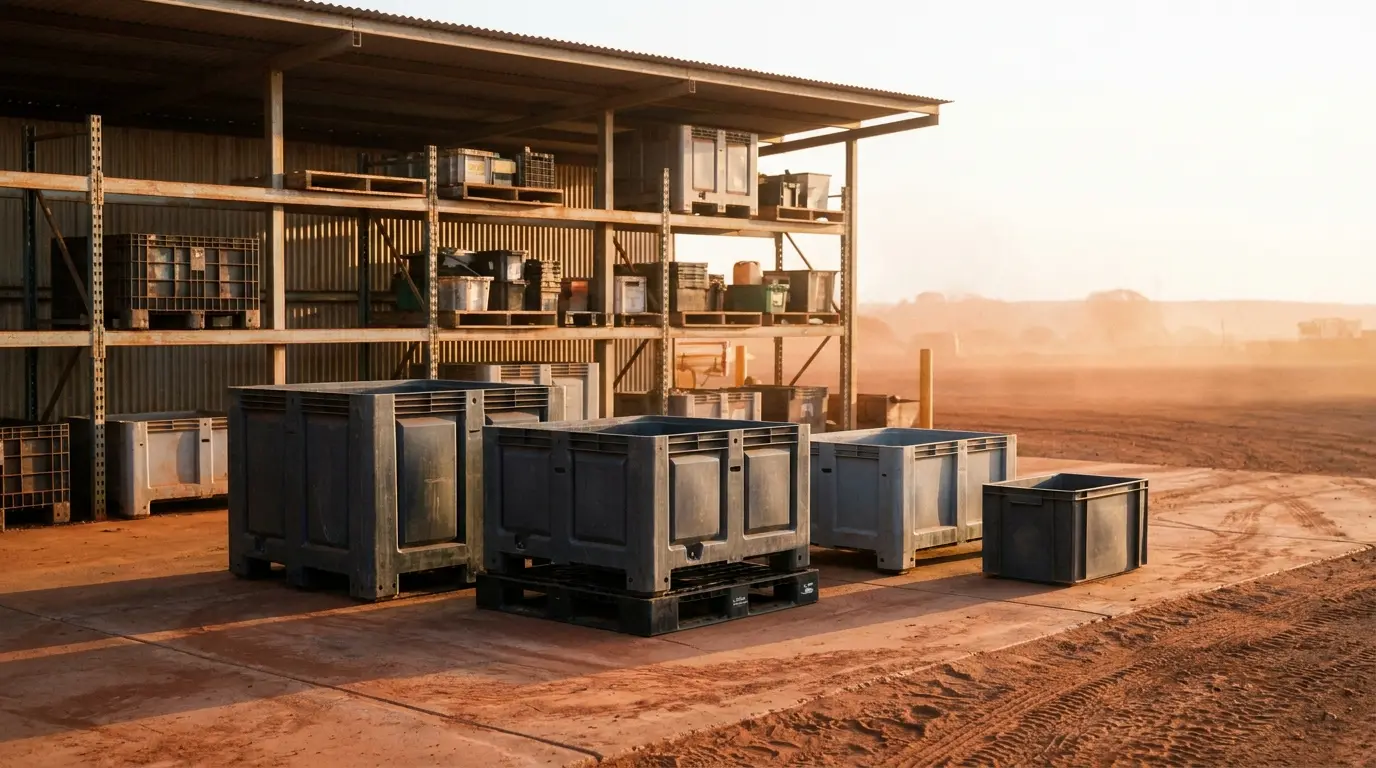
Nobody decides to run four pallet footprints. It happens the way most expensive things on a site happen: the workshop buys what the workshop needs, the lab buys what the lab needs, someone inherits a fleet with an acquisition, a supplier substitutes a near-equivalent during a shortage, and eight years later the store has four footprints, no lid fits anything, half the stacks are two high because the units underneath are the wrong size, and every rack bay is built for the deepest thing anyone ever put in it. This is an audit of what that drift actually costs, computed from published dimensions rather than asserted.
How many footprints should a mine site run?
The useful answer is one per duty class, not one overall. A site that handles reagent drums, drill samples, workshop spares and bulk consumables has genuinely different load profiles, and forcing them onto a single footprint costs capacity or load rating somewhere. Three or four chosen footprints that nest - a heavy rackable deck, a bulk-container size, a crate module that packs onto the deck cleanly - is a healthy fleet. Three or four accumulated footprints that were each somebody's local optimum is the expensive case, and from the outside the two look identical.
The distinction that makes it tractable is this: a footprint is not a size, it is a compatibility class. Size is continuous and you can reason about "a bit bigger" or "close enough". Compatibility is binary. Two units either share a lid, a stack and a bay, or they do not, and 20 mm is as fatal as 200 mm. Almost everything about the way containers are compared - litres, load ratings, wall style, fold height - is continuous, which is exactly why the one binary property is the one that drifts unnoticed.
The audit: 23 footprints in one range
Start with what a single supplier's range looks like, because it sets the scale of the problem before any site-level drift is added. Of our 132 published SKUs, 121 publish both plan dimensions, and those 121 carry 23 distinct footprints. (Counted with the longer axis first, so a 1200 × 800 and an 800 × 1200 are one footprint, not two. The 11 SKUs without published plan dimensions are mostly used and custom stock and are excluded rather than estimated.)
| Category | SKUs publishing plan dimensions | Distinct footprints |
|---|---|---|
| Plastic pallets | 46 | 7 |
| IBCs & bulk containers | 42 | 8 |
| Plastic crates | 33 | 11 |
| Total | 121 | 23 |
The first finding is in the overlap, or rather the absence of it. Only three footprints appear in more than one category - 1200 × 1000, 1200 × 800 and 1100 × 1100. Every other footprint in the range exists in exactly one product family. Pallets and bulk containers are, dimensionally, largely separate populations that happen to be sold together.
That leads directly to the second finding, and it is the one that changes how you plan a store. Only 3 of the 8 bulk-container footprints have a deck of the same footprint anywhere in the range, covering 23 of the 42 bulk SKUs. The other five footprints - 1300 × 1150, 1220 × 1145, 1200 × 1200, 1162 × 1162 and 1120 × 1120 - have no matching deck at all. That is not an oversight. Those units are self-supporting: they carry their own skids, feet or full-perimeter base and are designed to be handled directly, which is why they do not need a deck under them. But it means that for the majority of bulk footprints, "put it on a pallet" is not the plan, and any layout that assumes a matched deck under every unit is planning for a fleet that does not exist.
The five-millimetre problem
Here is the part that makes footprint drift genuinely hard to manage, and it is visible inside our own catalogue rather than out in the market. In the Australian size band, we publish three different footprints within five millimetres of each other:
| Footprint | What is on it | Published load ratings |
|---|---|---|
| 1165 × 1165 mm | BPB-E1165LS heavy-duty deck (1 SKU) | 10,000 kg static / 2,000 dynamic / 2,000 racking |
| 1162 × 1162 mm | The K1165 pallet-box family - 7 SKUs including its lid | 3,000 kg static / 500 dynamic (bodies) |
| 1160 × 1160 mm | BPB-E1160V medium-duty deck (1 SKU) | 10,000 kg static / 2,000 dynamic / 2,000 racking |
Three footprints, a five-millimetre total spread, and no person standing in a yard can tell them apart. Worse, the naming actively hides it: the deck at 1165 and the entire pallet-box family at 1162 both carry "1165" in the SKU, because they are all built to work with the Australian standard footprint - but they are not the same number, and a lid, an interlock or an automated handling system reads the number rather than the intention.
The two decks make the point most sharply. BPB-E1165LS and BPB-E1160V publish identical load ratings - 10,000 kg static, 2,000 kg dynamic, 2,000 kg racking - are both HDPE, both 4-way entry, both rackable and stackable. On every number a buyer normally compares, they are the same pallet. They differ by five millimetres of footprint and by their mass. If your purchasing process compares ratings and materials, it will treat these as interchangeable, and for stacking and rack-bay purposes they are not.
The three-millimetre gap between the 1162 body and the 1165 deck is not an error either - it is the clearance. A 1162 mm body on a 1165 mm deck lands with 1.5 mm of clearance per side, which is what you want: the body sits inside the deck edge with no overhang and essentially no slop. That is the designed pair, and it only works because someone chose 1162 deliberately.
Now put an ISO body on the same deck. A 1200 mm long unit on a 1165 mm deck overhangs by 35 mm in total, 17.5 mm per side - small enough to look perfectly fine from three metres away, and large enough that the container's corners are no longer over the deck edge. That is the drift mechanism in one sentence: the failure is not visible at the distance from which people check.
"Every footprint problem I've been called out to look at, someone had already looked at it and decided it was fine," says John Meir, Sales Leader at BulkPlasticBins. "That's not carelessness. Seventeen millimetres a side genuinely looks fine. The fix isn't training people to see smaller differences, it's taking the judgement away - spec by the published millimetres, not by the SKU name, and don't let a substitution through on the grounds that it's basically the same size."
Stacking is a footprint class, not a preference
A stacking interlock works by landing the feet or base of the upper unit on the rim or corner posts of the lower one. Change the footprint and that load path moves off the corners and onto unsupported wall - which is not the arrangement any published rating was established on. So every footprint is its own stack class, and the count is unforgiving: our bulk range publishes 8 footprints, therefore 8 stack classes.
The distribution matters more than the count. The two largest classes - 1200 × 1000 with 12 models and 1200 × 800 with 10 - hold just over half the bulk range between them. At the other end, 1100 × 1100 and 1220 × 1145 have a single model each: units that cannot stack with anything else in the range, only with more of themselves. If a site owns three of one of those and nothing else in the class, it owns three units that will never be part of a full stack.
This is where a mixed fleet costs floor rather than money directly. A store with four footprints does not have one bin population, it has four, and each one stacks only against itself. The practical result is several part-height stacks instead of fewer full ones, and a part-height stack occupies the whole footprint regardless of how tall it is. The empty-stack behaviour and the ground conditions that go with it are worked through in laydown yard layout; the load arithmetic of stacking itself sits in how high is safe to stack. One honest limitation to state: our catalogue publishes no systematic stacking-compatibility field, so the class-per-footprint rule above is a conservative reading of the geometry, not a published compatibility matrix - confirm any specific arrangement against the manufacturer's rating.
Lids follow exactly the same logic, and we audited them in detail recently: lids are footprint-level accessories, not per-model parts, which is why consolidating footprints makes a lid stock go further and why four of the bulk bodies that publish a footprint have no matching lid at all. That audit is in what a lid actually closes and is not repeated here.
What a 35 mm overhang actually costs you
Overhang is the most common symptom of footprint drift and the most casually tolerated. It is worth being precise about why it matters, and equally precise about what we are not claiming.
What overhang does is move the support away from the corners. A container's base - skids, nine feet, a full perimeter - is designed to transfer load into a deck or a floor at specific places. When the unit hangs over the deck edge, the outermost part of that base is unsupported and the load path shifts inboard onto whatever is still bearing. The published static, dynamic and racking figures were established on the unit properly supported, so an overhanging unit is operating outside the arrangement its numbers came from. That is a reason to eliminate overhang, not a calculation of how much margin is left, and we are not going to invent the second number.
In a rack, it stops being a matter of judgement altogether. AS 4084, the Australian standard for steel storage racking, defines unit load overhang as the maximum horizontal distance the unit load protrudes beyond the outer edge of the pallet - a defined dimension in the standard's own terms, which means it is something the rack design is expected to account for rather than a tolerance the operator gets to spend. If your loads overhang, the rack designer needs to know by how much. Which standard governs what on a site is summarised in AS 1940 vs AS 3780 vs AS 4084, and the rating that binds in a rack is covered in pallet load ratings.
There is also a plain handling cost that gets overlooked. An overhanging load is the one that catches a rack upright on the way in, gets clipped by a passing forklift in an aisle, and takes the impact on a corner post rather than on a beam. Damage from that is not a slow structural argument, it is a bent unit and a retirement decision - the criteria for which we set out in pallet inspection and retirement.
The rack bay is sized to the worst case
Here is where mixed footprints turn into permanent, structural waste, and it is the argument that usually persuades a site to act. A rack bay is built once, for the deepest unit that will ever go in it. Every shallower unit stored in that bay gives away the difference for the life of the installation.
Across our bulk range the deepest footprint is 1300 mm. Size a bay for that, and here is what each of the other footprints leaves on the table on the depth axis alone:
| Bulk-container footprint | Models | Unused bay depth vs a 1300 mm bay |
|---|---|---|
| 1300 × 1150 | 3 | 0 mm (0%) |
| 1220 × 1145 | 1 | 80 mm (6.2%) |
| 1200 × 1200 | 6 | 100 mm (7.7%) |
| 1200 × 1000 | 12 | 100 mm (7.7%) |
| 1200 × 800 | 10 | 100 mm (7.7%) |
| 1162 × 1162 | 7 | 138 mm (10.6%) |
| 1120 × 1120 | 2 | 180 mm (13.8%) |
| 1100 × 1100 | 1 | 200 mm (15.4%) |
A 1100 mm unit in a bay built for 1300 mm gives away 15.4% of the bay's depth, permanently, on every bay it occupies. Note carefully what this table is and is not: it is the depth the bay must provide for the deepest unit, expressed as a percentage, on the plan axis only. It is not a claim about beam capacity, aisle width or how many units fit a bay - those depend on the bay width, the beam length and the rack design, which belong to the rack supplier and to core shed layout.
The lesson is a sequencing one, and it is the most useful thing on this page: choose the footprint before the rack, not after. Racking is the longest-lived and least reversible decision in a store. A footprint chosen after the bays are up is a footprint constrained for twenty years by a decision made for a load that may no longer exist.
The same worst-case logic reaches past your own fence, which is the argument for aligning with a recognised size rather than an internally optimal one. The Australian footprint is specified in AS 4068-1993 Flat pallets for materials handling, and Australian receiving specifications reference it directly and unforgivingly. Queensland Health, for instance, requires that pallets delivered to its distribution centres and regional warehouses comply with AS 4068-1993 and "measure 1165mm wide x 1165mm deep x 150mm high", alongside a maximum stored pallet height of 1500 mm measured from the floor including the pallet, and a maximum of 1000 kilograms product and pallet combined (health.qld.gov.au, Supplier Guide, Supply Chain Branch). That is a real receiving gate stated in millimetres, and it is exactly the kind of constraint that makes a locally optimal odd size expensive the first time you have to ship on it.
Standardising without buying everything twice
The reason footprint drift persists is that the obvious fix - replace the fleet - is the one nobody will fund. It is also unnecessary. Consolidation works on the margin, over replacement cycles, provided the target is set first and enforced at the point of purchase. Five steps, in order.
1. Count what you actually run. Not what the standard says, not what purchasing thinks - measure the units in the store and count distinct footprints. The number is almost always higher than expected, because the near-misses in the section above do not announce themselves. This is a half-day job with a tape measure and it is the only step that cannot be skipped.
2. Group by duty class, not by department. Heavy rackable, bulk volume, crate module, and whatever specialised class you genuinely have. Departments are how the drift happened; duty classes are how it gets undone.
3. Pick the target footprint per class at the rack bay. The bay is the long-lived constraint and the outbound receiving spec is the external one, so let those two choose, then check the choice against lids, stacking and your handling equipment. Choosing at the bay is what stops you optimising a footprint for one crop of loads and paying for it in steel.
4. Enforce it at purchase, in millimetres. Write the target footprint into the specification as published plan dimensions, and treat "equivalent size" substitutions as a rejection rather than a convenience. The 1165/1162/1160 example above is the case in point: a SKU name is not a footprint.
5. Retire on drift, not on age. Off-target units get replaced when they reach end of life anyway - so the transition costs nothing extra beyond the discipline of not re-buying the odd size. Where an off-target unit is in good condition, move it to a use where it does not need to stack or rack with anything.
The one thing worth resisting is the temptation to standardise on one footprint across a whole site, because that is how you end up carrying ore samples in a container sized for consumables. Nesting classes beat a single class. If you are choosing between the common Australian and international sizes, the comparison is laid out in CHEP vs Euro vs Australian pallet sizes; for the FIBC case specifically, bulk bag pallets: 1300 × 1100 vs 1165 works that decision through. Browse the mining range, compare footprints directly across the plastic pallet range and IBCs & bulk containers or the full catalogue, or send your footprints, rack bay dimensions and quantities for a spec-backed quote.
Common questions
How many pallet and container footprints should a mine site standardise on?
Fewer than you have, and almost never one. A single footprint cannot serve a site that runs reagent drums, ore and core samples, workshop spares and bulk consumables, because those loads have genuinely different mass, volume and handling profiles. The workable target is one footprint per duty class - typically a heavy rackable deck size, a bulk-container size and a crate module that packs onto the deck - chosen so the classes nest rather than compete. What costs money is not having three footprints, it is having three that were each chosen by a different department in a different year and share no lids, no stacks and no rack bays.
What is the Australian standard pallet size?
1165 × 1165 mm. It is specified in AS 4068-1993 Flat pallets for materials handling, and Australian receiving specifications cite it directly - Queensland Health, for example, requires pallets delivered to its distribution centres to comply with AS 4068-1993 and to "measure 1165mm wide x 1165mm deep x 150mm high" (health.qld.gov.au). It is a square footprint, which is why it behaves differently from the rectangular ISO and Euro sizes when you rotate a load. Why that particular number exists is a longer story, told in why is the Australian pallet 1165 × 1165 mm?
Can you stack bulk containers with different footprints?
Not safely, and not as a routine practice. A stacking interlock is designed so the feet or base of the upper unit land on the rim or corner posts of the lower one; change the footprint and the load path moves off the corners onto unsupported wall, which is not what any of the published ratings were established on. Treat each footprint as its own stack class. Our bulk range publishes eight footprints, so it contains eight stack classes, and two of those - 1100 × 1100 and 1220 × 1145 - have only a single model each, meaning a unit that cannot stack with anything else in the range. Confirm any specific stacking arrangement with the manufacturer's rating rather than by eye.
How much overhang is acceptable on a pallet?
Treat it as a number you declare rather than one you judge on site. AS 4084 (Steel storage racking) defines unit load overhang as the maximum horizontal distance the unit load protrudes beyond the outer edge of the pallet, which makes it a dimension the rack design accounts for, not a tolerance you use up. On the floor, overhang moves support away from the container's corners and loads its base in a way the published rating did not assume. The practical rule: know the figure, tell your rack supplier, and where a load is dense or a rack is involved, refer the case to the rack designer or a structural engineer. Our companion guide to static, dynamic and racking ratings covers why the rack figure is the binding one.
How were the footprint counts on this page calculated?
They are a direct count of our own published catalogue on the date of writing. Of 132 SKUs, 121 publish both plan dimensions; those 121 carry 23 distinct footprints, counted with the longer axis first so that a 1200 × 800 and an 800 × 1200 are treated as the same footprint. The category splits are 46 pallet SKUs across 7 footprints, 42 bulk-container SKUs across 8, and 33 crate SKUs across 11. The remaining 11 SKUs publish no plan dimensions - mostly used stock and custom items - and are excluded rather than estimated. All figures change as the range changes, and no price or cost figure appears anywhere on this page.
Is it cheaper to standardise on one footprint or keep a mixed fleet?
We publish ratios and geometry rather than prices, so the honest answer is about where the savings come from rather than how large they are. Consolidating footprints recovers value in four measurable places: lids become interchangeable across more of the fleet, stacks get taller because more units belong to the same class, rack bays stop being sized for a worst case that only a few units need, and spares and replacements come from a deeper pool. Against that, forcing an unsuitable footprint onto a duty class costs you capacity or load rating on every cycle. Audit what you actually run before deciding - the count of footprints in your store is usually higher than anyone expects, and that count is the number worth attacking.
Sources: Australian standard pallet footprint, AS 4068-1993 Flat pallets for materials handling (Standards Australia), cited together with the receiving specification quoting it — Queensland Health, Supply Chain Branch, Supplier Guide (health.qld.gov.au), which requires pallets delivered to its distribution centres and regional warehouses to comply with AS 4068-1993, to measure 1165 mm wide × 1165 mm deep × 150 mm high, to be stored to a maximum height of 1500 mm from the floor including the pallet, and to weigh a maximum of 1000 kg product and pallet combined; retrieved and quoted directly on the date of writing. Unit load overhang as a defined dimension, AS 4084 Steel storage racking (Standards Australia), definitions clause; the definition is cited to establish that overhang is a declared design dimension, and no permissible overhang value is quoted or implied — rack design, bay sizing, beam capacity and ground bearing are matters for the rack supplier and, where rack design is in question, a structural engineer. This page is a purchasing and layout guide, not a racking design or engineering opinion. Footprints, external dimensions, tare masses, volumes, materials, base types and load ratings are the published figures for each model in our own catalogue on the date of writing and change as the range changes; the counts (132 SKUs, 121 publishing both plan dimensions, 23 distinct footprints, and the 46/7, 42/8 and 33/11 category splits) are a direct count of that catalogue, with footprints normalised longer-axis-first so that a 1200 × 800 and an 800 × 1200 count once. Clearance, overhang and unused-bay-depth figures are arithmetic on those published plan dimensions and are geometric only; unused bay depth is stated on the plan axis alone and is not a claim about beam capacity, bay width or units per bay. The stack-class count treats each distinct footprint as its own class, which is a conservative reading of the published geometry and not a published compatibility matrix — our catalogue records no systematic stacking-compatibility field, and any specific stacking or racking arrangement should be confirmed against the manufacturer's rating. Load figures are manufacturer-tested ratings for the specific models shown and vary with load distribution, beam span and temperature. Not a quote.